Why Risk-Loving Players Chase Glory in Online Poker

Let’s get real – if poker were all about maximizing long-run EV, then the entire world would play like a robot. Cold. Calculating. Boring.

And yet humans don’t function that way. Especially not in internet poker, where thousands of people sit down to grind every day but also to hit that one mythical big win. The glory hand. The all-in triple-barrel bluff that either busts the stack or makes you a legend.

Turns out, there’s a name for this psychological tendency: skewness preference. And a new study shows that it’s alive and well on the virtual felt.

First Off: What the Heck Is “Skewness”?

Quick math detour – promise it won’t hurt.

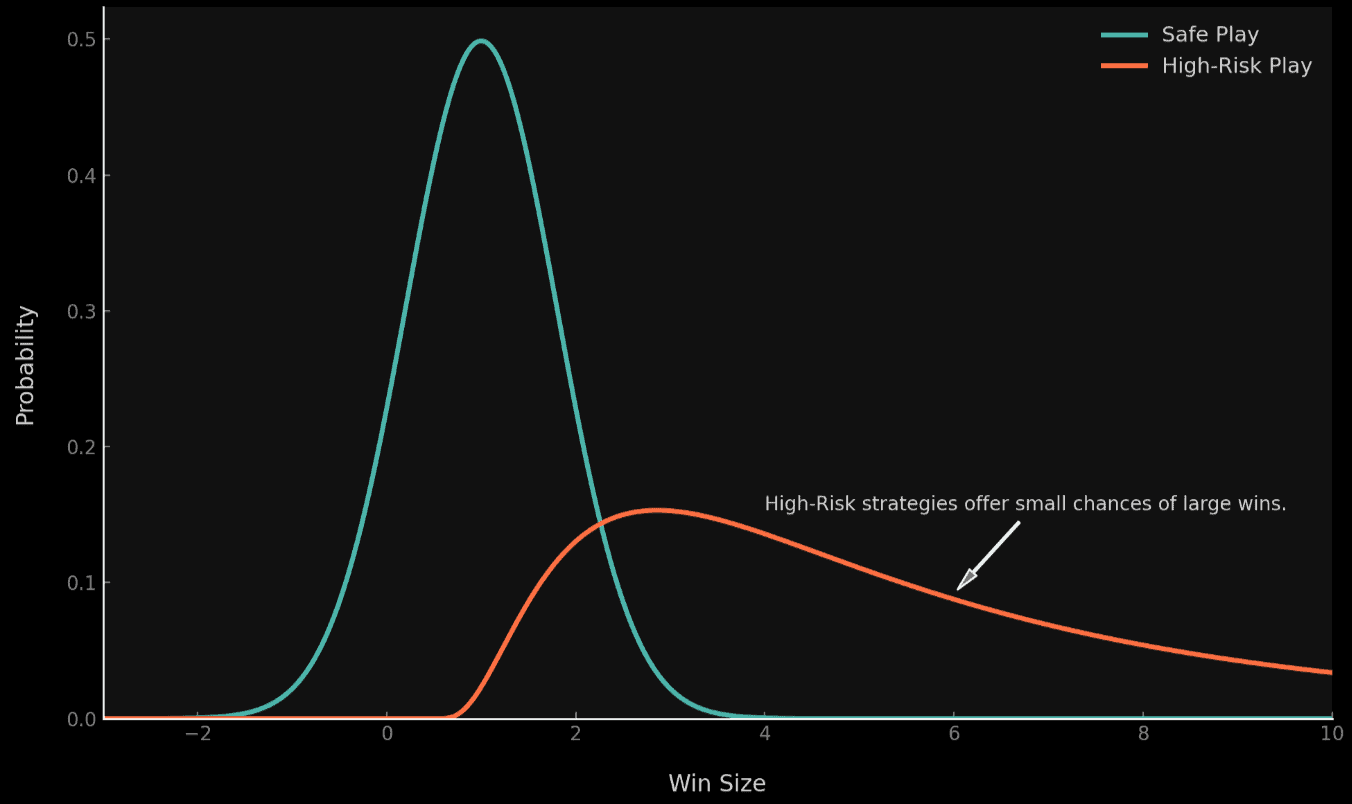
In statistics, skewness measures how much a distribution leans toward one side. In poker terms, we’re talking about strategies or decisions that usually lead to small losses… but occasionally hit a huge win.

Think of it like this:

  • A negatively skewed strategy: small, frequent wins, but rare huge losses. (Safe, but you can bust hard.)

  • A positively skewed strategy: lots of small losses, but sometimes? Boom. Massive payout.

And guess what kind of skew most players secretly love? Yup – positive skew.

What the Study Looked At (And Why It’s Cool)

A group of researchers analyzed millions of online poker hands from real players. We’re talking actual money, actual decisions, and no theoretical lab nonsense.

They measured:

  • How often players went for skewed plays (like chasing long-shot draws)

  • Whether more skewed strategies led to better or worse long-term outcomes

  • How preferences shifted across skill levels, formats, and stakes

And the verdict?

Players – especially recreational ones – show a consistent preference for positively skewed strategies. Even when those plays have a negative expected value.

Translation: people know it’s -EV… and do it anyway.

Why Would Anyone Play -EV Hands on Purpose?

Ah, the million-dollar question. Or maybe the $0.01/$0.02 question, depending on your bankroll.

Here’s why skewness is so seductive:

  1. The Power of the Jackpot Fantasy
    Humans love upside. Even if the odds suck. Just look at lottery sales or crypto moonshots. Same logic in poker – players chase huge wins because they feel amazing, even if they’re rare.

  2. Emotional Amplification
    Winning a massive pot with a crazy draw gives you more dopamine than grinding out five small pots. Our brains aren’t wired for balance; they’re wired for story.

  3. Tilt Insurance (Weird, But Real)
    When you’re losing, you might intentionally go for high-variance lines to “turn the session around.” It’s not rational, but it’s human.

  4. The Twitch Effect
    Streamers, content creators, and online personalities often skew their play toward highlight-reel hands. Viewers don’t care about tight folds – they want fireworks.

Skill Level Matters (But Not How You Think)

One of the most surprising findings?

Even experienced players show a skewness bias. Not as extreme as newbies, sure, but still present. Especially in tournament formats, where big swings are baked into the structure.

Here’s what the data suggests:

  • Cash game regs skew less – they’re more disciplined, especially at higher stakes.

  • Low-stakes grinders skew more – likely chasing fast results or “breaking even with glory.”

  • Tournament players skew naturally due to payout structure (hello ICM), but the preference spikes when stacks are short.

So next time someone jams a weird combo draw on the turn… it might not be a punt. It might just be skewness doing its thing.

Continue reading →

1,005 Words

How PokerGPT Is Changing the Game in Online Poker AI

There’s a new player at the table – and no, it’s not another hoodie-wearing grinder or Twitch-streaming shark. It’s PokerGPT, a lean, mean, language-model-powered machine that’s been quietly flipping the script on what it means to build smart, scalable poker bots. And unlike its power-hungry predecessors, it doesn’t need a data center to win.

If you’ve ever wondered how artificial intelligence poker is evolving past brute force computation and toward something, dare we say, intuitive-you’re about to find out.

From CFR to GPT: Why Poker Needed a Smarter Brain

Let’s be real: most previous poker AIs were overkill. Pluribus and Libratus? Brilliant, sure-but resource hogs. These monsters used counterfactual regret minimization (CFR) to conquer the poker machine. We’re talking thousands of CPU cores, terabytes of memory, and weeks of crunching just to simulate a few million hands.

And if you’ve ever tried extending CFR from heads-up to multi-player tables, you know the game tree balloons like a bad bluff-completely impractical in real-time play.

That’s where PokerGPT comes in swinging. This new model ditches heavy computation in favor of large language models (LLMs) – the same tech behind ChatGPT – and it’s surprisingly good at the whole poker thing.

What Makes PokerGPT a Game-Changer?

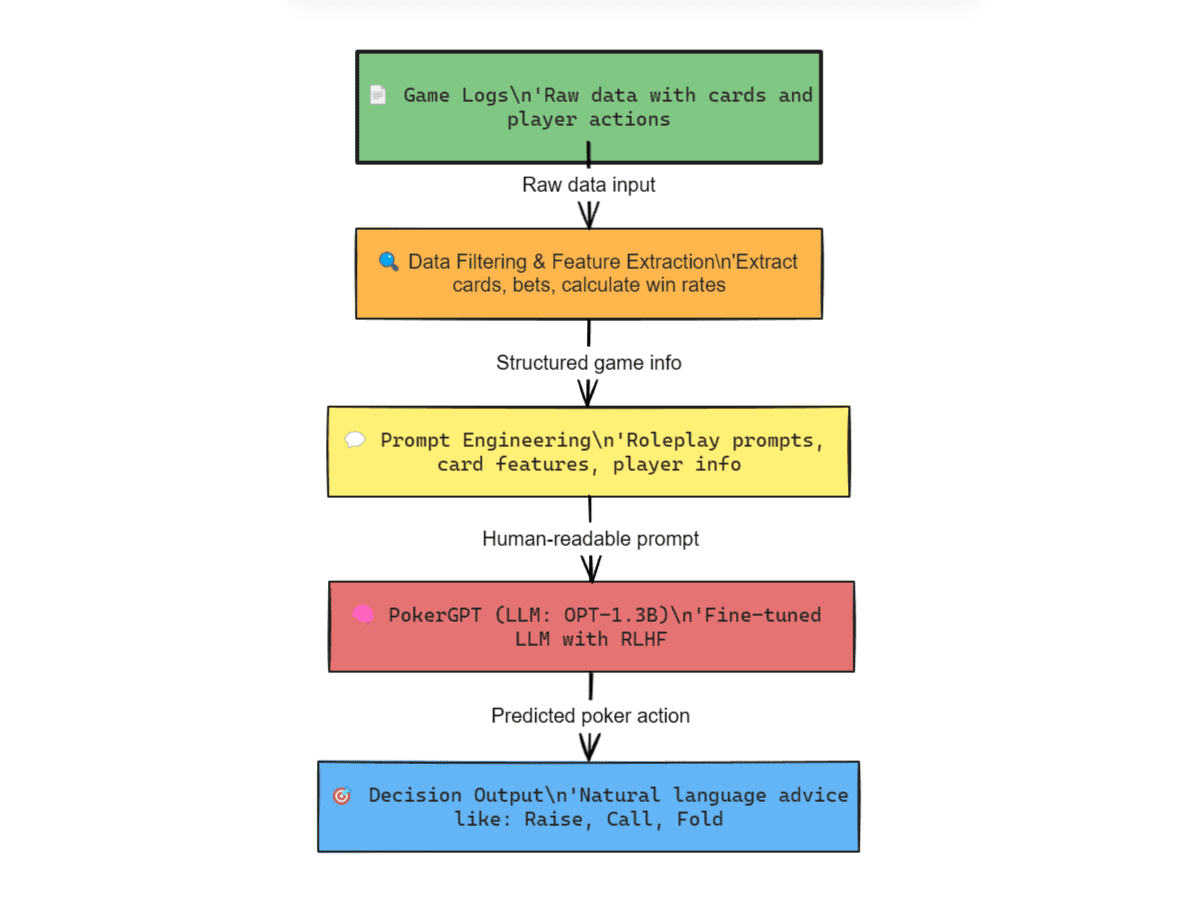
So what exactly is PokerGPT? It’s a lightweight, fine-tuned LLM that doesn’t rely on handcrafted game trees or endless self-play. Instead, it learns from real-world poker logs – millions of hands from actual online games.

That means it isn’t just theoretically strong. It plays like a human, thinks like a human, and reacts in real time-just like you’d expect from the best poker bot in the room.

Here’s the cheat sheet version of what makes PokerGPT different:

  • Text-based input/output: Forget game trees-PokerGPT reads poker history and makes decisions like a chatty coach.

  • Fast and lean: Trained on a single GPU in under 10 hours. Response time? About five seconds. Talk about efficient poker hacks.

  • Multiplayer ready: Works across any number of players – something most CFR-based systems simply can’t do well.

  • Low barrier: No need for PhDs in game theory to use or modify it.

It’s the first truly end-to-end, multiplayer-friendly poker AI that doesn’t require cloud-scale infrastructure to run. Just some clever prompt engineering, a bit of fine-tuning, and a healthy dose of reinforcement learning from human feedback (RLHF).

Wait, Language Models Can Play Poker?

You bet they can.

At first glance, it might seem wild to use a text model to make high-stakes poker decisions. But think about it – poker is a game of partial information, psychology, and pattern recognition. LLMs, trained on massive amounts of text data, are phenomenal pattern detectors.

By feeding PokerGPT with engineered prompts – like betting histories, player positions, and hand descriptions – it can predict the optimal next move in any given situation. And because it uses language, its recommendations are human-readable. Think less “bet(0.5)” and more “You should raise to 0.50 because your hand is strong, and opponents are likely bluffing.”

That level of explainability? Huge.

Data-Driven Smarts: How PokerGPT Learns

PokerGPT’s developers gathered over a million real poker games from platforms like PokerStars. Then they filtered, cleaned, and labeled them based on outcomes and player skill (measured in milli-big-blinds per hand, or mbb/h).

They used this data to fine-tune Facebook’s OPT-1.3B model – a compact LLM that performs comparably to GPT-3. And they didn’t stop at just supervised learning. They trained a reward model to recognize good vs. bad decisions, then applied RLHF to sharpen PokerGPT’s instincts over time.

The result? A poker AI that adapts to human behavior, plays strategically across stages (preflop to river), and even mimics the styles of winning players.

And guess what? When tested against bots like Slumbot, it delivered a higher win rate than other leading models, including AlphaHoldem and ReBeL – all while using fewer resources.

Continue reading →

1,087 Words

Monte Carlo Tree Search and Opponent Modeling in NLT Hold’em

Poker has been an area of contention among researchers in artificial intelligence (AI) researchers for some time now. Unlike in deterministic games such as chess, no-limit Texas Hold’em adds an additional layer: incomplete information, bluffing, and an enormously vast game tree render solving by raw computation infeasible.

To tackle this intricacy, researchers have developed superior algorithms in AI through combining Monte Carlo Tree Search (MCTS) with adversary modeling. This enables poker bots to search through extensive tree decisions, predict adversary moves, and dynamically adjust methods.

In this article, we’ll be examining just how these methods work, exactly why these methods work in poker so well, and what this suggests about poker in the future.

Monte Carlo Tree Search: Artificial Intelligence in Poker Pillar

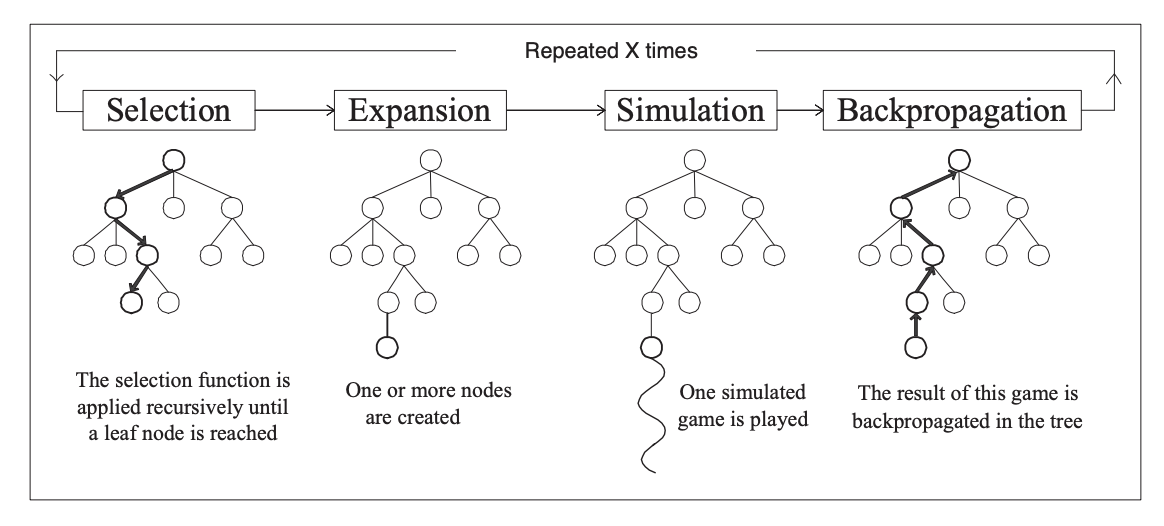
Monte Carlo Tree Search (MCTS) is an anytime algorithm in that it dynamically modifies its policy upon increased run time. It is simply to go through thousands of virtual poker hands, monitor results, and utilize these to inform choices.

How MCTS Works in Poker

MCTS operates in four overall phases:

  1. Selection: The computer plays through the game tree by playing most hopeful moves derived through previous computer simulations.
  2. Expansion: When encountering an unknown situation, the algorithm expands by making additional potential moves.
  3. Simulation: The computer plays through the game in random order starting with a novel node, making predictions.
  4. Backpropagation: The computer adjusts its decision tree by strengthening winning moves while obscuring over moves that lose.

This iterative process allows poker AI to calculate optimum moves by not explicitly examining each game situation in an explicit manner, making it incredibly efficient in extensive games including Texas Hold’em.

Why MCTS is So Strong in Poker

  • Handles Imperfect Info: As in chess where everything is known, in poker nothing is visible. MCTS provides to approximate about probabilities and decide upon this.
  • Scalability: The algorithm does not have to have an overall game tree to run; just computational resources to run in, getting better over time.
  • Balance Between Exploitation vs. Exploration: It wisely exploits known profitable avenues and scouts in an attempt to gain improved results through new alternatives.

The success in poker has encouraged widespread adaptation in various areas, including finance, game AI research, and robotics.

Opponent Modeling: Modeling Adversary Behavior

One of the most glaring weaknesses in early bots was that they lacked adjustability in playing against humans. This is where enters in opponent modeling, allowing an AI to keep an eye on player trends and predict.

How Opponent Modeling Works

  • Action Tracking: Artificial Intelligence traces every player’s bets, raises, and bluffs.
  • Pattern Recognition: Through machine learning patterns and classes opposing players to player categories by identifying patterns.
  • Adaptive Strategies: How AI responds to opposition tendencies by making decisions in real time to optimize.

For example, in the case where an opponent always bluffs in later positions, the AI is going to call in these later positions, thereby increasing in overall winning percentage.

Common Player Types Identified by AI

  • Loose-Aggressive (LAG): Makes bets regularly, bluffs regularly, and pushes. Exploits by calling regularly and laying traps.
  • Tight-Passive (TP): Only folding marginal hands and bets in strength. Artificial Intelligence exploits by playing aggressively against these.
  • Unpredictable Players: Artificial Intelligence is pattern recognition to adapt to non-standard patterns in bets by continuously evolving improved algorithms.

The ability to identify these player types and take advantage of them has significantly improved online poker performance by AI.

Clustering Opponents: Bringing Back an Online Poker Game-Changer

Traditional opponent modeling was carried out in static player profiles that used to fall short in opposition to dynamic player moves. K-Models Clustering is an advanced technique which pools similar players by playing style.

Benefits of K-models Clustering

  • More Accurate Predicts – As opposed to modeling an individual player, computer is modeling sets of identical patterned players.
  • Faster Learning – Artificial Intelligence learns better in adapting by recognizing patterns in each cluster.
  • Improved Adaptability – As opposed to processing each player uniquely, now the AI is generalized to respond to player types in an efficient manner.

This technique has significantly improved poker performance by making it significantly more difficult to exploit weaknesses by human opponents.

Real-World Applications: Utilizing AI Poker Robots

Several AI systems have been developed to have both in MCTS and in modeling an adversary:

  • DeepStack: The First Artificial Intelligence to Win Professional Hold’em Heads-Up No-limit Hold’em.
  • Libratus: A computer system that overpowered top professionals in over thousands of hands to win millions in virtual chips.
  • Pluribus: A computer system that was beaten by multiple human opponents in six-player no-limit Hold’em to demonstrate that AI can comprehend multiplayer game strategy.

These systems utilize MCTS, modeling opposition, and cluster to make nearly flawless poker plays.

Continue reading →

1,177 Words

Tartanian Unveiled: How GTO Bots Conquered NL Hold’em

Imagine a robot that beats human opponents in high-stakes no-limit Texas Hold’em, a formerly seemingly impossibly tough game for computers. In 2007, that is exactly what Tartanian did, earning a second-place finish in the AAAI Computer Poker Tournament. But why did that robot AI succeed? Let us step through science that went into its success, its application of game theory optimal (GTO) strategies, as well as its approach in dealing with messiness in poker in a beautiful manner.

Why No-Limit Poker is a Nightmare for AI

No-limit Texas Hold’em is not a game of chess. In this case, you can bet as much as you can, resulting in a seemingly endless space of strategy. Consider that in a single hand, you can reraise $10, $100, or try a $1,000 all-in. For AI, that means billions of decisions to consider—far more than can be handled by brute computing.

Tartanian solved this with three innovations:

  • Discretized Betting Models: Simplifying bets into strategic options like half-pot, pot, and all-in.
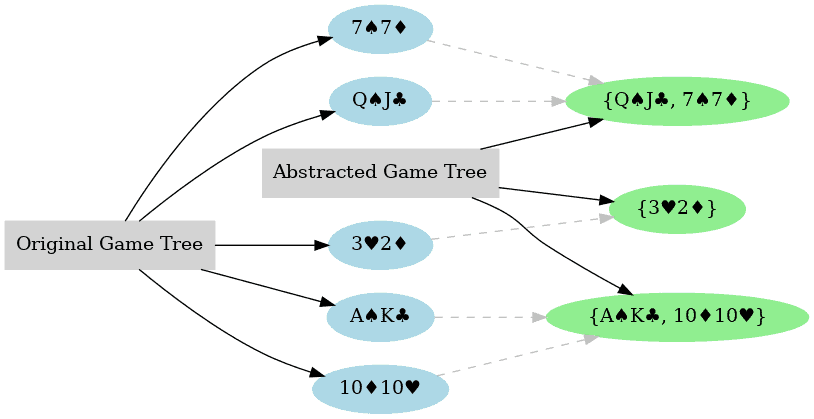
  • Automated Abstraction: Grouping similar hands to reduce complexity without losing strategic depth.
  • Equilibrium-Finding Algorithms: Calculating unexploitable strategies using cutting-edge math.

Tartanian’s Secret Weapon: The Betting Model

In no-limit poker, bet sizing is everything. Tartanian’s creators realized humans rely on a few key bets:

  • Half-pot: Great for bluffs and value bets (e.g., making opponents call with weak hands).
  • Pot-sized bets: Shut down draws and protect strong hands.
  • All-in: A high-risk, high-reward move for critical moments.

By limiting bets to these sizes, Tartanian avoided getting lost in infinite possibilities. But here’s the twist: when opponents made “weird” bets (like 144 chips pre-flop), Tartanian mapped them to the closest strategic option. For example, a 144-chip bet would be treated as all-in—not a pot-sized bet—thanks to a clever relative distance algorithm.

Key Takeaway:

“Tartanian didn’t just mimic human bets—it outsmarted them by focusing on what matters.”

Automated Abstraction: The Art of Simplifying Chaos

Imagine trying to analyze every possible card combination in a game. With 52 cards and four betting rounds, the possibilities are astronomical. Tartanian used automated card abstraction to group similar hands, reducing the game tree from ~10⁷¹ nodes to something manageable.

For example:

  • Pre-flop: 10 buckets (e.g., grouping all medium pairs).
  • Flop: 150 buckets (e.g., flush draws vs. made hands).
  • Turn/River: 750–3,750 buckets for precise post-flop play.

This let Tartanian focus on strategically similar scenarios, like treating A♠A♣ and A♦A♥ as identical. The result? A leaner, faster AI that didn’t miss critical nuances.

Equilibrium Computation: Solving the Unsolvable

Tartanian’s final trick was solving the game using Nash equilibrium—a strategy where no player can gain an edge by deviating. But with such a massive game tree, traditional methods failed.

Enter gradient-based methods. Such instruments, coded specifically in an XML-based language, handled 10⁷¹ nodes with ease. The key? Dynamically generating optimized C++ code specifically for Tartanian’s betting algorithm. That saved development time in terms of weeks as well as improved its speed.

Results: Tartanian’s Masterstroke (And A Monumental Misstep)

In the 2007 AAAI competition, 8/10 opponents, from bigweights such as Hyperborean, got crushed by Tartanian. But it tripped over its betting algorithm with non-standard-size bets in a match with PokeMinn.

Continue reading →

862 Words

How AI Conquered Poker: From Bots to Superhuman Play

Poker has been a skill, psychological, and strategic game for a long time, and a challenge for artificial intelligence (AI) with a rich and long-standing heritage. Unlike in chess, in which any piece and move can be seen, in poker, information is imperfect, and AI must make a decision based on probability, deceit, and opponent actions. Poker researchers have, over time, designed increasingly complex poker bots through game theory, machine learning, and Monte Carlo simulations.

This article describes how AI in poker has developed, starting with early rule-based approaches through to current state-of-the-art bots capable of challenging and even beating professionals at the game.

Early Attempts: Rule-Based Systems

The early AI poker programs operated with a knowledge-based system, in which expert-established rules determined a decision. These types of systems were static and predictable and could therefore be exploited when humans discovered their patterns.

Some early implementations, for instance, utilized if-then rules to fold, call, or raise based on expert-established hand rankings. These programs could face poor opponents but faltered with experienced opponents who could modify approaches.

A famous instance of such an approach is Turbo Texas Hold’em, a commercial AI for poker, in which expert approaches were programmed in its decision mechanism. It could beat casual opponents but could not beat opponents with adaptability in changing its approaches when opponents played an aggressive or deceitful manner.

Monte Carlo Simulations: Smarter Decision-Making

Research in AI for poker continued, and its implementers adopted Monte Carlo simulations to make decisions smarter. Instead of depending on predefined rules, such programs simulated a thousand or more hands and scenarios and estimated the expected value (EV) of an action.

The process worked like this:

  1. The AI assigned possible hands to opponents based on past actions.
  2. It simulated future community cards and betting rounds.
  3. It calculated win chance and chose the most profitable move.

The technique was utilized in such programs as Pokerbot and Poki, developed at University of Alberta’s Computer Poker Research Group (CPRG). These programs played competently when pitted against humans but showed considerable vulnerabilities. For instance, they overestimated or underestimated aggressivity in opponents, sometimes at a pricey expense.

Game Theory and Nash Equilibrium

A famous AI poker achievement involved using game-theoretic approaches. Central to this is Nash equilibrium, named for mathematician John Nash.

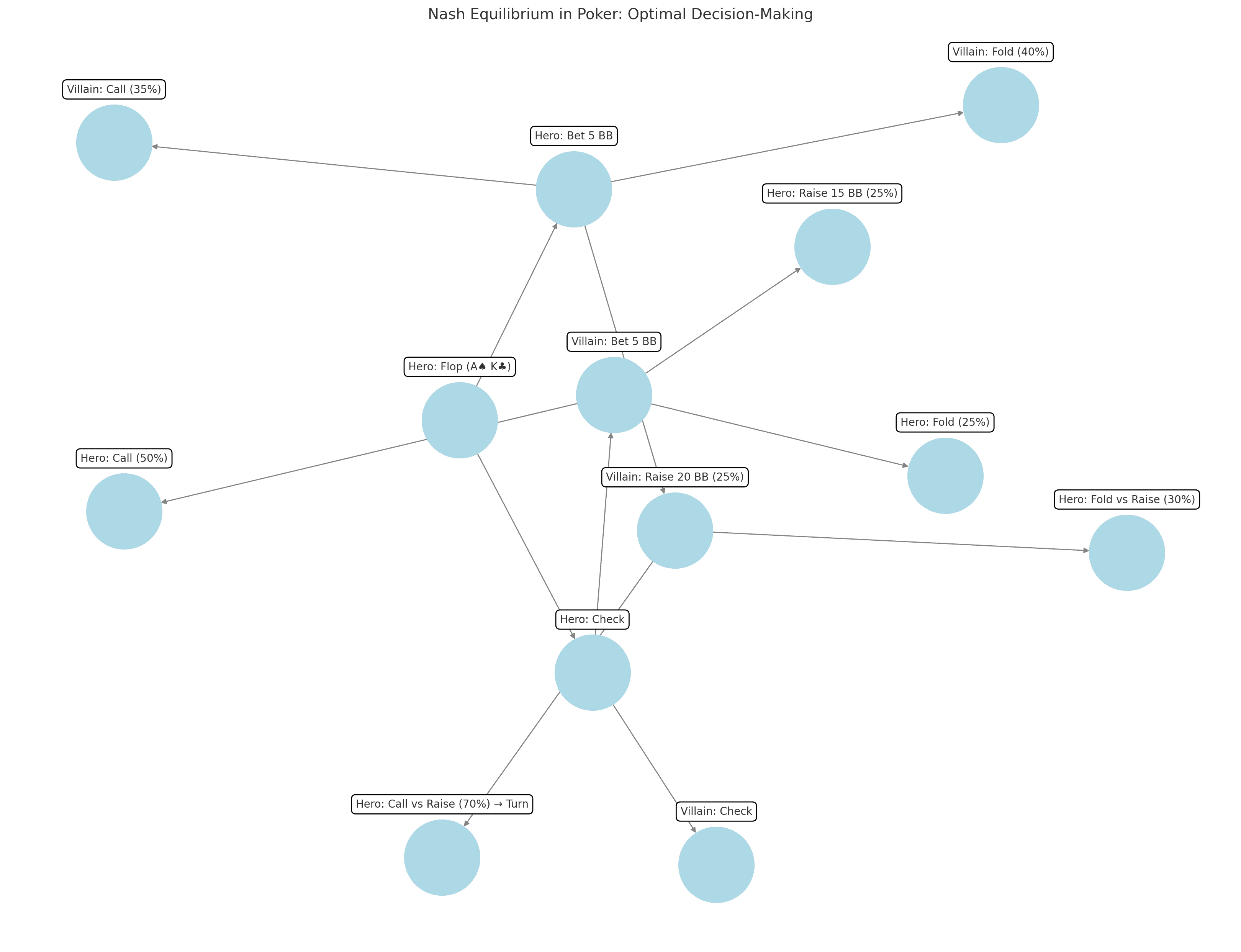
A Nash equilibrium poker strategy is one in which, when both players use it, neither can obtain a better outcome through a move in its strategy. That renders it an unexploitable one, in that opponents can no longer exploit it consistently.

Scientists extrapolated Nash’s principle to poker in three ways:

  • Abstracted the game in order to simplify.
  • Applied linear programming in order to calculate near-optimum strategies.
  • Designed AI to play off of probability distributions, not inflexible rules.

This facilitated such programs as Cepheus (2015), the first AI ever to “solve” heads-up limit Texas Hold’em. Not flawless, Cepheus played so well no human could beat it consistently.

Exploitive AI: Learning and Adapting

Nash equilibrium strategies, strong as they are, are not necessarily most profitable when played in competition with poor-playing opponents. An unbalanced, unexploitable strategy played out by a bot could miss out on taking real player mistakes for an advantage.

Continue reading →

1,032 Words

Cracking the Code: How AI Masters Opponent Modeling in Poker

Poker has long been a proving ground for psychological battles, with opponents reading each other, bluffing, and acting in seconds under uncertainty. What happens, then, when artificial intelligence (AI) enters the mix?

AI long ago conquered games such as chess and Go, both perfect information games for each move. Poker, however, involves a challenge—hidden information, deceit, and unpredictable humans. How, then, can AI poker robots win in a sea of uncertainty? The answer is through opponent modeling and expectimax search, two techniques that allow poker robots to learn, adapt, and outmaneuver humans at poker.

So, let’s see how AI is unlocking the poker code and its implications for future poker

AI Poker: Something Greater Than Simple Probability

The conventional view is a poker bot is nothing but a math calculator that works out odds and acts in terms of probability alone. Hand strength and pot odds count, naturally, but top-class AI poker robots go a whole lot deeper in terms of arithmetic.

The real wizardry comes with opponent modeling—the ability for an AI to monitor an opponent’s style and adapt its behavior in reaction. That’s when AI outdoes conventional “static” pokerbots, following unchangeable, pre-written programs.

How Opponent Modeling Works

Imagine yourself at a table with a bot that watches your every move. It logs your bluffer’s frequency, when and when not to fold, and how high a bet to make in a case in point. Over a period, it constructs a rich picture of your routines, similar to an experienced player.

Here’s an opponent model an AI looks out for:

Betting Habits – How often will an opponent raise in position? Do they follow through with a bet following a flop?

Bluffing Rate – How often, and under what circumstances, will an opponent bluff?

Reactivity to Aggression – Do opponents fold when aggressed, or will they call down a poor hand?

Over Time Adjustments – Do opponents change over a stretch of play?

By gathering and processing such information, AI refines its style to exploit weaknesses—calling down a bluffer, for instance, or tightening when a loose opponent comes at them.

Expectimax Search: AI’s Best Kept Secret

So, then, how will an AI make its move with regard to such an opponent model? Step in expectimax search, a powerful decision algorithm for allowing AI to navigate poker’s uncertain information environment.

Expectimax search is an extension of minimax search, a renowned algorithm for perfect information games like chess. But in poker, information is hidden (in opponents’ hands) and uncertain (the draw of community cards), and decision-making a whole lot more complicated.

How Expectimax Search Works

Simulates Outcomes – AI takes into consideration all conceivable hands an opponent can have in terms of past behavior.

Assigns Probabilities – AI estimates probabilities for each conceivable opponent hand and bet.

Estimates Expected Value (EV) – AI estimates each conceivable move (bet, call, fold, raise) for its profitability in terms of opponent behavior.

Makes Optimal Action – AI takes the move with the most EV, for the most long-term gain.

Continue reading →

1,166 Words

AI Poker Hacks: Revolutionizing the Game

Poker is intuitively no longer won. With artificial intelligence already taking over the game, players who had insight into the recent developments in poker have come up with a number of advantages, from poker bots and AI-powered models to strategic “hacks” and cheat sheets. Tools today help reshape the way poker is viewed and played. Let’s explore how technology has changed this game of ages into a cutting-edge competition.

The Rise of AI in Poker

AI has transformed from a conceptual theoretical model into an implemented useful tool that commands at the poker table. AI machines like DeepStack AI, Pluribus, and PokerAlfie were designed for real-time analysis of tricky situations, calculating probabilities and optimal plays faster than any human mind. This technological advantage is becoming increasingly evident in professional and casual games alike, and therefore players need to understand and adapt to these changes.

Poker Bots: Helpers or Threats?

Poker bots – programs which automatically play poker – are very controversial among both players and platforms alike. This technology can therefore mimic human strategy, considering revised information in real time. Indeed, bots like AlphaPoker from DeepMind have beaten professional players in major tournaments.

But there is also a dark side. Most poker sites ban bots outright, as their participation tends to give some players an unfair advantage over the rest. Advanced versions beat detection systems and come with disturbingly high ethics, given how they are downloadable or privately created.

Pros of Bots: The ability to analyze many more permutations per second than is humanly possible and thus make better decisions. Cons of Bots: Over-reliance or misuse of such bots will ruin the spirit of gaming. For players who are into using poker bots, these can well be put into good legal use offline while training or as a personal refinement of strategies.

The Strategic Poker Hacks and Cheat Sheets

AI is not the only way to do it. For those preferring a manual advantage, strategic tools like poker cheat sheets and hacks will serve well.

Quick References

A cheat sheet just makes decision-making a whole lot easier by summarizing optimal plays for any situation. When to bluff, when to fold? A good cheat sheet tells you this and takes the guessing out of it. These download-ready sheets are available for both amateurs and pros.

Examples of Poker Cheat Sheets:

  • Odds calculators that determine the strength of your hand.
  • Tables on how to react to common betting patterns.

The above tools won’t play the game for you but will certainly give you great insight into how you can make the odds of the game fall in your favor.

Poker Hacks: How to Take It to the Next Level

But what’s a poker hack? Not methods of cheating, but how to play wiser. Most hacks require incorporating some form of technology during gameplay. This could be real-time betting pattern analysis or even the use of specialized software for opponent studies.

Popular ones include the following:

  • Poker Now Hack: Perfect during live games to give probabilities instantly.
  • WSOP Cheats: More specific strategies for World Series of Poker events.

Game Theory Meets Poker: The AI Innovations

The influence of AI in poker goes beyond just bots. Recent breakthroughs in game theory are redefining strategy, with tools able to solve complex games of imperfect information. In a study, researchers Sam Ganzfried and Tuomas Sandholm showcased algorithms that could compute the optimal moves for the notoriously tricky river rounds in Texas Hold’em.

Continue reading →

1,015 Words

Demystifying Poker AI: The Role of ACPC Protocol

In the last few years, Artificial Intelligence has hit the poker world, changing the dimensions of online gameplay. One tool facilitating this revolution is the ACPC protocol: a framework of rules designed for automated computer poker competitions. This article deconstructs how the ACPC protocol works, what it means for poker players, and the general role of AI in online poker.

What is the ACPC Protocol?

The Automated Computer Poker Competition, or ACPC, protocol is a communications framework originally designed to uniformize interactions between poker-playing programs and servers in the context of competitions. While the phrase may sound niche-level technical, this is actually the protocol that underlies strategies for some of the most advanced poker bots.

At the heart of the ACPC protocol lies determining how poker bots communicate with a server, interpret game state, and make decisions on their actions. It’s like the language an AI poker player uses to “speak” to the dealer and other players around the table. It’s designed to handle gameplay elements such as rounds of betting, visibility of cards, and positions at the table with incredible accuracy.

How Does the Protocol Work?

At first glance, the ACPC protocol can appear to be an alphabet soup of match states, betting strings, and card notations. Its functionality, however, is pretty straightforward if you break it down.

Match States: The Core Communication Unit

The server sends MATCHSTATE messages to the client (the bot) constantly, which describes the current state of the game. They consist of:

  • Player position: Who is next to act.
  • Hand number: Which hand is being played.
  • Betting actions: A list of actions taken during the current round (e.g., “r” for raise, “c” for call).
  • Visible cards: Hole cards and community cards.

For example:

MATCHSTATE:0:30:rc/:9s8h|/8c8d5c informs the bot about its position, the hand number, the betting history, and visible cards thus far.

Player Responses: Calculated Actions

The bots respond to match states with actions that are calculated very carefully based on probabilities and game theory. A simple response might look like this:

MATCHSTATE:0:30:rc/:9s8h|/8c8d5c:c

The bot decides to call here after analyzing the game state.

Flexible for Different Poker Variants

Whether it’s limit or no-limit Texas Hold’em, the protocol extends to support game rules describing betting, the rank of hands, and the interaction between players. The flexibility of this protocol is part of its popularity in both research and competitive domains.

How Do Poker Bots Utilize the Protocol?

In essence, poker bots use ACPC for processing game information, assessing their positions in a game, and using strategies. A closer look:

  • Pattern Detection on Betting: Bots utilize match states as a way to follow the sequence of events: bets, raises, and folds. A simple string, such as r300r900c, may show them that the opponent is overly aggressive and lead them to implement the necessary defense mechanism.
  • Probability Calculation: They calculate odds in real time. Supposing community cards appear to be 8c8d5c with the hole cards 9s8h, from there, the bot could very well take a shot at making a straight or full house and react based on that probability.
  • Decision Trees and Game Theory: More advanced bots make their moves in accordance with game theory. A raise, call, or fold is not done on a whim. Each move has been computed exhaustively in order to maximize profit.

Challenges of Playing Against Bots

For human players, though, there are huge challenges looming in the shape of AI-powered opponents. Poker bots have some serious advantages using protocols such as ACPC:

  • Consistency and Precision: Bots don’t tilt. Emotions, fatigue, or pressurizing never affect them, so they can maintain relentless precision.
  • Data-Driven Strategies: With access to historical game data, bots can easily switch tactics mid-game to play on players’ weaknesses.
  • Unerring Memory: Bots remember every hand that’s been played, and over time they’re able to recognize patterns and adjust—which few pros are really able to manage.

Can You Tell If You Are Playing a Poker Bot?

Continue reading →

984 Words

Mastering Poker with AI: Potential-Aware Abstractions

Poker has for a while been celebrated as a card game of skill, chance, and mental finesse but is now increasingly becoming a testing ground for artificial intelligence. The sheer size of the game tree for poker – particularly no-limit Texas Hold’em – puts even the technically best algorithms to the test. Given the fact that there are approximately 10¹⁶⁵ nodes in the complete tree of games, the kind of straightforward solving of the kind is not computationally feasible. Abstraction is one of the groundbreaking ways by which poker is abstracted for the AI. The latest development in this arena now takes AI poker strategies a step beyond the rest: potential-aware imperfect-recall abstraction.

Game Abstraction in Poker

Abstraction reduces complicated games such as poker by bundling comparable states of the game and hence lowers the level of decisions the AI must make. It would be equivalent to attempting to estimate the grains of sand in a beach by performing analysis on the potential result of each hand – it’s too much. With abstraction, however, AI breaks down such a massive decision tree in clusters manageable for the tech.

First, this abstraction was manual – a human-intuitive way to define clusters. Several years later, an automation using algorithms to group states into clusters based on metrics of expected hand strength, such as a measure of a hand’s probability of winning against a random opponent, was proposed. Fair enough, but often quite out of touch with the actual nuances of how hands unfold throughout a round.

Earth Mover’s Distance and Distribution Awareness

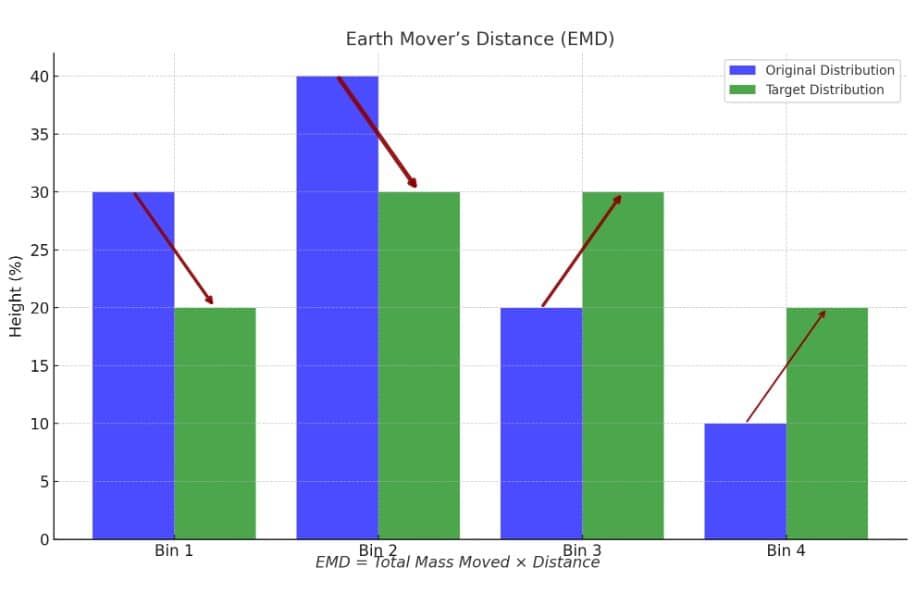
More abstraction refinement involved the application of the distribution-sensitive techniques such as taking a complete distribution of the strength of the hand instead of averaging. Such a procedure was also combined with the application of the Earth Mover’s Distance, a mathematical tool for ascertaining the amount of work involved in transforming one such distribution into another. In the context of poker, such a process can be conceptualized as the comparison of probabilities of winning through a complete set of board possibilities.

There are also constraints in the case of distribution-aware abstraction. It concentrates in the end-round of poker and overlooks build-up of the strength of the hand by previous rounds. Two hands may look the same in terms of the end-round distributions of the equity while playing quite differently in previous streets. This omission paved the way for potential-aware techniques.

Introducing Potential-Aware Imperfect-Recall Abstractions

Potential-aware imperfect-recall abstraction is a paradigm shift. Rather than targeting the endgame alone, this method takes account of the way a hand’s equity evolves in every round. Through the analysis of the “trajectory” of the strength distributions, AI is capable of making more subtle decisions.

One such innovation is the application of imperfect recall such that the AI can “forget” during later rounds. Paradoxical as it seems, forgetting can serve by putting computation in the context of the more important details. Thus, for instances like TcQd and 5c9d, they can have comparable endgames but differ a great deal earlier in the rounds as indicated by their paths in the turn and flop distributions.

Experimental Success in No-Limit Texas Hold’em

The potential-aware algorithm was put to test in no-limit Texas Hold’em in extensive experiments where it ruled supreme over the older methods. The researchers used a fixed betting abstraction for their experiments and found enormous improvements.

Continue reading →

877 Words

The Game Theory Twist in Poker: Uncertainty Explained

Poker has long been a testing ground for strategic thinking, fusing together psychology, probability, and game theory. The most interesting investigation, perhaps, is the model advanced by von Neumann and Newman-a simplified approach, which reduces poker to its most basic, possible moves. How different things become when you add a little wrinkle-a little uncertainty about the strength of the terminal hand. Let’s dive into how this nuance of game theory morphs strategies and what it says about poker today.

A Simplified View: Von Neumann and Newman Poker

John von Neumann started to analyze poker using his new field of game theory back in the 1920s. A simple model of two-person poker was later extended by Newman. The model represents a two-player poker game in which each player is dealt a “hand,” a real number between 0 and 1. First, player X has the right to bet a fixed amount or to check. If player X bets, then player Y responds by either calling the bet or folding.

The simplicity reveals two important insights. First, optimal strategies involve bluffing-a mix of betting strong hands and low-value hands-so opponents can never be sure what they’re up against. This, Von Neumann proved, gave Player X a predictable edge of 5/9 of the pot in the basic model.

The Newman’s model gave more leeway to Player X in that he could vary his bet size. It boosted the flexibility of the bettor’s edge up to 4/7 of the pot. These models remain important touchstones in research about the strategic essence of poker.

Uncertainty: Flipping the Script

In real poker, perfection of information is a mirage. Unseen cards and shifting possibilities mean that players rarely have any sure idea about their ultimate hand strength. Researchers built a “flip” into the von Neumann and Newman versions of poker.

Here is how this goes: whenever a showdown occurs, an unbalanced coin flip with bias q determines whether the weaker hand takes the pot. With probability 1 − q, the winner is the stronger hand. But with probability q, the tables turn – introducing randomness, akin to the real poker surprises, such as community cards in Texas Hold’em flipping a weak starting hand into a powerhouse.

At q=0, this is the flip-free game, identical to the original models. At q=1/2, the result is a pure coin toss-the player has no advantage. Somewhere between these extremes, a surprising result was found.

Surprising Results: The Power of Uncertainty

One intuitive feeling might be to think that uncertainty hurts the bettor, Player X. After all, adding randomness to the outcome of the game seems to undermine any control. Surprisingly, the math tells a different story.

For the von Neumann model, starting at q= 0 and increasing, Player X’s advantage increases and reaches a maximum at q=1/3. Player X’s expected payoff soars to 7/12 of the pot, a 5% increase over the original game. Why? Less bluffing is required, since with the flip, Player Y must call more often, even with mediocre hands.

Continue reading →

930 Words