How DIVAT Improves Decision Analysis in Online Poker

Online poker is just as much about strategy as it is about numbers. All that real skill is often obscured by variance, luck, and psychological game inherent in the game. That’s where decision evaluation tools such as DIVAT or Decision Independent Value Assessment Tool come in. It works out the quality of a decision instead of the outcome, further developing how success is judged in poker.

DIVAT-like tools will be those with much value for poker AI developers, because they get rid of noise from variance and instead focus on the real-skill aspects of the game. Be it professional performance analysis or just someone looking for poker hacks to improve your game, such insight is in depth, with no traditional metric ever being capable.

What Is DIVAT?

DIVAT is an analytical framework that tries to de-couple quality of decisions from the outcomes of poker hands. It is the opposite of the usual evaluations given, which relate so much to results, at DIVAT, using expected value, decisions are evaluated.

Here’s how it works:

  1. Baseline Strategy: DIVAT works by comparing the choice of a player against some baseline strategy, usually game-theoretically derived.
  2. Variance Reduction: Centered on the target of EV, DIVAT diminishes random beat bad beats or fortunate river cards.
  3. Skill-Based Metrics: The tool identifies very well when players perform optimal or poor moves, thus allowing focused improvements.
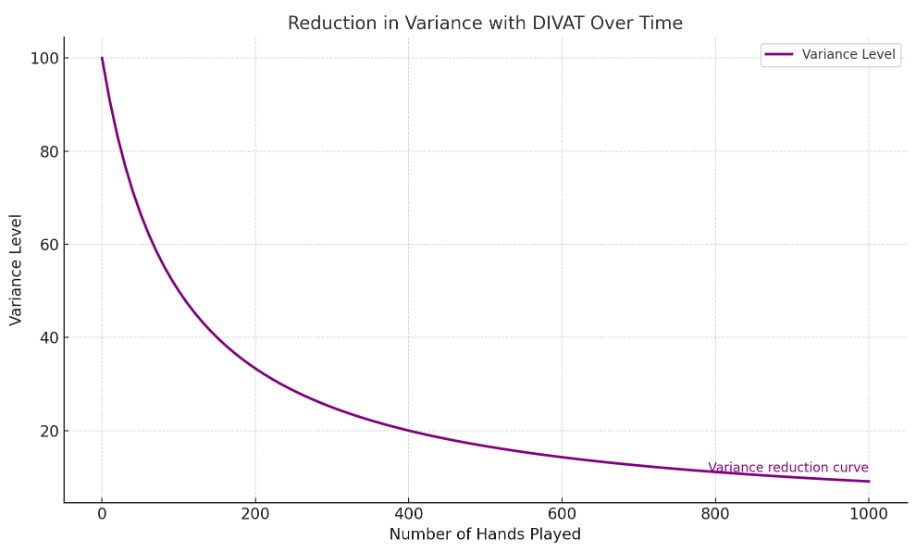
With DIVAT integrated, for AI systems such as DeepStack AI or PokerAlfie, performance finally puts on very clearly and is not skewed by luck. It’s in many ways a very advanced poker cheat sheet-instead of giving advice, it grades decisions retroactively.

How DIVAT is used by AI

These reinforcement learning algorithms rely on decision evaluation tools like DIVAT for fine-tuning strategies and optimizing gameplays. For example, a poker AI bot can utilize DIVAT to analyze millions of hands played virtually, thus identifying patterns and thereby improving its decision-making.

Here is what happens behind the scenes:

  • Data Analysis: The AI collects data on choices made throughout gameplay.
  • Comparison: DIVAT compares every decision with the best action predicted by the strategy of the AI.
  • Learning: It will tune its algorithms to better align with EV-maximizing decisions.
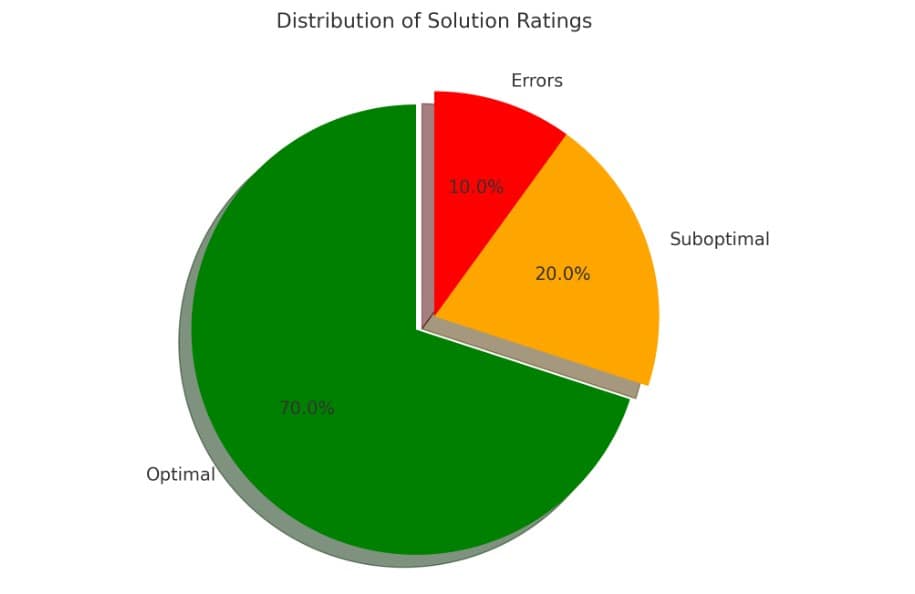
This is the difference between the advanced systems like the DeepMind poker bot and the trivial poker bots online. While simpler bots rely on static rules, DIVAT-equipped systems evolve continuously with new opponents and scenarios.

—

The Role of DIVAT in Human Play

DIVAT isn’t only for AI: it’s also a strong tool for human players. Because it assesses decisions independently of outcomes, it’s a fair-minded measure of skill. Example:

  • A player who consistently makes good decisions but experiences bad luck will still score highly under DIVAT.
  • Conversely, someone relying on luck to win big hands may score poorly, highlighting areas for improvement.

But to the serious players, it’s a poker cheat in the best possible sense: improving their strategy without cheating off the integrity of the game.

Applications in online poker

  1. Training and Skill Development: DIVAT affords players chances to identify the weaknesses in one’s strategy. By focusing on decision quality, it helps reduce eventual mistakes made by a player.
  2. Benchmark for AI Performance: This is indicative of how well the poker ai online systems work for developers.
  3. Noise Reduction: DIVAT, by filtering out luck, makes it so much easier to recognize performance trends that are long-term.
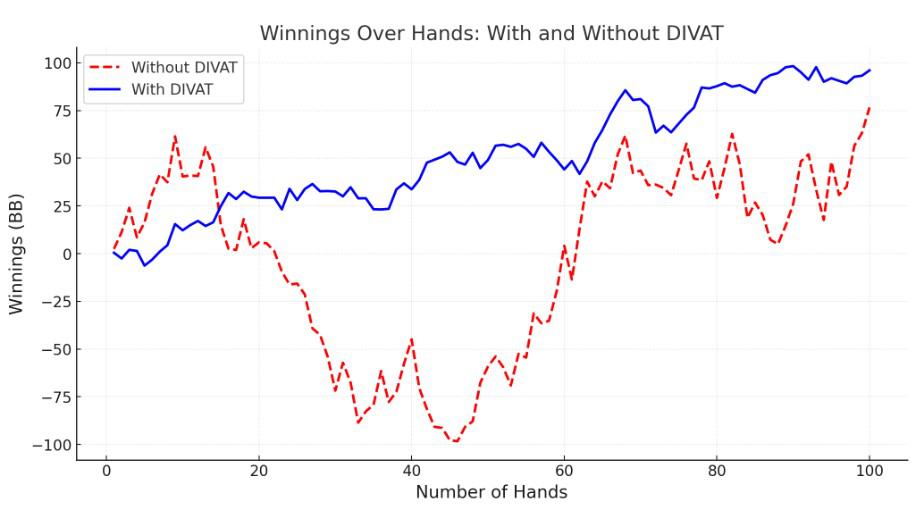
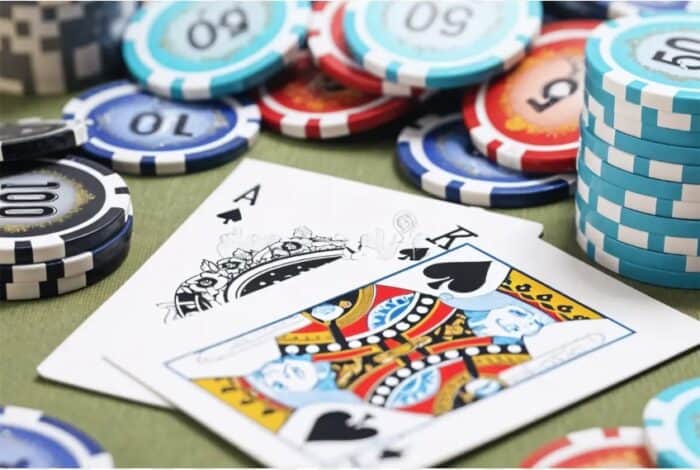
It will be where, for example, in the case of a professional reviewing his plays during a WSOP tournament with DIVAT, he will be less bothered with the win/loss but precisely assessing various points where he deviated from the optimal strategy.

DIVAT vs Traditional Metrics

Traditional poker metrics often include win or even ROI, which, though useful, do not factor in the critical variable of variance. DIVAT bridges the gap by placing an onus on decision-making itself.

This difference makes DIVAT a tool indispensable to serious players but also for ai poker bot systems.


Challenges and Ethical Considerations

While DIVAT has obvious advantages, its use is certainly not without controversy. In competitive games, the use of such tools as DIVAT opens questions of fair play. To what extent should players in live games be allowed to use sophisticated analysis?

Now, platforms have AI detectors to ensure fair play by banning unauthorized tools. However, tools like DIVAT have been widely accepted because they focus on post-game analysis. Understanding the limits of ethics is key for players who use systems under the term poker bot online.

The Future of Poker Decision Analysis

As AI continues to evolve, tools like DIVAT will become even more sophisticated. Potential advancements include:

  • Real-time Evaluation: AI can implement the principles of DIVAT into ongoing matches by providing real-time feedback on decisions.
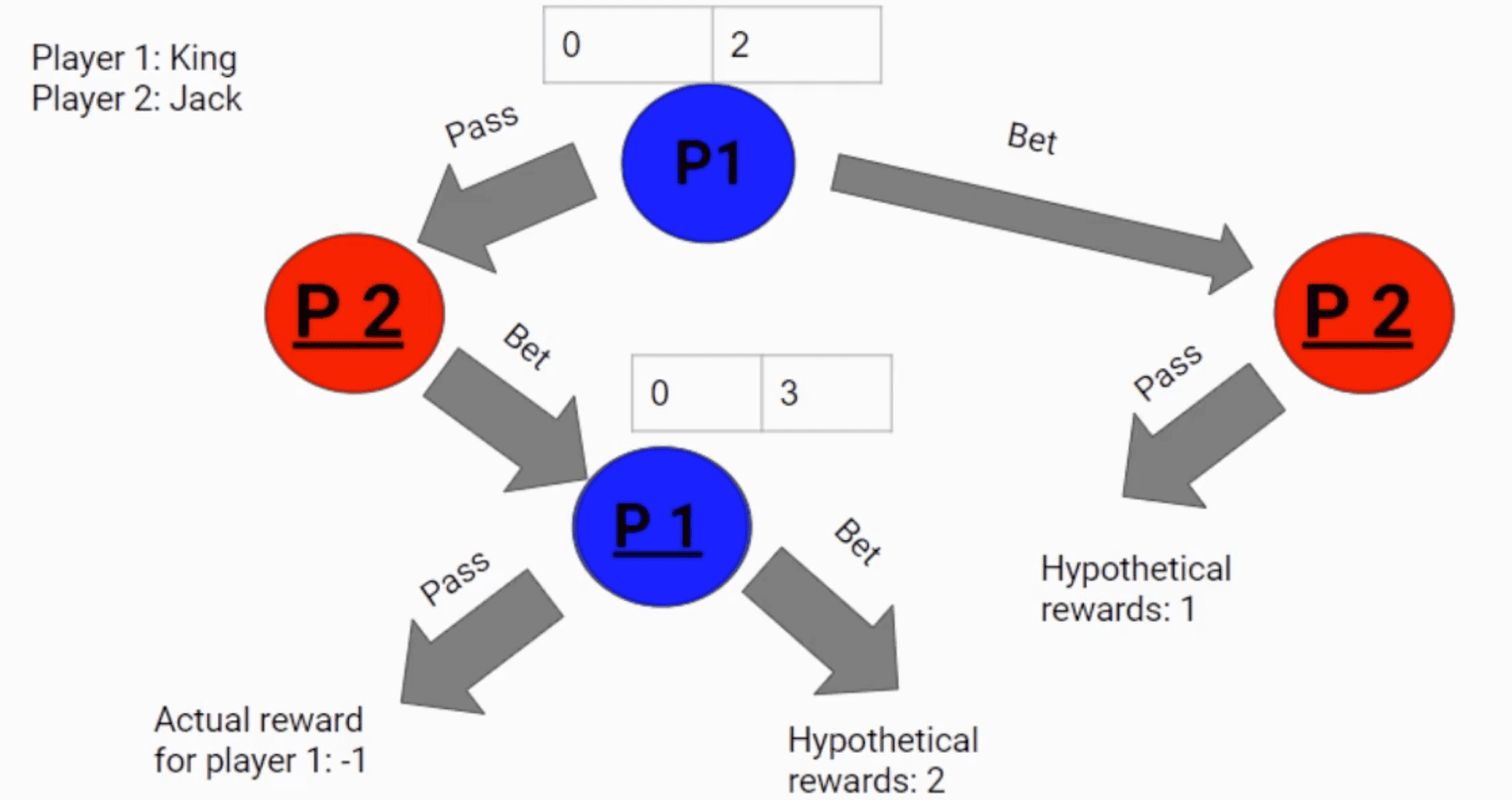
  • Decision Trees Visualization: More development for building perhaps highly intuitive results interpretation by the visualization of decision trees.
  • Integration with Training Platforms: DIVAT could well become part of the regular training programs wherein players would work out strategies with precision. 

For the time being, few tools exist, like bot software download and poker online AI systems, which give a glimpse into what’s possible. 

Conclusion 

DIVAT is an utter new world of online poker where one perceives a decision to be everything. Giving focus to the quality of decisions rather than the outcome, it really equalizes everything between AI and human players. 

DIVAT gives unequalled insight to a developer striving to perfect the best bot for poker and to a player wanting to get better. It is not about just winning; instead, it’s about playing wiser and growing with the game. 

Let this be a lesson next time someone sits at the table: the most important values are in the quality of decisions, and every move counts with DIVAT on one’s side.

955 Words

How AI Models Opponents to Dominate Online Poker

The emergence of ai in online poker

From an instinctive art, online poker grew into a complete electronic combat sphere commanded by AI. Advanced algorithms comprising opponent modeling and decision trees gave all powers to AI to defeat the very best human. Days of poker hacks are gone, and technological AI has arrived to make every step important in strategy.

At the heart of this transformation is the remarkable modeling of opponents made possible by the AI. Analyzing betting patterns, tendencies, and past results, these systems predict opponents’ strategies in real time. Against professional human veterans or similarly advanced poker bots, this evolving AI rises to any challenge.

How opponent modeling works

Opponent modeling includes the process through which AI predicts, and then manipulates, the strategy of opponents. Unlike the rudimentary tool of a poker cheat sheet that gives a little static advice, opponent modeling is dynamic and context-informed.

Here’s how it works:

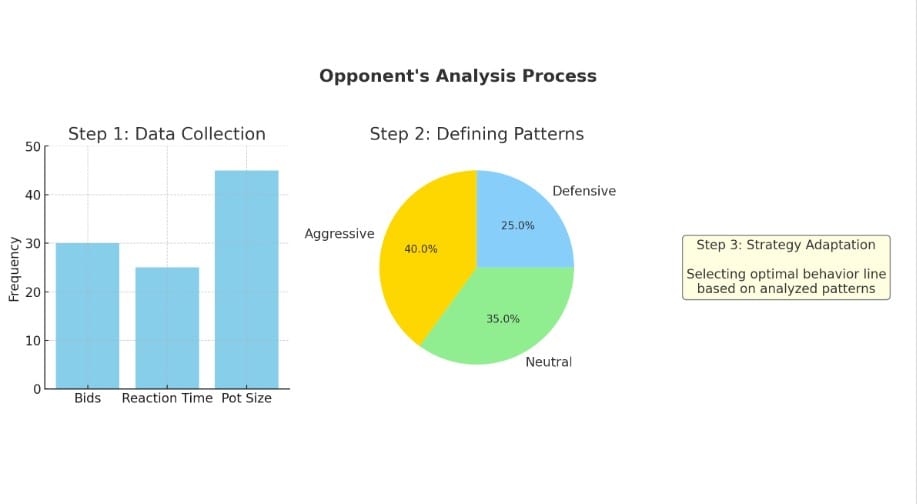
  1. Data collection: AI collects data regarding opponents’ actions, such as bet size, fold frequency, and bluff pattern.
  2. Pattern recognition: It finds the pattern in players’ game strategies-how one player bluffs in a certain situation.
  3. Strategy adjustment: AI adjusts its strategy to take advantage of these tendencies without compromising on strong defensive play.

It’s this capability that lends superpower to the DeepMind poker bot and to Pluribus poker. That is, while playing against a loose-aggressive player, AI calls against bluffs more frequently, while against a tight opponent, its focus would be on extracting value with strong hands.

A whole different kettle of fish for the casual player, no more poker hacks, but how artificial intelligence poker is going to change the game.

Decision trees: the backbone of ai strategy

Decision-making in AI majorly involves decision trees, where each and every probable action is mapped out such that AI considers the risk associated with it over the reward for every given move.

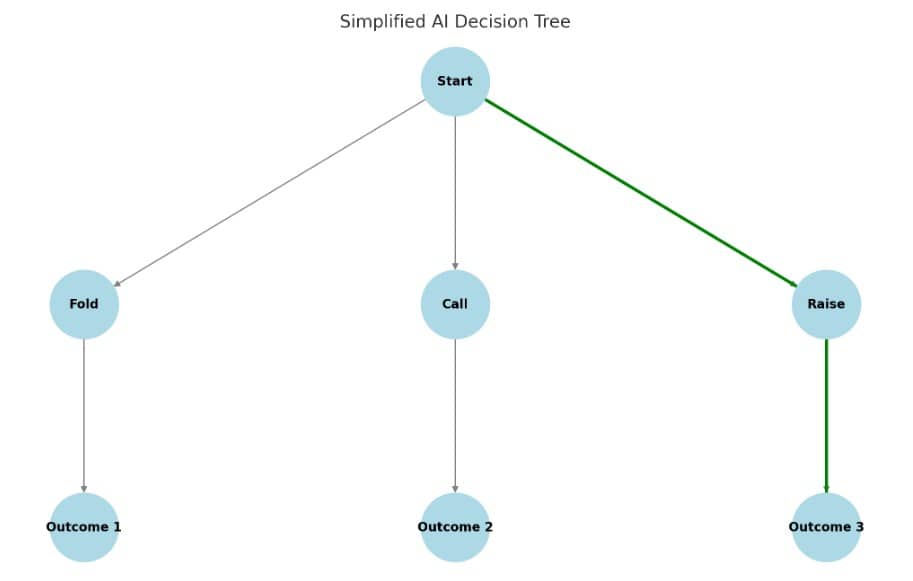
Now, let’s consider a case in which AI needs to make a raise-call-fold decision; let’s see how a decision tree will weigh it:

  • The likelihood of winning if the AI calls.
  • The potential gain from raising.
  • The expected loss from folding.

This analysis goes beyond human opponents. Decision trees also power AI to defeat many poker online bots and recognize it as the supreme bot in competitive settings.

Unlike older methodologies, decision trees change in real time, the AI will not have to reuse any old information and become predictable in any way, unlike poker machine hack strategies.

Regret minimization: learning from mistakes

Another important foundation in poker strategy using AI: minimizing regret. The idea here is that it minimizes any past mistakes by continually updating the decisions.

For instance, when AI recognizes it lost value by folding certain hands, it readjusts its strategy to avoid similar mistakes in the future. This is an ongoing process by which AI inches closer to game-theoretic equilibrium, where their actions are as unexploitable as possible.

Unlike poker now hack tricks, this is not about shortcuts but long-term, meant for consistent improvement mixed with opponent modeling in such a way that the system becomes effective against unpredictable humans and poker bots online.

Applications in online poker

It replaced almost everything that could be attributed to online poker-from the casual game to high roller tournaments. Examples include:

  1. Training tools: Now, platforms are developing AI-driven training simulations for games where players go up against advanced poker AI bots to stay tuned with the pattern and strategize.
  2. Real-time analysis: AI systems provide real-time insights during games, identifying optimal moves based on current conditions.
  3. Tournament play: AI proved its strengths in events such as the WSOP when analyzing opponents in ways no human can.

Tools like poker AI online or bot software download make all the difference for players wanting an edge. These give that needed precision and adaptability that will enable them to play at the top.

Challenges and ethical considerations

As is often the case with poker, AI is not without its controversies. Most online outlets ban poker bots to keep the game integrity intact. With increased regularity, AI detectors will find out which players are using unauthorized tools.

Not all uses of AI are contentious, however. Training tools and analytical programs like DeepStack AI and PokerAlfie augment one’s learning process without compromising the spirit of fair play. As a matter of fact, the task will really be to balance novelty with ethics.

The Future of AI in Poker

The AI technology keeps improving, and its use in poker is no exception. Its future generations might include:

  • Emotional analysis in real time: AI will interpret opponents’ emotional states by observing facial expressions or voice patterns.
  • Multiplayer optimization: Advanced systems would always be better in multi-table tournaments because the variables are further complicated.
  • AR/VR integration: Imagine playing virtual poker with AI coaches that guide in real-time, making the training seamlessly fit within the fun.

For now, one needs to train with all the available tools-be it programs of poker AI bot or download global poker apps. One needs to understand everything about AI and Poker for competitiveness during this new era.

Conclusion 

Artificial Intelligence brought online poker to a completely new level of competitiveness and dynamics. With such weaponry as the decision tree, opponent modeling, and regret minimization, AI will not just be playing poker but mastering it. Be it an amateur player or an experienced one; this information doesn’t matter.

The next time one goes against a computer opponent, he should remember that this isn’t just a machine but the culmination of years of research and innovations that have been so skillfully engineered as to test all aspects of the game.

939 Words

How AI transforms online poker with advanced decision trees

The rise of AI in online poker

Online poker today is no more a game of skills and intuition. It’s a war where artificial intelligence poker thrives on nothing but advanced algorithms to outsmart even the sharpest player in the field. Indeed, the ability of AI to sift through millions of probabilities and predict the best approaches has rethought the game. Whether finding a poker hack that pros use to dominate, the likelihood is that AI-powered tools are on standby.

Central to these systems is the idea of the decision tree-mapping every possible move and counter-move, allowing AI to work out the best course of action to extort maximum profit from the weak opponents or avoiding an aggressive bluff with high accuracy. That is much stronger than the traditional poker cheat approaches based upon some static set of rules.

What are decision trees in AI poker?

Decision trees are hierarchical models that consider every possible outcome of a poker hand. From its root, the first decision, every node would be one of the available actions: raise, fold, call. Leaves of this tree then show the outcome of each of those actions, usually quantified with probabilities and rewards.

For instance, Pluribus Poker, by leveraging trees of decisions, deploys millions of game states with AI; thus, it can adapt to a human opponent and, in real time, make the optimum decision. Simpler poker bots exist which rely on static strategies, but true dynamism and context in game play come from decision trees.

Imagine you’re facing a poker online bot. If it’s powered by decision trees, it can recognize your tendencies, like over-folding to bluffs. Because this AI doesn’t just respond but learns and adapts, this is the best poker bot available for any kind of competition.

Balancing exploitation and defense

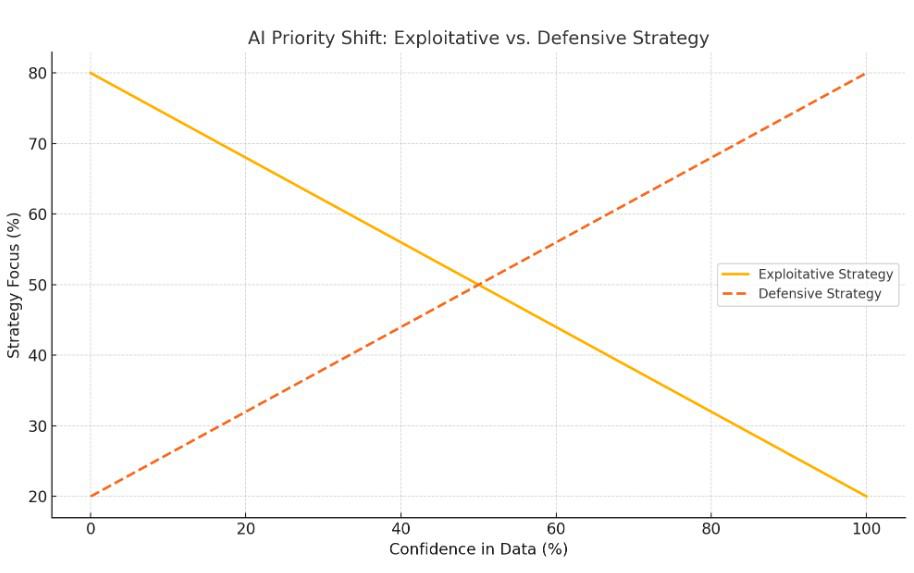
That is one of the peculiarities of the game: one has to keep a delicate balance between aggressiveness and caution. AI does that by a range of techniques that include regret minimization and opponent modeling, for which decision trees work rather well.

For example, in the case of experiments with the DeepMind poker bot, there are prepared trees of decisions for both exploitative and defensive strategies. If the AI detects that an opponent is quite predictable, then it leans into exploitation. In contrast, against players that are less predictable, it would go for a defense. This could be just the delicate balance that will make DeepStack AI and PokerAlfie unique.

Unlike most of the poker machine hacks that were actually outdated, decision trees-based AI is evolving with the game, considering further steps and long-term outcome in relation to instant benefits in order to make it work against diverse opponents.

Applications in online poker

Following is the way AI-powered decision trees have altered several factors in online poker:

  1. Real-time adaptation: these decision trees enable them to find the patterns after which the strategy is exploited in the middle part of the game.
  2. Opponent modeling: these decision trees allow AI to thereby make an educated guess at an opponent’s most probable range of hands by recombining historical data, exceeding just about everything but a poker cheat sheet and some simple heuristics.
  3. Training tools for players: most of these training platforms use large decision trees where any situation may be played out against top-tier online poker bots by a user-large learning tools for optimal strategies.

For those prepared to exploit each of these skills, some websites will provide downloads of the bot software. With such tools, it’s possible to train with more sophisticated AI but not take any sort of risk in live play.

Why AI decision trees excel in poker

Decision trees stand proud with their unrivaled precisions and adaptability. Why have they ranked higher than the usual techniques:

  • Scalability: AI can grade thousands of scenarios simultaneously, which is unimaginable for human capabilities.
  • Context Awareness: decision trees update themselves from historical data on specific opponents, with no static changing of strategies.
  • Reduced Bias: AI is not easily biased from emotional decisions, like a human player, nor is it ever tired.

The online poker bots base, for instance, their decision trees on real-time analytics to compute the most gainful move. Examples of sophistication that no manual poker hack could ever achieve are many.

The role of AI in tournaments

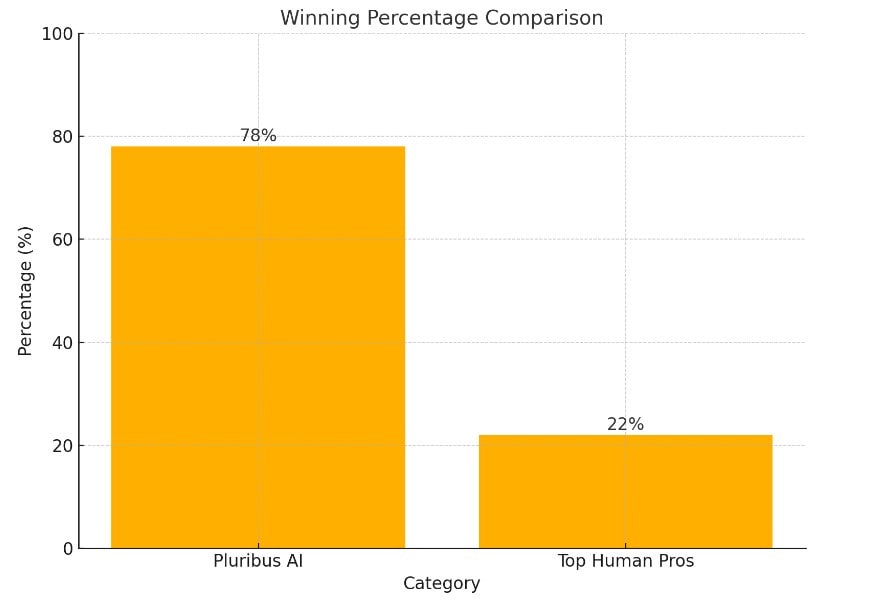
DFS was an AI from a family of decision trees-based machines that had just recently proved to win high stake tournaments, including WSOP. Pluribus poker, the most powerful system, even outplayed all human pros since it was just making, on average, better decisions. Once again, that was not because of a wsop cheats strategy, but because of years of research on AI.

It would be like playing against an AI that has all the tactics at its core and knows where your weakness is-that’s what the experience will be with these poker AI bots. This would, in fact, show that they must adapt quickly or perhaps even face losses.

The future of AI in poker

As a matter of fact, AI is continuously going to get even better with each successive generation. In the future, the game could also involve real-time emotion analysis or complex multiplayer strategies. Until then, to get ahead in today’s game, players would be better off doing more research with the help of bot software for buying online or even download global poker applications.

These applications, derived from the concept of the decision tree frameworks, give valuable insights that can definitely turn around the game. Whether it be a pro or just an enthusiastic player, it is important to understand where AI meets poker in order for this new game to survive successfully.

Conclusion 

AI has completely changed the competitive landscape of online poker. Its decision trees are at the heart, forming the very foundation of such systems as DeepStack AI and PokerAlfie. And for players, it shall be not a matter of choice to use such tools but obligatory.

The next time anyone plays against an artificial intelligence opponent, remember: it always boils down to not being about the cards but how strategically one can calculate and know nuances of the game. With AI in assistance, now’s the time to take it up a notch.

1,034 Words

Balancing Exploitation and Defense: AI in Poker Strategies

The AI Revolution in Online Poker: Balancing Exploitation and Defense

Online poker is no longer just a game of intuition – it’s a proving ground for artificial intelligence. As someone who develops cutting – edge poker software, I’ve witnessed how AI reshapes strategies in real time. At the forefront of these innovations is the Data – Biased Response (DBR) technique, which empowers poker AI to exploit weaknesses while maintaining a defense against counterattacks.

This turns out to be quite critical in competitive online poker since an over – inclination toward the exploitation of the same makes him more vulnerable. It was at this right balance of DBR that AI could thrive even in very high stake games and include WSOP cheats scenarios or poker against bots environments. 

What is Data – Biased Response?

Smoothes the road that poker AI travels to cope with incomplete and mostly unreliable opponent data. Actually, it’s the evolution of poker hacks, but then again, much nicer. It adjusts confidence of DBR concerning correctness of opponent model on a basis of amount and quality of observation, not putting equal confidence into all observed data.

The strategy will be extended where, for instance, more strength should be built into that trend in case, at different stages, a player continuously bluffs. Yet different from a mere pokie cheat, it also covers what might happen in a case of misleading data. DBR constructs adaptive yet resistant strategies by changing the probabilities of exploit and defense.

This tends to be extremely significant in incomplete – information games of Limit Texas Hold’em. Players are inherently non – deterministic and bots in poker tend to fall apart when playing against someone who plays in an unorthodox style. DBR helps ensure that in partial observability the AI is going to be solid competing against either humans or poker online bots.

DBR vs. Traditional AI Approaches

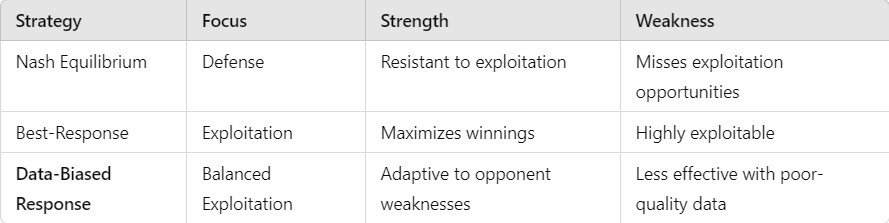
Most of these classical AI approaches, including Nash’s equilibrium, are based on strategies against losses regarding the worst case. Of course, this does make it very robust, but in many cases this results in failure to exploit obvious weaknesses and thus leaves some would – be winnings on the table. Best Response does exactly the opposite: while it maximizes the exploitation, it crumbles when faced with skilled or adapting opponents.

DBR fills in that gap by offering a weighted compromise. For a comparison of the three approaches:

One of the most important reasons why DBR is so crucial for modern poker AI bots is because it might fit into a huge range of applications. For example, DeepMind Poker Bot served very well with its abstract modeling, and at the same time, work for maximum performance against the real world would fall to DBR, in the case of imperfect data.

Now, imagine an AI system studying all results from those many, many hands played. He sees everything, remembers big trends – a lot of raises or folds. He then uses DBR to dynamically adjust the following with some really high confidence data: 

  • High Confidence Data: He has them play in targeted exploitation much as one would apply a focused poker cheat sheet.

The low – confidence data provides him with the insurance that he is resistant to unexpected strategies.

In addition, this flexibility makes the DBR an innovative approach at least in the setting of the mixed human players and online poker bots.

Real – World Applications

  1. Against Human Players: The AI – based DBR, having adapted to the aggressive players by exploiting the passiveness in the weaker opponent, has done pretty well thus far in, say, the WSOP tournament series.
  2. Competitor to Other Bots: It competes in the exploitation of other online poker bots and protects against the bot strategies that are predictable.
  3. Learning Aids and Practice: For many, AI – driven DBR is considered one of the best methods to study or practice chess. In principle, they really do provide practice against a human opponent with remarks on the defects of the strategy behind poker online bot. 

Why DBR Is the Future of Online Poker AI

But DBR’s true power, however, is scalability – from very high stakes games to the ones in which consumer – facing tools turn AI from a helping little sidekick into a strategic powerhouse. A system within DBR stands; it is for those players who want the best bot for poker, or even downloading a bot for poker, aware of the advantage.

It’s not about winning but about redefining the game. For all the capability of AI, which DeepStack AI and PokerAlfie have represented in poker, the system referred to as DBR takes it to a totally different dimension. Competing against human ingenuity along with competing against developed algorithms, bringing in the best of both worlds, makes this poker AI competitive by maintaining a balance in exploitation and defense.

Conclusion

But in the real world, poker, while incrementally enhanced, is pitted against increasingly formidable foes: human challengers or poker online AI – whereas poker AI itself remains in the development stage online. First of all, a preliminary understanding of how DBR works will provide the most significant advantage.

No poker machine hack, no shortcut, but the future of Artificial Intelligence in poker that would adapt and rule with changes in online play. Let me tell you – developer to reader – it was with DBR that you truly reached the frontier of what could be achieved with AI in poker. Are you prepared to take it to the next level?

918 Words

How CFR Shapes the Future of Online Poker AI

Poker has long been about strategy, instinct, and calculated risk, yet the Internet also turns it into an unassailable domain of A.I. However, deep inside its core, the unlikely math breakthrough that played into its creation is: Counterfactual Regret Minimization – how AI makes unbeatable strategies in incomplete information games like poker.

As the developer of advanced poker software, I’ve seen firsthand how CFR has transformed the landscape of online poker. With CFR, poker bots don’t just play – they learn, adapt, and consistently outperform even the savviest human opponents. If you’ve ever wondered how poker hacks evolve from simple tricks to sophisticated algorithms, CFR is the answer.

What is Counterfactual Regret Minimization?

The CFR is an iterative algorithm that converges to a Nash equilibrium through iterative strategy enhancements with the use of “regret” minimization – the loss resulting from not taking hindsight’s best action. In poker terms, this happens through folding on better hands or not bluffing when one could have done so. Runs millions of poker hand simulations, analyzing the possible decisions at every stage and updating a strategy to minimize the regret:.

Now consider an online poker bot. The previously considered outcomes and probability models will have the CFR that has the bot evaluate every possible move of calling, raising, and folding. It will converge on a strategy which would balance aggression with caution. Thus, it comes closer to Nash Equilibrium, since that would make it unreadable and just about impossible to exploit.

Whereas, for example, anyone who has worked with poker cheat sheets, CFR introduces another whole level of depth. It is instead adaptive to the opponent strategy and keeps readjusting in view to make the best decision whatever the situation.

Real – world success: CFR in practice

But it’s not just theoretically effective – it’s also been battle – tested in the highest stakes games. Probably the most famous use case is Pluribus Poker, an AI created by Facebook and Carnegie Mellon University. Using this very strategy, namely CFR, it bested some elite players of No – Limit Texas Hold’em, and this was something considered impossible up until then.

Other successes came when the DeepMind poker bot applied the principles of CFR to become very good at heads – up poker. It was with this counterfactual reasoning capability that it kept outplaying its human adversaries to cinch the strength of the algorithm in the real world.

For the average player, the concept of CFR might be some kind of fiction novel. Their theory is also part of most online poker bots. They put them into practice to inflate their profit margins. Normally, they do much better than a human that tries to operate on gut feeling or with ill – conceived notions of poker machine hacks.

Why the CFR is so important in online poker’s AI

For a developer like myself, CFR is a game – changer: finally, the green light will be given to building the best poker bots able to compete at any level. That is to say:

  1. Versatility: The CFR – driven bot is sure to create waves in dynamic environments – whether it is aggressive opponents or cautious grinders, the bot self – corrects in real time to reap the weaknesses.
  2. Scalability: Whereas most of the previously mentioned algorithms were at best barely able to handle large game trees, here comes CFR doing so with ease for multi – player games with complex betting structures.
  3. Precision: Reducing regret allows CFR to make the best decision every time and smooth out those random wild swings so common in less mature systems.

That would then be the level of granular differentiation to really set it apart from an average bot to the best bot for poker. That is also why CFR lies at the heart of most advanced AI training and analytics applications.

The Moral Question: CFR and Chess Sharers

Fairness in online poker has grown to be one of those highly debated issues, especially with the appearance of CFR – powered bots. While for some people, such tools are nothing but poker hacks, for others, they tend to undermine the integrity of the game. Nowadays, many places deploy AI detectors to identify suspicious patterns of play and further ban online poker bots. 

It is very good as a developer that it supplements and doesn’t replace an entire poker experience. Great tools for training and analytics, but it is just one of those things – playing live – that no version of DeepStack AI or Poker Alfie will replace. The only tricky part for the players, however, is knowing when one is actually playing against a bot. 

Signs may include things such as unchanging bet sizing, quick decisions, and being unable to adjust to unusual plays. If you feel you’re playing against a bot, then try some unexpected moves. It may just push the AI outside his comfort zone.

Bringing CFR to Your Game 

So, how might one exploit the power of CFR without downloading a full – fledged poker AI bot?

  1. Research Counterfactual Thinking: If you were in that session now and were sorry for folding, you would raise instead of call. You can also perfect such techniques using online resources, maybe downloading some bot software or searching out poker cheat sheets. 
  2. Play Against CFR Bots: Many online AI training websites allow one to go up against the bots driven by CFR. The experience thus derived is really invaluable in understanding optimal play and recognizing patterns that poker bots online make. 
  3. Know Your Enemy: Even though you do not have access to AI, this will help you know the thought process behind a CFR bot. Those tendencies you can manipulate against an opponent. Most bots don’t fudge well against mixed strategies, so start there. 

The Future of CFR in Online Poker 

While the technology in CFR keeps getting better, so does most of its other applications outside poker. Anything that involves making a decision under partial information – be it financial modeling or cybersecurity – can be transformed on the principles of counterfactual regret minimization. 

The future of poker now will probably be a mixture of CFR and real – world data combined in real time. Think of a poker AI online tool that changes its strategy mid – game with the help of live data feeds. Alternatively, a training application uses CFR to simulate thousands of situations fitted just right for your leaks. 

The possibilities are endless, but so are the challenges. Thus, this leaves the poker community to find a fine line it needs to strike between innovation and fairness in times to come as the bots get ever more intelligent. For now, the way to be ahead is by riding the tide of technology, learning its strength, and adapting your game to the changing times.

 In a world in which poker against bots is increasingly the new norm, grasping CFR has ceased being optional but became one of the keys to not just mere survival but also making one thrive in the future of online poker.

1,178 Words

AI in Poker: Modeling Opponents for an Edge

Poker is a game of incomplete information. In chess or checkers, you know what he or she has, but in poker, you don’t. The greats are the ones who can fill in with betting patterns, table dynamics, and psychological insight.

Put together with the cold precision of artificial intelligence, it is human intuition you have. That’s where poker bots and advanced opponent modeling step in – the completely changed ways we think about poker and go into it.

Why Opponent Modeling Matters

Brute – force calculation and game – tree search are ways to mastery in chess, but only because everything is on the chessboard in sight. Poker, by contrast, is all about bluffing, deception, and suboptimal human decisions. It is an intriguing test bed for poker bots but demands quite another approach.

Opponent modeling uses statistical data in order to make predictions regarding the opponent’s most probable range of hands and adjusts strategy accordingly. Rather than making every adversary a faceless player, the technique personalizes the game. Historical betting behavior is put into perspective with the current board conditions and weighted probabilistic outcomes, so as to fine – tune decisions in real – time.

The benefits? To human players, it’s like having a cheat pamphlet of poker hacks; to AI, it’s the difference between a generic strategy and ruthlessly exploiting other people’s mistakes.

The Mechanics of Opponent Modeling

To make this bit more concrete, let’s focus on how opponent modeling works in Texas Hold’em, the most popular form of poker illuminated by world championships like WSOP.

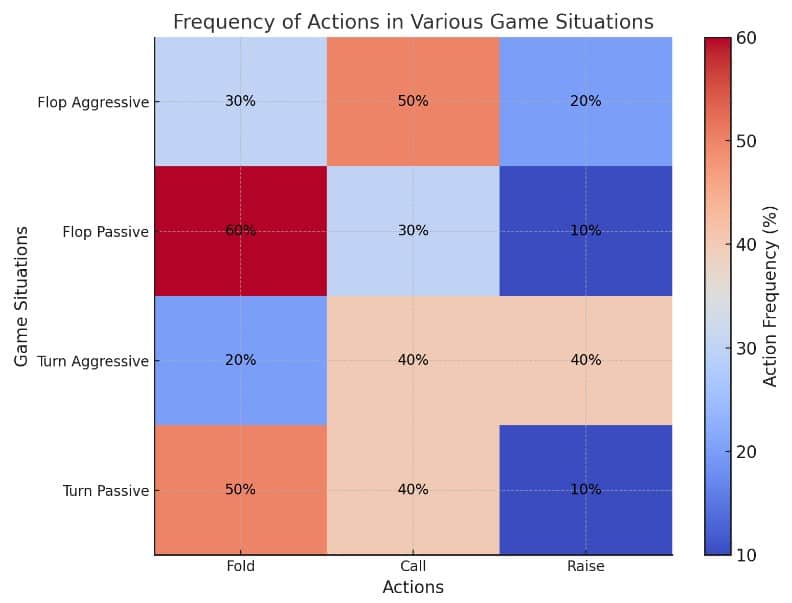
These large – scale simulations are important for decisions tuning in other systems, such as in Pluribus poker and DeepMind poker bot. First, the AI observes the pattern of betting, correlating this to probable hand strength. For instance, the usage of an aggressive raise preflop by an opponent, then being passive upon the flop, may indicate that he actually had a really strong opening hand but failed to connect with the community cards.

It is a process built on the idea of two things: hand strength and hand potential.

  • Hand strength estimates the chance that your hand is currently the best. For instance, using an Ace – Queen offsuit on the flop with a Jack – Ten – Eight board, your apparent hand strength could be in bad shape. However, computations could show that your hand will beat a random opponent’s cards about 58.5% of the time.
  • Hand potential accounts for how your hand could improve or deteriorate as additional cards are revealed. In the same scenario, drawing a King could complete a straight, significantly boosting your odds.

These metrics, in addition to opponent tendencies, are integrated using AI to determine the best action – saybe a bet, a call, a raise, or a fold. Systems like DeepStack AI and PokerAlfie go even further, dynamically responding to the strategy of opponents over time.

Real – World Applications: Data and Dollars

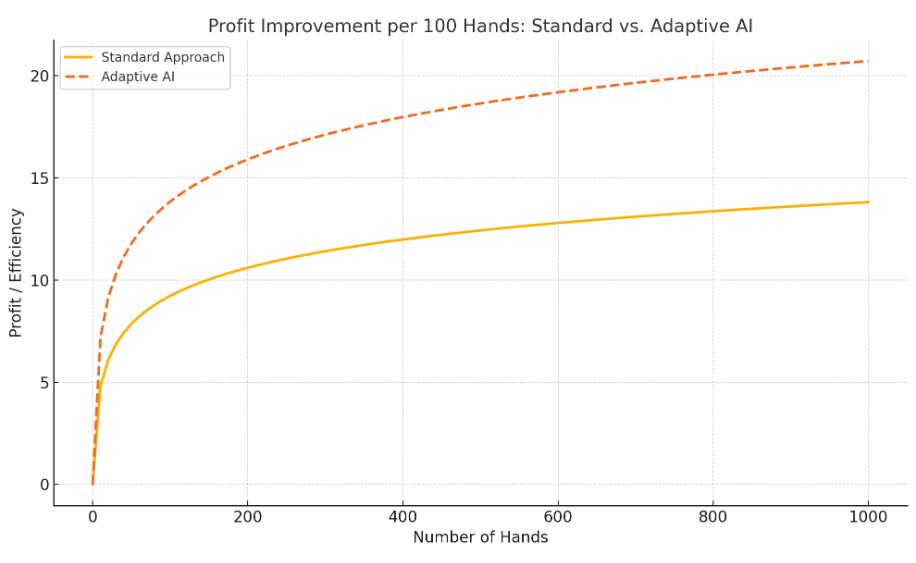
Indeed, in one experiment, using a poker bot called Loki, opponent modeling proved so effective that, after 100,000 hands, the opponent – modelling version was up over $5,000 on its non – modelling counterpart in a simulated $2/$4 game, and ever – rising bankrolls are normal in online games where players often oppose poker online bots.

Let’s contextualize it in real terms for players.

  • Data driven decision making: Well, it allows you to create an opponent model with ease using either poker cheat sheets or some kind of tracking software. Record how often a certain player is folding to three – bets or raising on the river. The patterns develop rather quickly and can be exploited for real money.
  • Variance Management: Poker is one of those games full of ups and downs. Frame up your strategy against specific kinks of opponents to minimize your reliance on luck and to make sure you maximize the skill – based edges.

Some of these tools – for instance, the so called purchase bots offer shortcuts toward the exploitation of emerging trends. Of course, not all “hacks” are created equal, and the best approach in general is a balance of human intuition and systematic analysis.

The Role of AI and Bots in Poker

Online poker AI tools raise debates about fairness and skills. That promising an edge to the players is the increased ethical and legal concern brought about by online poker bots. Playing with systems like DeepMind poker bot or PokerAlfie in unregulated environments gives an unfair deal for players using them, while on platforms, AI detectors are increasingly introduced to root out such practices.

Poker, for artificial intelligence researchers, is something of a unique playground in which to consider decision – making under conditions of uncertainty. Already with projects like Pluribus poker AI, it was documented that AI would win against professional players, even in multiplayer, but nothing in technology is perfect: poker machine hacks may eventually take advantage of the predictability of AI, and smart players use adaptive strategies to throw it off.

Becoming a Smarter Player

And how would the poker lover apply these lessons without downloading some sort of poker bot off the internet? Observe, then categorize your opponents: Are they aggressive or passive? Do they bluff often, or only bet when the hand is strong? Build a sort of model in your mind and adjust your game.

For example, if you notice that one player is in love with betting on any kind of flop, it may well be the sign of a poker cheating method of intimidating his opponent. Adjust this by calling his bluff more often or raise on great hands. Against online poker bots, just look for predictable betting patterns they may have. Typically, AI can’t play unorthodox strategies well, so mix it up to keep them off kilter.

Final Thoughts

Poker is a game of incomplete information, but it doesn’t have to be a guessing game. Leverage the insights powered by AI, say DeepStack AI, or sharpen up your strategic intuition – the bottom line remains the same: stack the odds in your favor.

While poker versus bot instances really illustrate something impressive in AI, they also bring out an achievable momentousness of human adaptability. Some tools, like poker now hacks or poker cheat sheets, may give a temporary advantage, but true mastery lies in understanding the deeper aspects of the game.

Ultimately, the biggest challenge of poker – and its ultimate reward – is to reward those that think one step further. You can overcome anything – from a table full of humans to the most advanced poker online AI – with the right tool and frame of mind.

1,099 Words