
Probably every professional poker player—whom we commonly refer to as “regulars”—understands that poker isn’t just about luck. Poker is about probability, statistics, cold calculation, and emotional detachment. Emotions are an essential part of being human. On one hand, they’re a vital component of life that helps us survive and make quick decisions when necessary. You wouldn’t stop to think about what to do if a furious man with a knife suddenly charged at you on the street, would you? If you haven’t trained yourself for such a situation, you won’t even have time to think—a mix of fear and panic will make you turn and run. According to Nobel laureate Daniel Kahneman, the decision was made for you by what’s known as System 1. System 1 helps you pull your hand away if you touch a hot object; when you brush your teeth, zip up your favorite jacket, or play your favorite chords on the guitar—you don’t think about it or focus on the process.
In the other corner of the ring is System 2. Its operation requires a great deal of resources. And the human brain is wired such that, for the sake of conservation—in the context of evolutionary survival—not everyone likes to engage System 2. For example, when you’re learning to code, figuring out the rules of a new board game that the weird guy with greasy hair (but who, for some reason, is friends with your best friend) brought to the party, or watching a documentary about how a nuclear reactor works—System 2 is at work. System 2 is slow, conscious, analytical, and resource-intensive. It kicks in when you need to solve a complex problem, check logic, or suppress an impulse from System 1. Here’s a simple example illustrating when System 2 is active and when System 1 is active, using basic mathematical operations:
- 2 x 2
- 48 x 23
In the first case, you simply need to glance at this simple mathematical equation to come up with the answer 5 (just kidding, 4). In the second case, you need to break the equation down into its simplest components in your head. First, you’ll mentally multiply 48 x 20 separately, and then add the result to the result of the expression 48 x 3. It’s complicated, isn’t it? And if you were chewing gum or listening to music in the background at the same time, you’d stop chewing and wouldn’t be able to make out the sounds of the music.
Unfortunately, salespeople and marketers have adopted Kahneman’s work for manipulative purposes. The thing is, System 1 very often fails. Unscrupulous salespeople take advantage of this. Here are a few examples. The first price you see becomes the anchor against which you’ll evaluate the purchase. Displaying an old or inflated price next to the new one makes the discount seem very tempting. An expensive item in the window makes all the other prices seem more affordable. Or, for example, let me share a story from my own life. A long time ago, about 10 years back, when my belly was smaller, the grass was greener, and ice cream tasted better, I got my driver’s license and saved up for a car for about two years. So there I was at the dealership, on a friend’s recommendation, to buy a brand-new car, but one registered from the previous year. It was technically the end of the year, and in a couple of weeks, that car would be two years old on paper. That’s exactly why the dealership was offering a great discount. While I was finalizing the paperwork and drafting the sales contract, my personal sales representative’s colleague walked up to him and asked, loudly and pointedly: “Are you selling that last black Honda Civic right now? Because I already have customers here to buy it.” My first reaction was panic, and five minutes later I had already put a deposit down at the dealership’s cashier. A week later, when the car transporter delivered my car, the price had naturally gone up, and this purchase went from being a super-profitable deal to just a regular one. But what if I’d had time to read the deposit agreement and had time to make a decision? Most likely, I would have looked at offers from other dealerships and, quite possibly, bought it somewhere else.
Let’s gradually move on to poker. What happened to me at that car dealership 10 years ago? I let my emotions get the better of me; the salespeople—marketers—had me wrapped around their little finger. A small trick, all within the law, but it felt as though I’d been cheated (in fact, I still consider it a scam). Now, let’s try to apply or draw an analogy between this real-life situation and situations that often arise at the poker table. What exactly are these situations? They are situations where, under stress, our brain must make decisions under time pressure. In other words, only two factors are needed for a systematic error in decision-making. It turns out the formula for a wrong decision is quite simple:
Limited time + emotional component = wrong decision
Just a moment ago, I lost an online poker tournament organized by the company I work for, using the simple formula described above. The player sitting across from me—to whom I had lost a significant portion of my stack just two hands earlier—simply called my all-in bluff. And as a result, I lost and was eliminated from the tournament. I’m not claiming my opponent is a bot (though who knows). I simply made the wrong decision based on my emotions in a split second. I’ll attach the hand history below.
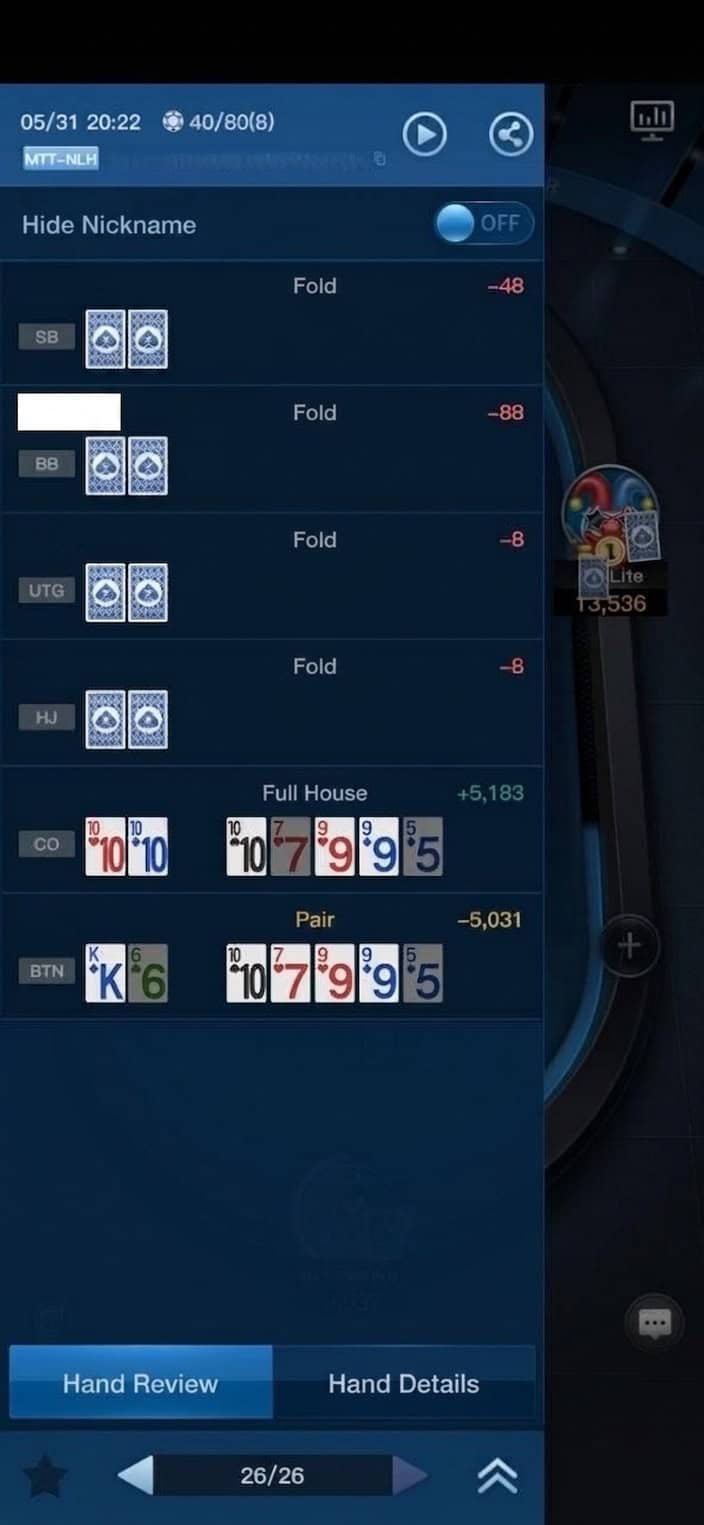
And there are a huge number of such mistakes—often referred to as cognitive biases—in situations relevant to poker. So, let’s get down to business, since the article is titled “How to Play Against a Poker Bot.” And I’m sure you’re hoping for a “magic pill” or a simple guide on how to play against a poker bot in order to beat it. The answer is quite simple and straightforward: don’t make mistakes. It’s enough to simply reduce the number of mistakes to increase your win rate. The advantage of poker bots is that they don’t care at all who they’re playing against. It doesn’t matter to them that they lost half their stack two hands ago. A poker bot is simply a mathematical model capable of calculating probabilities and backed by statistical data. Over the short term, an average poker amateur, with a bit of luck, can beat a poker bot, but over the long term, the poker bot has a massive advantage.
Well, actually, do chess grandmasters really engage on System 2 to analyze moves? The answer is no. The secret to success lies in constant practice, analyzing games, moves, and situations. Thanks to this, System 1 provides professional chess players with a more accurate decision than it does for beginners.
In other words, practice to train System 1, along with an understanding of cognitive biases and the ability to apply that knowledge at the poker table, will help you make the right decisions. That’s when chance comes into play—what many call luck.