

In the last few years, Artificial Intelligence has hit the poker world, changing the dimensions of online gameplay. One tool facilitating this revolution is the ACPC protocol: a framework of rules designed for automated computer poker competitions. This article deconstructs how the ACPC protocol works, what it means for poker players, and the general role of AI in online poker.
What is the ACPC Protocol?
The Automated Computer Poker Competition, or ACPC, protocol is a communications framework originally designed to uniformize interactions between poker-playing programs and servers in the context of competitions. While the phrase may sound niche-level technical, this is actually the protocol that underlies strategies for some of the most advanced poker bots.
At the heart of the ACPC protocol lies determining how poker bots communicate with a server, interpret game state, and make decisions on their actions. It’s like the language an AI poker player uses to “speak” to the dealer and other players around the table. It’s designed to handle gameplay elements such as rounds of betting, visibility of cards, and positions at the table with incredible accuracy.
How Does the Protocol Work?
At first glance, the ACPC protocol can appear to be an alphabet soup of match states, betting strings, and card notations. Its functionality, however, is pretty straightforward if you break it down.
Match States: The Core Communication Unit
The server sends MATCHSTATE messages to the client (the bot) constantly, which describes the current state of the game. They consist of:
- Player position: Who is next to act.
- Hand number: Which hand is being played.
- Betting actions: A list of actions taken during the current round (e.g., “r” for raise, “c” for call).
- Visible cards: Hole cards and community cards.
For example:
MATCHSTATE:0:30:rc/:9s8h|/8c8d5c informs the bot about its position, the hand number, the betting history, and visible cards thus far.
Player Responses: Calculated Actions
The bots respond to match states with actions that are calculated very carefully based on probabilities and game theory. A simple response might look like this:
MATCHSTATE:0:30:rc/:9s8h|/8c8d5c:c
The bot decides to call here after analyzing the game state.
Flexible for Different Poker Variants
Whether it’s limit or no-limit Texas Hold’em, the protocol extends to support game rules describing betting, the rank of hands, and the interaction between players. The flexibility of this protocol is part of its popularity in both research and competitive domains.
How Do Poker Bots Utilize the Protocol?

In essence, poker bots use ACPC for processing game information, assessing their positions in a game, and using strategies. A closer look:
- Pattern Detection on Betting: Bots utilize match states as a way to follow the sequence of events: bets, raises, and folds. A simple string, such as r300r900c, may show them that the opponent is overly aggressive and lead them to implement the necessary defense mechanism.
- Probability Calculation: They calculate odds in real time. Supposing community cards appear to be 8c8d5c with the hole cards 9s8h, from there, the bot could very well take a shot at making a straight or full house and react based on that probability.
- Decision Trees and Game Theory: More advanced bots make their moves in accordance with game theory. A raise, call, or fold is not done on a whim. Each move has been computed exhaustively in order to maximize profit.
Challenges of Playing Against Bots
For human players, though, there are huge challenges looming in the shape of AI-powered opponents. Poker bots have some serious advantages using protocols such as ACPC:
- Consistency and Precision: Bots don’t tilt. Emotions, fatigue, or pressurizing never affect them, so they can maintain relentless precision.
- Data-Driven Strategies: With access to historical game data, bots can easily switch tactics mid-game to play on players’ weaknesses.
- Unerring Memory: Bots remember every hand that’s been played, and over time they’re able to recognize patterns and adjust—which few pros are really able to manage.
Can You Tell If You Are Playing a Poker Bot?
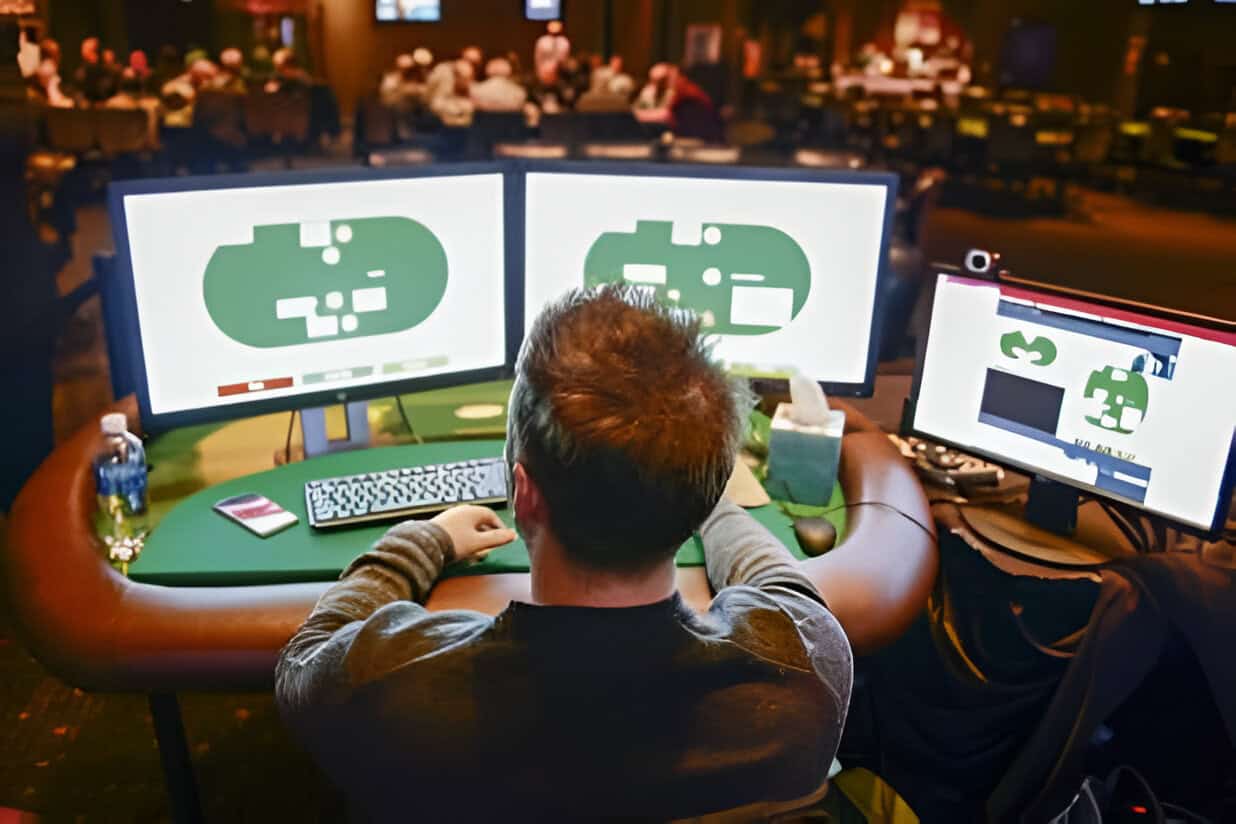
As challenging poker opponents, there are a few ways of recognizing poker bots at your table. Here are a few basic tips:
- Predictable Behaviour: Many bots stick to very consistent strategies. If one player always responds to raises in the same way, he may well be a bot.
- Inconsistent Timing: Bots usually respond almost instantly to situations that would cause hesitation from human decision-making.
- No Emotion: Players who never tilt or fall for your bluff may well be an AI.
Report bots to the platform administrators upon detection. In fact, most poker websites do wish to rid themselves of them in order to keep the game fair.
The Future of Poker and AI
The ACPC protocol was really just the beginning of where the game of poker would like to go with AI. Here’s what that will look like:
- Deep Learning Means More Sophisticated Bots: Already, bots like DeepStack and Libratus use complex neural networks to trounce professionals. Coming future AIs could integrate not just deep learning but the ability to make better judgments in real time.
- Better Training: AI isn’t for adversaries alone—it’s one incredibly powerful tool for training new players. Pros-to-be can run hands versus virtually any number of bots.
Ethics
As AI continues to evolve, so will ethical considerations of bots in online poker. Just how invasive should a bot be for an unfair advantage in winning?

Final Thoughts
The ACPC protocol has been an interesting confluence of technology and strategy that helps the bots play at the highest level of poker. However, when demystified, understanding how those bots work could finally yield an essential edge for human players over them. Adaptation and learning will ensure that even the most advanced AI adversary finds you prepared in the game.
Time to Get Better: Master deep play against poker bots, one hand at a time.