
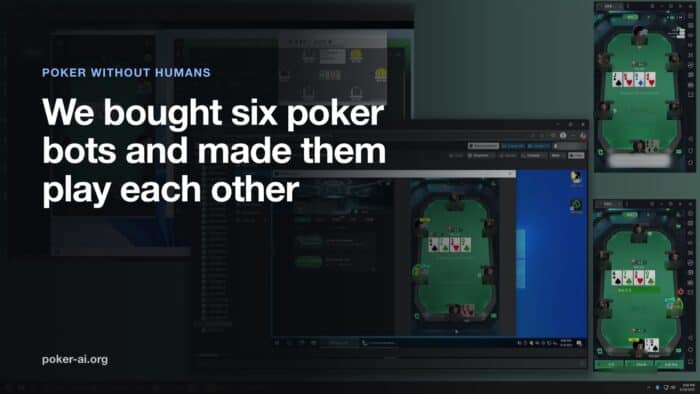
We had two AI bots, a few rule-based bots with profiles, a scam bot on a remote rig, four virtual machines, two Android emulators, a private club on PPPoker, hand trackers, and 24/7 screen recording. Not that all of this was absolutely necessary for the experiment. But once you’ve started collecting poker bots, you’ve got to take it seriously.
So… we bought all the commercial poker bots at the end of 2025, configured each one according to the sellers’ recommendations, and sat them down at one table. For almost three weeks they played against each other – hundreds of hours, ~26k recorded hands.
What came of all this? Quick recap:
- AI poker bots are winning, rule-based bots are losing. Reliable figures (95% interval): winrate +29.2 bb/100 versus -24.3. Everything is calculated taking into account margins of error, SD, and so on.
- No profile, not even a paid top profile, works in the long run. A rule-based bot with it has a winrate of -28 bb/100. That’s not even better than with the free default one.
- Old bots running on Windows on native PPPoker clients – were automatically banned by the system after approximately 10k hands.
- We were ready to keep playing up to 50-100k hands, but one PPPoker client update broke all the old bots. But the hands already played and the data are enough for conclusions and numbers.
Why we started this experiment
Every poker bot vendor writes roughly the same thing: AI, GTO, machine learning, “plays like a top reg,” “bluffs and remembers opponents,” “doesn’t get banned and looks like a human.” Nobody shows long-term graphs, of course, and when asked about results they answer along the lines of “the best proof is to buy it and check for yourself.”
I had roughly already figured out the outcome of this experiment, but my curious acquaintance wanted to see it live, and on top of that a new “AI poker bot” had just hit the market. Well, why not? Let the fun begin!
Setup
- Where: PPPoker, a new private club with new accounts.
- When: November 27 – December 15, 2025.
- What: NL4, 6-max and 9-max tables.
- Stacks: the bots played 100–200+ bb, as the vendors recommend. Winnings stayed on the table, so the winners’ stacks grew over time. Not all bots could auto top-up – for those, the stack was topped up manually ASAP.
- How many: 26,395 hands.
- How we recorded: trackers Hand2Note 4, EliteHUD, and screen recording with Bandicam.
Bots don’t care about limits: whether it’s 0.02/0.04 on the table or 5/10 — the bot calculates in big blinds. So the result is meaningful for any limit with similar stacks and rake in big blinds.
At the table sat six commercial products in seven configurations:
| Who | What it is |
|---|---|
| AI Bot A | AI bot; the poker engine runs on the vendor’s side |
| AI Bot B | AI bot; the poker engine runs on the vendor’s side |
| Rule-based bots based on OpenHoldem | Bot 1 working on profiles: default and paid top profile. Bot 2 working on default profile (as a separate product). |
| Rule-based bot 3 | Another bot working on profiles, default profile |
| 3UpGaming | Bot sold as “AI + GTO” |
The difference between the two generations is how the bot makes a decision. A rule-based bot works on a profile – a large set of rules with a predefined algorithm. Usually the base of such a profile is simplifications from a GTO solver, equity calculation plus the author’s own tweaks in one direction or another – to make the bot tighter or more aggressive, possibly with some randomization here and there. The calculations of such bots are done on the user’s PC and are usually transparent, unlike AI bots. A machine learning bot, on the other hand, computes the decision: the model and the algorithm evaluate the specific situation as a whole.