

Poker has been a skill, psychological, and strategic game for a long time, and a challenge for artificial intelligence (AI) with a rich and long-standing heritage. Unlike in chess, in which any piece and move can be seen, in poker, information is imperfect, and AI must make a decision based on probability, deceit, and opponent actions. Poker researchers have, over time, designed increasingly complex poker bots through game theory, machine learning, and Monte Carlo simulations.
This article describes how AI in poker has developed, starting with early rule-based approaches through to current state-of-the-art bots capable of challenging and even beating professionals at the game.
Early Attempts: Rule-Based Systems
The early AI poker programs operated with a knowledge-based system, in which expert-established rules determined a decision. These types of systems were static and predictable and could therefore be exploited when humans discovered their patterns.
Some early implementations, for instance, utilized if-then rules to fold, call, or raise based on expert-established hand rankings. These programs could face poor opponents but faltered with experienced opponents who could modify approaches.
A famous instance of such an approach is Turbo Texas Hold’em, a commercial AI for poker, in which expert approaches were programmed in its decision mechanism. It could beat casual opponents but could not beat opponents with adaptability in changing its approaches when opponents played an aggressive or deceitful manner.
Monte Carlo Simulations: Smarter Decision-Making
Research in AI for poker continued, and its implementers adopted Monte Carlo simulations to make decisions smarter. Instead of depending on predefined rules, such programs simulated a thousand or more hands and scenarios and estimated the expected value (EV) of an action.
The process worked like this:
- The AI assigned possible hands to opponents based on past actions.
- It simulated future community cards and betting rounds.
- It calculated win chance and chose the most profitable move.
The technique was utilized in such programs as Pokerbot and Poki, developed at University of Alberta’s Computer Poker Research Group (CPRG). These programs played competently when pitted against humans but showed considerable vulnerabilities. For instance, they overestimated or underestimated aggressivity in opponents, sometimes at a pricey expense.
Game Theory and Nash Equilibrium
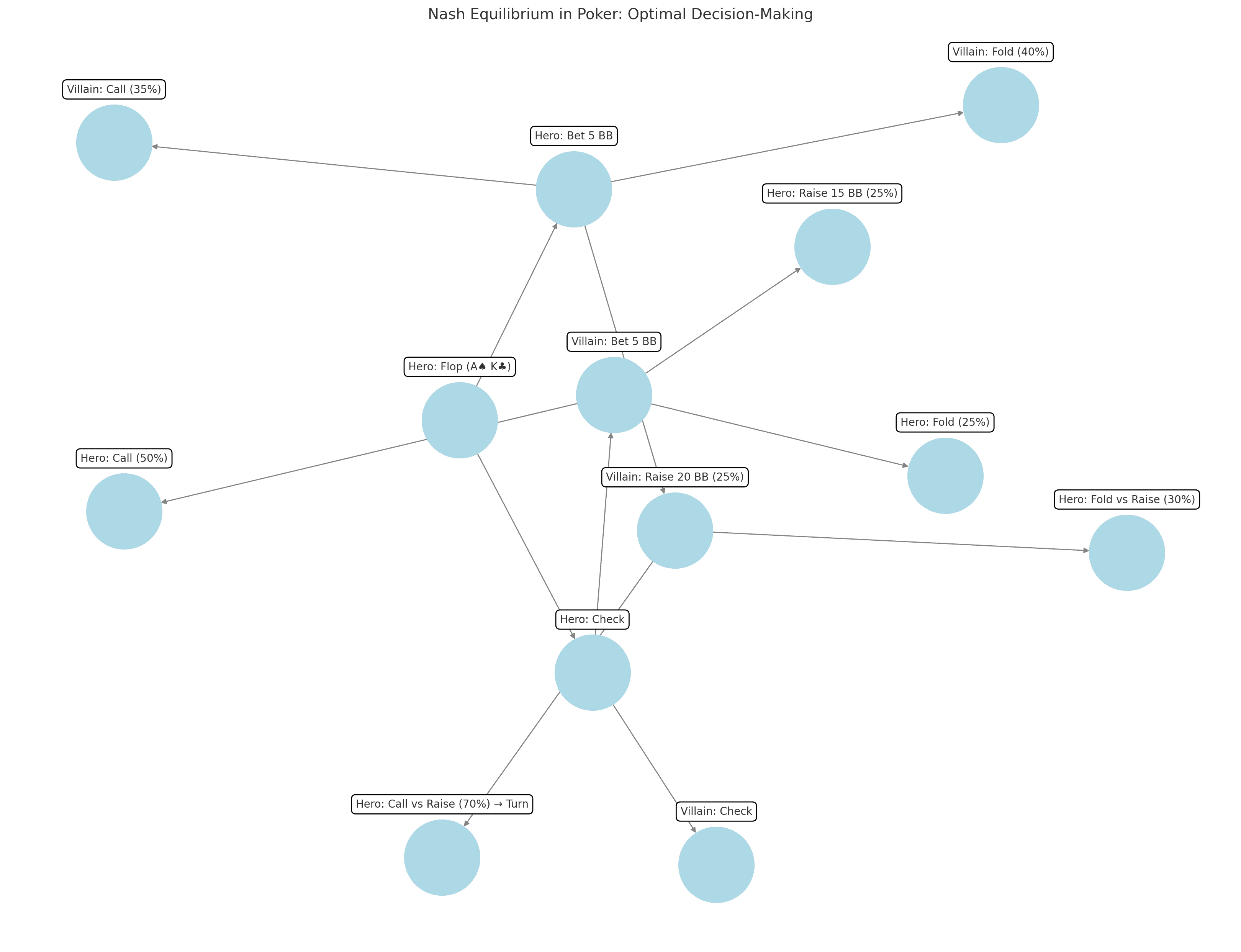
A famous AI poker achievement involved using game-theoretic approaches. Central to this is Nash equilibrium, named for mathematician John Nash.
A Nash equilibrium poker strategy is one in which, when both players use it, neither can obtain a better outcome through a move in its strategy. That renders it an unexploitable one, in that opponents can no longer exploit it consistently.
Scientists extrapolated Nash’s principle to poker in three ways:
- Abstracted the game in order to simplify.
- Applied linear programming in order to calculate near-optimum strategies.
- Designed AI to play off of probability distributions, not inflexible rules.
This facilitated such programs as Cepheus (2015), the first AI ever to “solve” heads-up limit Texas Hold’em. Not flawless, Cepheus played so well no human could beat it consistently.
Exploitive AI: Learning and Adapting
Nash equilibrium strategies, strong as they are, are not necessarily most profitable when played in competition with poor-playing opponents. An unbalanced, unexploitable strategy played out by a bot could miss out on taking real player mistakes for an advantage.
To maximize winnings, AI engineers incorporated opponent modeling, in that a bot could adapt its strategy in reaction to seen behavior. These programs functioned through:
- Observing opponents’ routines (e.g., how often a player bluffed).
- Laying out future moves.
- Adjusting choices in order to exploit weaknesses.
For example, an AI could have detected an opponent who bluffed too frequently and could have called more, and an opponent who played too passively and could have put pressure in with strong bets.
This move from static to adaptive AI generated bots that played much better in real-play environments.
Deep Learning and Poker AI
The poker AI breakthrough was achieved with deep reinforcement learning—the same technology that fueled high-performance AI computers such as AlphaGo. With deep reinforcement learning, poker bots could:
- Learn strategies from a blank sheet through self-play.
- Improve through the play of millions of hands and refinement of decision-making.
- Use neural networks to evaluate complex environments.
One of the most famous AI poker systems, constructed in 2019 by Carnegie Mellon University and Facebook AI, was a breakthrough achievement. Unlike early, heads-up focused bots, Pluribus outplayed top-class human professionals in six-player no-limit Texas Hold’em.
How Pluribus Revolutionized Poker
Pluribus adopted several breakthroughs that made it incredibly strong:
- Limited Lookahead: Instead of attempting to calculate all potential scenarios, Pluribus considered only relevant future scenarios.
- Mixed Strategy Play: It adopted randomized bet patterns, and it became increasingly challenging for humans to anticipate.
- Self-Improvement: By using reinforcement learning, it optimized its strategy through continued practice with itself.
By beating a number of the best poker professionals in the world, Pluribus demonstrated AI could work with multi-player dynamics, a big source of challenge in poker AI research.
Ethical Consequences and Poker AI in the Future

Academic AI having become that strong, concerns have increased regarding its use in online poker and fair gaming. Several concerns revolved about exploiting poker bots for cheating, particularly in high-value gaming sessions.
The Most Critical Ethical Concerns
- Unfair Advantage – Players can unknowingly face AI opponents.
- AI Detection – Online poker websites must develop wiser bot detection algorithms in order to maintain fairness.
- Regulation Challenges – Should AI be in poker in cyberspace, or must it be prohibited?
While AI continues to become more sophisticated, poker websites must use stricter anti-bot security, utilizing AI to detect AI and make a leveler.
Conclusion
AI for poker has come a long way from simple rule-based robots to deep-learning algorithms capable of outdoing even professionals. By leveraging game theory, Monte Carlo simulations, and machine learning, AI have reached a point where it can outsmart even high-class players.
Though these advances have been astonishing, they have kindled controversy over the integrity of poker in cyberspace and the role of AI in competitive forums. As technology continues to develop, poker will serve as a testing ground for AI development, proving the capabilities and limitations of strategy, decision, and human-machine competition.
Will AI dominate poker in the future, or will humanity’s gut and adaptability forever maintain an upper edge? Only the future will tell.