Monte Carlo Tree Search and Opponent Modeling in NLT Hold’em

Poker has been an area of contention among researchers in artificial intelligence (AI) researchers for some time now. Unlike in deterministic games such as chess, no-limit Texas Hold’em adds an additional layer: incomplete information, bluffing, and an enormously vast game tree render solving by raw computation infeasible.

To tackle this intricacy, researchers have developed superior algorithms in AI through combining Monte Carlo Tree Search (MCTS) with adversary modeling. This enables poker bots to search through extensive tree decisions, predict adversary moves, and dynamically adjust methods.

In this article, we’ll be examining just how these methods work, exactly why these methods work in poker so well, and what this suggests about poker in the future.

Monte Carlo Tree Search: Artificial Intelligence in Poker Pillar

Monte Carlo Tree Search (MCTS) is an anytime algorithm in that it dynamically modifies its policy upon increased run time. It is simply to go through thousands of virtual poker hands, monitor results, and utilize these to inform choices.

How MCTS Works in Poker

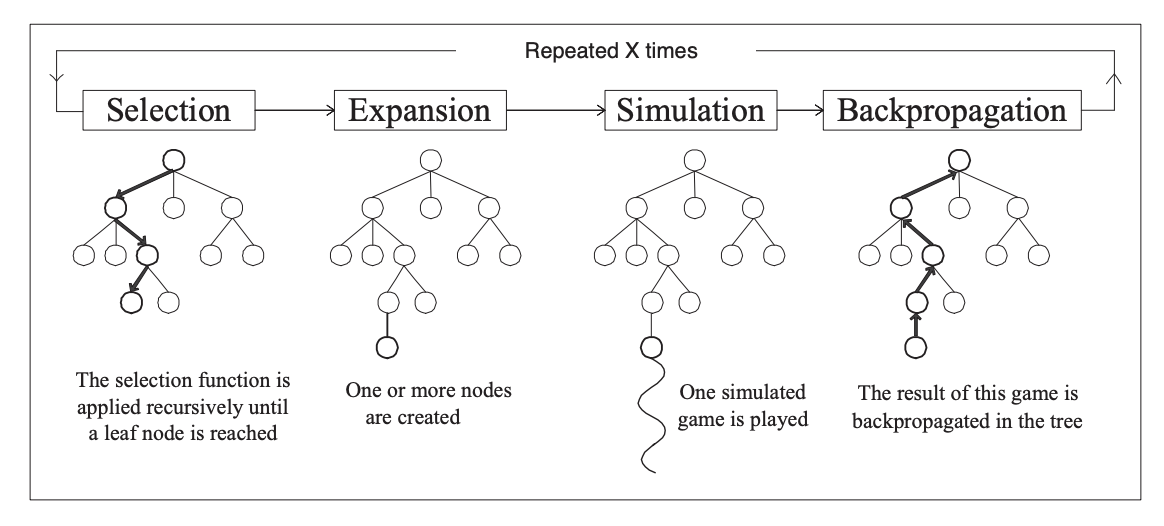
MCTS operates in four overall phases:

  1. Selection: The computer plays through the game tree by playing most hopeful moves derived through previous computer simulations.
  2. Expansion: When encountering an unknown situation, the algorithm expands by making additional potential moves.
  3. Simulation: The computer plays through the game in random order starting with a novel node, making predictions.
  4. Backpropagation: The computer adjusts its decision tree by strengthening winning moves while obscuring over moves that lose.

This iterative process allows poker AI to calculate optimum moves by not explicitly examining each game situation in an explicit manner, making it incredibly efficient in extensive games including Texas Hold’em.
Why MCTS is So Strong in Poker

  • Handles Imperfect Info: As in chess where everything is known, in poker nothing is visible. MCTS provides to approximate about probabilities and decide upon this.
  • Scalability: The algorithm does not have to have an overall game tree to run; just computational resources to run in, getting better over time.
  • Balance Between Exploitation vs. Exploration: It wisely exploits known profitable avenues and scouts in an attempt to gain improved results through new alternatives.

The success in poker has encouraged widespread adaptation in various areas, including finance, game AI research, and robotics.

Opponent Modeling: Modeling Adversary Behavior

One of the most glaring weaknesses in early bots was that they lacked adjustability in playing against humans. This is where enters in opponent modeling, allowing an AI to keep an eye on player trends and predict.

How Opponent Modeling Works

  • Action Tracking: Artificial Intelligence traces every player’s bets, raises, and bluffs.
  • Pattern Recognition: Through machine learning patterns and classes opposing players to player categories by identifying patterns.
  • Adaptive Strategies: How AI responds to opposition tendencies by making decisions in real time to optimize.

For example, in the case where an opponent always bluffs in later positions, the AI is going to call in these later positions, thereby increasing in overall winning percentage.

Common Player Types Identified by AI

  • Loose-Aggressive (LAG): Makes bets regularly, bluffs regularly, and pushes. Exploits by calling regularly and laying traps.
  • Tight-Passive (TP): Only folding marginal hands and bets in strength. Artificial Intelligence exploits by playing aggressively against these.
  • Unpredictable Players: Artificial Intelligence is pattern recognition to adapt to non-standard patterns in bets by continuously evolving improved algorithms.

The ability to identify these player types and take advantage of them has significantly improved online poker performance by AI.

Clustering Opponents: Bringing Back an Online Poker Game-Changer

Traditional opponent modeling was carried out in static player profiles that used to fall short in opposition to dynamic player moves. K-Models Clustering is an advanced technique which pools similar players by playing style.

Benefits of K-models Clustering

  • More Accurate Predicts – As opposed to modeling an individual player, computer is modeling sets of identical patterned players.
  • Faster Learning – Artificial Intelligence learns better in adapting by recognizing patterns in each cluster.
  • Improved Adaptability – As opposed to processing each player uniquely, now the AI is generalized to respond to player types in an efficient manner.

This technique has significantly improved poker performance by making it significantly more difficult to exploit weaknesses by human opponents.

Real-World Applications: Utilizing AI Poker Robots

Several AI systems have been developed to have both in MCTS and in modeling an adversary:

  • DeepStack: The First Artificial Intelligence to Win Professional Hold’em Heads-Up No-limit Hold’em.
  • Libratus: A computer system that overpowered top professionals in over thousands of hands to win millions in virtual chips.
  • Pluribus: A computer system that was beaten by multiple human opponents in six-player no-limit Hold’em to demonstrate that AI can comprehend multiplayer game strategy.

These systems utilize MCTS, modeling opposition, and cluster to make nearly flawless poker plays.


Combining MCTS with Opponent Modeling to Maximize Efficiency

The true power in computer poker in modern times is in combining MCTS with modeling an opponent.

  • MCTS provides an effective baseline policy through probabilistic outputs.
  • Opponent modeling fine-tunes this strategy by exploiting specific opponent tendencies.
  • Clustering techniques accelerate training by making subsequent training faster compared to earlier.

This synergy allows superior dynamic tactics to be employed by AI over top player-generated tactics.

Ethical Concerns: Can Online Poker Welcome Artificial Intelligence?

As AI grows in sophistication, implications regarding AI-powered poker robots have been brought forward.

Arguments Against Online Poker Using Artificial Intelligence

  • Unfair Advantage: No computational capacity is present in humans to solve optimally.
  • Potential for cheating: Robots can be used to cooperate by sharing secret card information between each other to achieve an advantageous lead.
  • Threat to Online Poker Industry: When bots win, recreational players can decide to leave behind, leaving behind poker room liquidity.

Arguments in Favor of Artificial Intelligence

  • Enhancing Training Tools: Many professionals now utilize AI in post-game analysis to support improving tactics.
  • New Challenges to Human Players: Playing with an AI player obliges humans to change their playing style.
  • Innovations in Artificial Intelligence Research: Artificial Intelligence Research in poker has produced breakthroughs in non-gaming applications in machine learning.

As a result, most poker establishments now utilize AI recognition systems to prevent bots while allowing AI-powered analytics to be employed to prepare training.

The Future of AI in Poker: What’s Next?

The evolution of poker computer programs raises key questions:

  • Will online poker rooms have to have an AI detection system in place? Online poker players fear cheating.
  • Can AI be used to train humans? Professional poker professionals have been training with computer simulations.
  • What’s the next breakthrough?

The next breakthroughs can be in in-game adaptation in which in gameplay, AI can change in accordance with experience gained in gameplay. As AI grows in sophistication, poker technique is just going to continue to get better.

Conclusion

AI has altered life in poker to an unprecedented extent with Monte Carlo Tree Search, modeling oppositions, and cluster algorithms bringing game technique to unimaginable levels. As these tools keep improving, poker robots shall improve by leaps and bounds to challenge human competitors in unimaginable ways. Whether you’re an amateur player of poker or an AI researcher, something is certain: poker is no game anymore, leadership is now in AI.

1,177 Words

Tartanian Unveiled: How GTO Bots Conquered NL Hold’em

Imagine a robot that beats human opponents in high-stakes no-limit Texas Hold’em, a formerly seemingly impossibly tough game for computers. In 2007, that is exactly what Tartanian did, earning a second-place finish in the AAAI Computer Poker Tournament. But why did that robot AI succeed? Let us step through science that went into its success, its application of game theory optimal (GTO) strategies, as well as its approach in dealing with messiness in poker in a beautiful manner.

Why No-Limit Poker is a Nightmare for AI

No-limit Texas Hold’em is not a game of chess. In this case, you can bet as much as you can, resulting in a seemingly endless space of strategy. Consider that in a single hand, you can reraise $10, $100, or try a $1,000 all-in. For AI, that means billions of decisions to consider—far more than can be handled by brute computing.

Tartanian solved this with three innovations:

  • Discretized Betting Models: Simplifying bets into strategic options like half-pot, pot, and all-in.
  • Automated Abstraction: Grouping similar hands to reduce complexity without losing strategic depth.
  • Equilibrium-Finding Algorithms: Calculating unexploitable strategies using cutting-edge math.

Tartanian’s Secret Weapon: The Betting Model

In no-limit poker, bet sizing is everything. Tartanian’s creators realized humans rely on a few key bets:

  • Half-pot: Great for bluffs and value bets (e.g., making opponents call with weak hands).
  • Pot-sized bets: Shut down draws and protect strong hands.
  • All-in: A high-risk, high-reward move for critical moments.

By limiting bets to these sizes, Tartanian avoided getting lost in infinite possibilities. But here’s the twist: when opponents made “weird” bets (like 144 chips pre-flop), Tartanian mapped them to the closest strategic option. For example, a 144-chip bet would be treated as all-in—not a pot-sized bet—thanks to a clever relative distance algorithm.

Key Takeaway:

“Tartanian didn’t just mimic human bets—it outsmarted them by focusing on what matters.”

Automated Abstraction: The Art of Simplifying Chaos

Imagine trying to analyze every possible card combination in a game. With 52 cards and four betting rounds, the possibilities are astronomical. Tartanian used automated card abstraction to group similar hands, reducing the game tree from ~10⁷¹ nodes to something manageable.

For example:

  • Pre-flop: 10 buckets (e.g., grouping all medium pairs).
  • Flop: 150 buckets (e.g., flush draws vs. made hands).
  • Turn/River: 750–3,750 buckets for precise post-flop play.

This let Tartanian focus on strategically similar scenarios, like treating A♠A♣ and A♦A♥ as identical. The result? A leaner, faster AI that didn’t miss critical nuances.

Equilibrium Computation: Solving the Unsolvable

Tartanian’s final trick was solving the game using Nash equilibrium—a strategy where no player can gain an edge by deviating. But with such a massive game tree, traditional methods failed.

Enter gradient-based methods. Such instruments, coded specifically in an XML-based language, handled 10⁷¹ nodes with ease. The key? Dynamically generating optimized C++ code specifically for Tartanian’s betting algorithm. That saved development time in terms of weeks as well as improved its speed.

Results: Tartanian’s Masterstroke (And A Monumental Misstep)

In the 2007 AAAI competition, 8/10 opponents, from bigweights such as Hyperborean, got crushed by Tartanian. But it tripped over its betting algorithm with non-standard-size bets in a match with PokeMinn.

Lesson Learned:

Even the best poker bots have blind spots. Tartanian’s creators later refined their “reverse mapping” to handle such edge cases—a tweak that would’ve secured first place.

The Future of Poker AI: Beyond Tartanian

Tartanian paved the way for modern GTO software like PokerSnowie and GTO Sensei. Today’s bots use similar principles but with deeper neural networks and real-time analytics. Yet, challenges remain:

  • Adapting to human quirks: How to handle unpredictable bet sizes.
  • Scaling to multiplayer: No-limit games with 6+ players.

As AI evolves, one thing’s clear: game theory optimal strategies are here to stay.

How Tartanian’s Legacy Shapes Modern Poker Tools

Tartanian’s innovations directly influenced today’s hold ’em software for iPhone and poker bet sizing charts. Apps like GTO Sensei and PokerSnowie use discretized betting models and automated abstraction to simplify complex strategies.

Example:

When you use a poker trainer app to practice bet sizing, you’re leveraging the same principles Tartanian used to map 144-chip bets to all-in actions.

The Human vs. Bot Debate: Is Poker Solved?

Tartanian’s success sparked debates about whether AI could “solve” poker. While bots now dominate in controlled settings, human players retain an edge in adaptability. As Slumbot and DeepStacks evolve, the line between human and machine blurs—but creativity and intuition remain uniquely human.

Practical Applications for Players

Tartanian’s research isn’t just academic. Modern tools like Warbot and Simple GTO Trainer let you:

  • Simulate hands against AI opponents.
  • Analyze leaks with poker cheat sheets.
  • Refine strategies using RTA poker (real-time assistance).

Pro Tip:

Pair these tools with a PokerTracker 4 or analog to review real-game decisions against GTO benchmarks.

Conclusion

Tartanian wasn’t just a bot—it was a milestone in AI history. By combining game theory optimal principles with smart abstraction and custom code, it proved that machines could master poker’s chaos. For players today, tools like hold ’em software for iPhone or poker bet sizing charts owe their existence to pioneers like Tartanian.

862 Words

How AI Conquered Poker: From Bots to Superhuman Play

Poker has been a skill, psychological, and strategic game for a long time, and a challenge for artificial intelligence (AI) with a rich and long-standing heritage. Unlike in chess, in which any piece and move can be seen, in poker, information is imperfect, and AI must make a decision based on probability, deceit, and opponent actions. Poker researchers have, over time, designed increasingly complex poker bots through game theory, machine learning, and Monte Carlo simulations.

This article describes how AI in poker has developed, starting with early rule-based approaches through to current state-of-the-art bots capable of challenging and even beating professionals at the game.

Early Attempts: Rule-Based Systems

The early AI poker programs operated with a knowledge-based system, in which expert-established rules determined a decision. These types of systems were static and predictable and could therefore be exploited when humans discovered their patterns.

Some early implementations, for instance, utilized if-then rules to fold, call, or raise based on expert-established hand rankings. These programs could face poor opponents but faltered with experienced opponents who could modify approaches.

A famous instance of such an approach is Turbo Texas Hold’em, a commercial AI for poker, in which expert approaches were programmed in its decision mechanism. It could beat casual opponents but could not beat opponents with adaptability in changing its approaches when opponents played an aggressive or deceitful manner.

Monte Carlo Simulations: Smarter Decision-Making

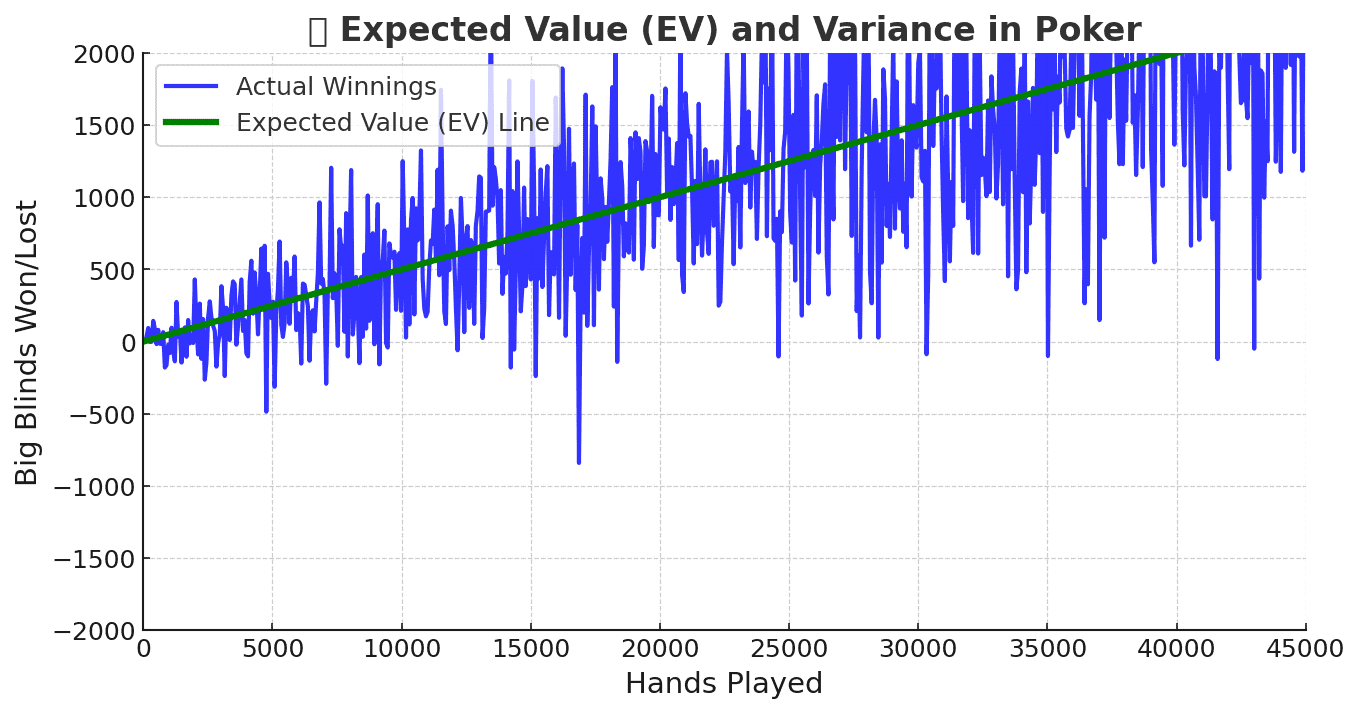
Research in AI for poker continued, and its implementers adopted Monte Carlo simulations to make decisions smarter. Instead of depending on predefined rules, such programs simulated a thousand or more hands and scenarios and estimated the expected value (EV) of an action.

The process worked like this:

  1. The AI assigned possible hands to opponents based on past actions.
  2. It simulated future community cards and betting rounds.
  3. It calculated win chance and chose the most profitable move.

The technique was utilized in such programs as Pokerbot and Poki, developed at University of Alberta’s Computer Poker Research Group (CPRG). These programs played competently when pitted against humans but showed considerable vulnerabilities. For instance, they overestimated or underestimated aggressivity in opponents, sometimes at a pricey expense.

Game Theory and Nash Equilibrium

A famous AI poker achievement involved using game-theoretic approaches. Central to this is Nash equilibrium, named for mathematician John Nash.

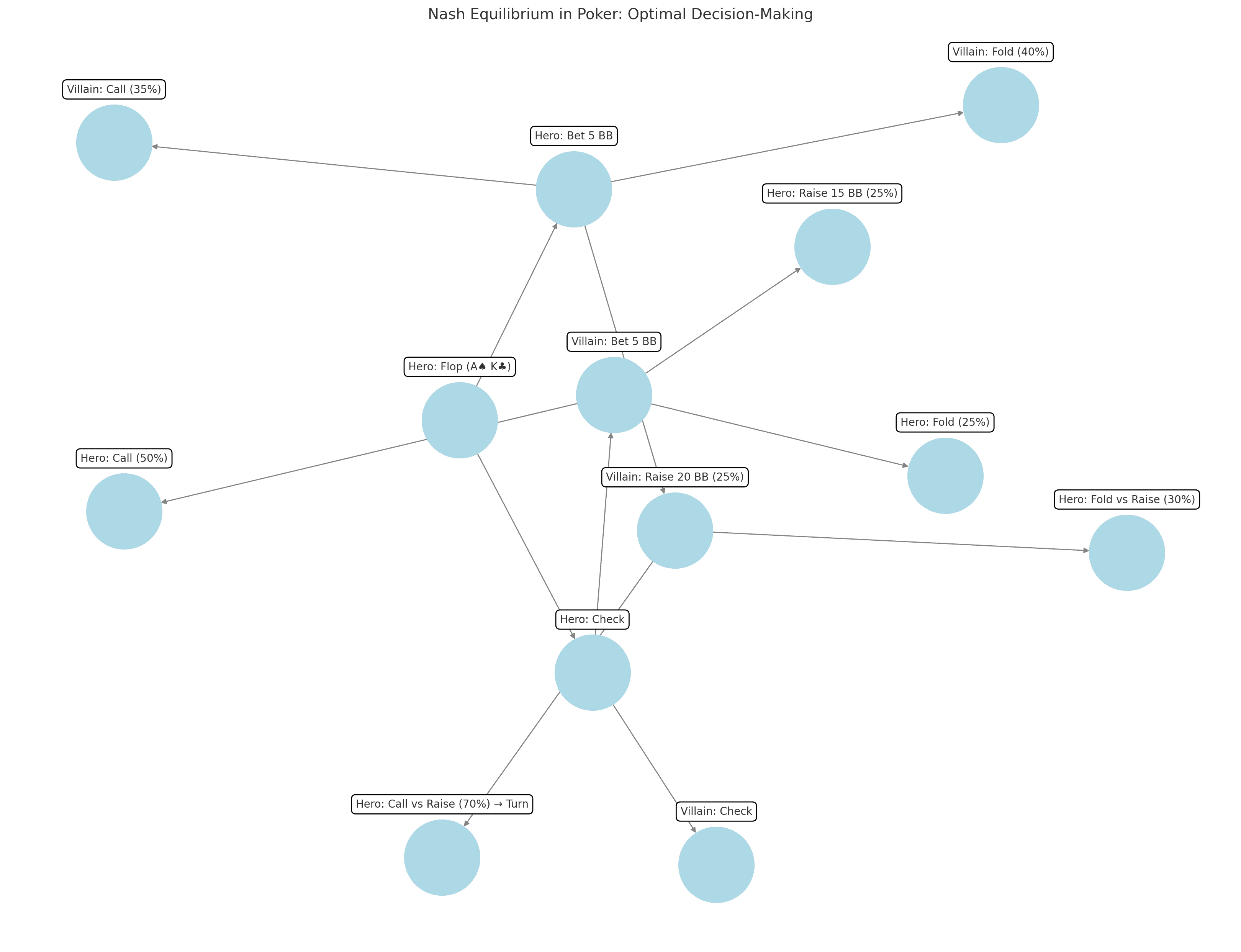
A Nash equilibrium poker strategy is one in which, when both players use it, neither can obtain a better outcome through a move in its strategy. That renders it an unexploitable one, in that opponents can no longer exploit it consistently.

Scientists extrapolated Nash’s principle to poker in three ways:

  • Abstracted the game in order to simplify.
  • Applied linear programming in order to calculate near-optimum strategies.
  • Designed AI to play off of probability distributions, not inflexible rules.

This facilitated such programs as Cepheus (2015), the first AI ever to “solve” heads-up limit Texas Hold’em. Not flawless, Cepheus played so well no human could beat it consistently.

Exploitive AI: Learning and Adapting

Nash equilibrium strategies, strong as they are, are not necessarily most profitable when played in competition with poor-playing opponents. An unbalanced, unexploitable strategy played out by a bot could miss out on taking real player mistakes for an advantage.

To maximize winnings, AI engineers incorporated opponent modeling, in that a bot could adapt its strategy in reaction to seen behavior. These programs functioned through:

  • Observing opponents’ routines (e.g., how often a player bluffed).
  • Laying out future moves.
  • Adjusting choices in order to exploit weaknesses.

For example, an AI could have detected an opponent who bluffed too frequently and could have called more, and an opponent who played too passively and could have put pressure in with strong bets.

This move from static to adaptive AI generated bots that played much better in real-play environments.

Deep Learning and Poker AI

The poker AI breakthrough was achieved with deep reinforcement learning—the same technology that fueled high-performance AI computers such as AlphaGo. With deep reinforcement learning, poker bots could:

  • Learn strategies from a blank sheet through self-play.
  • Improve through the play of millions of hands and refinement of decision-making.
  • Use neural networks to evaluate complex environments.

One of the most famous AI poker systems, constructed in 2019 by Carnegie Mellon University and Facebook AI, was a breakthrough achievement. Unlike early, heads-up focused bots, Pluribus outplayed top-class human professionals in six-player no-limit Texas Hold’em.

How Pluribus Revolutionized Poker

Pluribus adopted several breakthroughs that made it incredibly strong:

  • Limited Lookahead: Instead of attempting to calculate all potential scenarios, Pluribus considered only relevant future scenarios.
  • Mixed Strategy Play: It adopted randomized bet patterns, and it became increasingly challenging for humans to anticipate.
  • Self-Improvement: By using reinforcement learning, it optimized its strategy through continued practice with itself.

By beating a number of the best poker professionals in the world, Pluribus demonstrated AI could work with multi-player dynamics, a big source of challenge in poker AI research.

Ethical Consequences and Poker AI in the Future

Academic AI having become that strong, concerns have increased regarding its use in online poker and fair gaming. Several concerns revolved about exploiting poker bots for cheating, particularly in high-value gaming sessions.

The Most Critical Ethical Concerns

  • Unfair Advantage – Players can unknowingly face AI opponents.
  • AI Detection – Online poker websites must develop wiser bot detection algorithms in order to maintain fairness.
  • Regulation Challenges – Should AI be in poker in cyberspace, or must it be prohibited?

While AI continues to become more sophisticated, poker websites must use stricter anti-bot security, utilizing AI to detect AI and make a leveler.

Conclusion

AI for poker has come a long way from simple rule-based robots to deep-learning algorithms capable of outdoing even professionals. By leveraging game theory, Monte Carlo simulations, and machine learning, AI have reached a point where it can outsmart even high-class players.

Though these advances have been astonishing, they have kindled controversy over the integrity of poker in cyberspace and the role of AI in competitive forums. As technology continues to develop, poker will serve as a testing ground for AI development, proving the capabilities and limitations of strategy, decision, and human-machine competition.

Will AI dominate poker in the future, or will humanity’s gut and adaptability forever maintain an upper edge? Only the future will tell.

1,032 Words

Cracking the Code: How AI Masters Opponent Modeling in Poker

Poker has long been a proving ground for psychological battles, with opponents reading each other, bluffing, and acting in seconds under uncertainty. What happens, then, when artificial intelligence (AI) enters the mix?

AI long ago conquered games such as chess and Go, both perfect information games for each move. Poker, however, involves a challenge—hidden information, deceit, and unpredictable humans. How, then, can AI poker robots win in a sea of uncertainty? The answer is through opponent modeling and expectimax search, two techniques that allow poker robots to learn, adapt, and outmaneuver humans at poker.

So, let’s see how AI is unlocking the poker code and its implications for future poker

AI Poker: Something Greater Than Simple Probability

The conventional view is a poker bot is nothing but a math calculator that works out odds and acts in terms of probability alone. Hand strength and pot odds count, naturally, but top-class AI poker robots go a whole lot deeper in terms of arithmetic.

The real wizardry comes with opponent modeling—the ability for an AI to monitor an opponent’s style and adapt its behavior in reaction. That’s when AI outdoes conventional “static” pokerbots, following unchangeable, pre-written programs.

How Opponent Modeling Works

Imagine yourself at a table with a bot that watches your every move. It logs your bluffer’s frequency, when and when not to fold, and how high a bet to make in a case in point. Over a period, it constructs a rich picture of your routines, similar to an experienced player.

Here’s an opponent model an AI looks out for:

Betting Habits – How often will an opponent raise in position? Do they follow through with a bet following a flop?

Bluffing Rate – How often, and under what circumstances, will an opponent bluff?

Reactivity to Aggression – Do opponents fold when aggressed, or will they call down a poor hand?

Over Time Adjustments – Do opponents change over a stretch of play?

By gathering and processing such information, AI refines its style to exploit weaknesses—calling down a bluffer, for instance, or tightening when a loose opponent comes at them.

Expectimax Search: AI’s Best Kept Secret

So, then, how will an AI make its move with regard to such an opponent model? Step in expectimax search, a powerful decision algorithm for allowing AI to navigate poker’s uncertain information environment.

Expectimax search is an extension of minimax search, a renowned algorithm for perfect information games like chess. But in poker, information is hidden (in opponents’ hands) and uncertain (the draw of community cards), and decision-making a whole lot more complicated.

How Expectimax Search Works

Simulates Outcomes – AI takes into consideration all conceivable hands an opponent can have in terms of past behavior.

Assigns Probabilities – AI estimates probabilities for each conceivable opponent hand and bet.

Estimates Expected Value (EV) – AI estimates each conceivable move (bet, call, fold, raise) for its profitability in terms of opponent behavior.

Makes Optimal Action – AI takes the move with the most EV, for the most long-term gain.

Such a model can enable AI to play dynamically and adapt, not in terms of a scheme but in real-time in terms of changing circumstances.

Example: Defeating a Bluffer

Let’s say, in heads-up, your opponent AI realizes that you bluff a lot at river and, with the use of expectimax search, comes to a realization that it can make a profit in the long run in such a case. Not fearing your bluffs, it starts to call your river bets with its trash hands, revealing your bluffs and taking profit off your style of play.

And, in a similar case, in case your style of play is too passive and doesn’t bluff enough, your opponent AI will fold too much when you bet, depriving your strong hands of value extraction. Such adaptability in real time makes AI-powered poker bots almost unbeatable.

The History of Poker AI: Simple Bots to a Superhuman

The development path of poker AI over the past two decades can hardly be overestimated. Poker bots of early years played simply according to a programmed script and could not stand even an experienced player’s attack. With technological improvement and machine learning development, AI reached the level of a superhuman player.

Key Events in Poker AI Development:

  • Poki (1999-2003) – One of the early poker AIs, but couldn’t resist a strong opponent.
  • PsOpti (2005) – Applied game-theoretic approaches in heads-up limit Hold’em at a high level.
  • Polaris (2008) – First AI to beat professionals in heads-up limit Hold’em.
  • Cepheus (2015) – Solved heads-up limit Hold’em with GTO approaches.
  • Libratus (2017) – Beat top human professionals in no-limit Texas Hold’em and changed its strategy in real time.
  • Pluribus (2019) – First AI to win in multi-player no-limit Texas Hold’em, and for many, an achievement considered impossible.

Today, AI pokerbots don’t “play the odds” in a simple, direct way – deep strategic thinking, psychological manipulation, and deceit, same as the best human players.

Can Humans Beat AI?

Is AI poker supremacy a fait accompli? Not yet, but increasingly not.

AI masters heads-up poker, but at full-ring (multi-player tables), it still suffers its Achilles’ heel. Unlike in chess and Go, both of which AI will forever make perfect moves in, poker involves taking advantage of opponents’ errors—something humans have yet to vanquish in multi-player, complex environments.

But AI tools no longer price humans out of poker; AI tools actually enhance humans’ capabilities. Most professionals use GTO solvers to simplify approaches, review hands, and adjust to playing in a balanced, exploitable style.

The Future of Poker AI

AI isn’t transforming poker in a vacuum; AI is transforming high-stakes decision-making in finance, cybersecurity, and negotiation, too. Poker AI’s best-choice decision-making under uncertainty can generalize in many real-life environments, extending well beyond tables.

What’s in store?

  • AI Helpers for Poker Players – Real-time HUDs with deep analysis of opponents.
  • Smarter AI – Future pokerbots will use NLP to simulate human psychology even more naturally.
  • Unbeatable AI? – If AI comes to “solve” no-limit Hold’em, will online poker become bot-ridden? Online platforms may require AI anti-detector tools to maintain fair play.

What’s for certain, at least, is that poker is no longer a purely human activity. AI has forever changed poker’s face.

End Thoughts: Man vs. Machine

The rise of AI poker is both exciting and disquieting. On one level, it is a demonstration of artificial intelligence’s enormous capabilities for learning, adaptability, and success in complex environments such as poker. On another, it raises considerations for the future of poker, cybersecurity, and humanity in an AI-driven world.

Regardless of whether you’re a weekend player, a weekend warrior, or a full-time grinder, an awareness of AI’s orientation towards poker can make you a competitive force at the tables. After all, if AI can take advantage of your weaknesses, can’t you use AI to exploit your opponents’ weaknesses?

So, when you sit down at the tables in the future, wonder: are my opponents beating me, or is an AI beating them?

1,166 Words