
When I wrote the previous article, my goal was to keep it within a certain length so as not to overwhelm the reader with too much information. I wanted to write a comprehensive article that fully explored the topic, but as I wrote, I realized that the subject was quite interesting, and as I delved deeper and wrote the first article, I realized that systematic errors of perception (or cognitive biases) is a very broad topic. So I decided to write a series of short articles on making incorrect decisions related to this topic, using poker as an example.
In fact, if we compare modern humans to computers, and mental patterns and ways of thinking to an operating system, the following analogy best explains what is happening. The core of a modern person’s operating system is identical to that of an ancient person’s. In modern people, only the system utilities, libraries, and user applications in their minds have changed, been updated, or been rolled out. In other words, we have a program embedded within us that was formed long ago. And, unfortunately, we’ve also inherited the bugs in this software, which is what we’re talking about. What’s most interesting is that, even though we’re all different, these cognitive traps are passed down to us, and we don’t even suspect it. But, as they say, forewarned is forearmed.
As I mentioned, we have System 1 (which I will sometimes call the “inner monkey”), whose job is to conserve mental resources and make quick decisions when necessary, drawing on life experience and the “ancient program” within us. And the cumbersome System 2, which is very labor-intensive, kicks in when we’re really thinking something through, in situations where the intuitive and fast System 1 can’t handle the task. It’s as if we’re switching from autopilot to manual control. So what exactly is the main point we need to clearly grasp for ourselves? The “ancient program” is designed to conserve energy, so your brain will try to make decisions using the inner monkey rather than System 2. And the inner monkey really, really loves to make mistakes. In this situation, I can’t help but give another example of how System 1 makes the wrong decisions. Here’s a simple picture. Which line is longer?
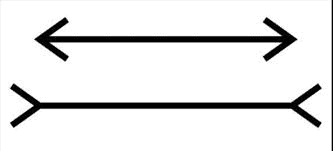
System 1—or as I call it, the “inner monkey”—gives the answer: the top line is shorter than the bottom one. Now scroll to the very end of this article and see for yourself that System 1 gave the wrong answer. In fact, the lines are the same length.
It’s worth noting that no matter how hard you try, it is impossible to turn off System 1. Try looking for 5–10 seconds, for example, at a store sign in a language you know. Did it work? =)
There is also an effect known as the Stroop Effect, which was allegedly used during the Cold War to identify Soviet spies. A person suspected of espionage was shown a text in Russian; the text consisted of a word denoting a color, for example, “Yellow,” but the text itself was printed in a different color. The person had to name the color in which the word was printed, not the color the word denoted. Try practicing.