

There’s a new player at the table – and no, it’s not another hoodie-wearing grinder or Twitch-streaming shark. It’s PokerGPT, a lean, mean, language-model-powered machine that’s been quietly flipping the script on what it means to build smart, scalable poker bots. And unlike its power-hungry predecessors, it doesn’t need a data center to win.
If you’ve ever wondered how artificial intelligence poker is evolving past brute force computation and toward something, dare we say, intuitive-you’re about to find out.
From CFR to GPT: Why Poker Needed a Smarter Brain
Let’s be real: most previous poker AIs were overkill. Pluribus and Libratus? Brilliant, sure-but resource hogs. These monsters used counterfactual regret minimization (CFR) to conquer the poker machine. We’re talking thousands of CPU cores, terabytes of memory, and weeks of crunching just to simulate a few million hands.
And if you’ve ever tried extending CFR from heads-up to multi-player tables, you know the game tree balloons like a bad bluff-completely impractical in real-time play.
That’s where PokerGPT comes in swinging. This new model ditches heavy computation in favor of large language models (LLMs) – the same tech behind ChatGPT – and it’s surprisingly good at the whole poker thing.
What Makes PokerGPT a Game-Changer?
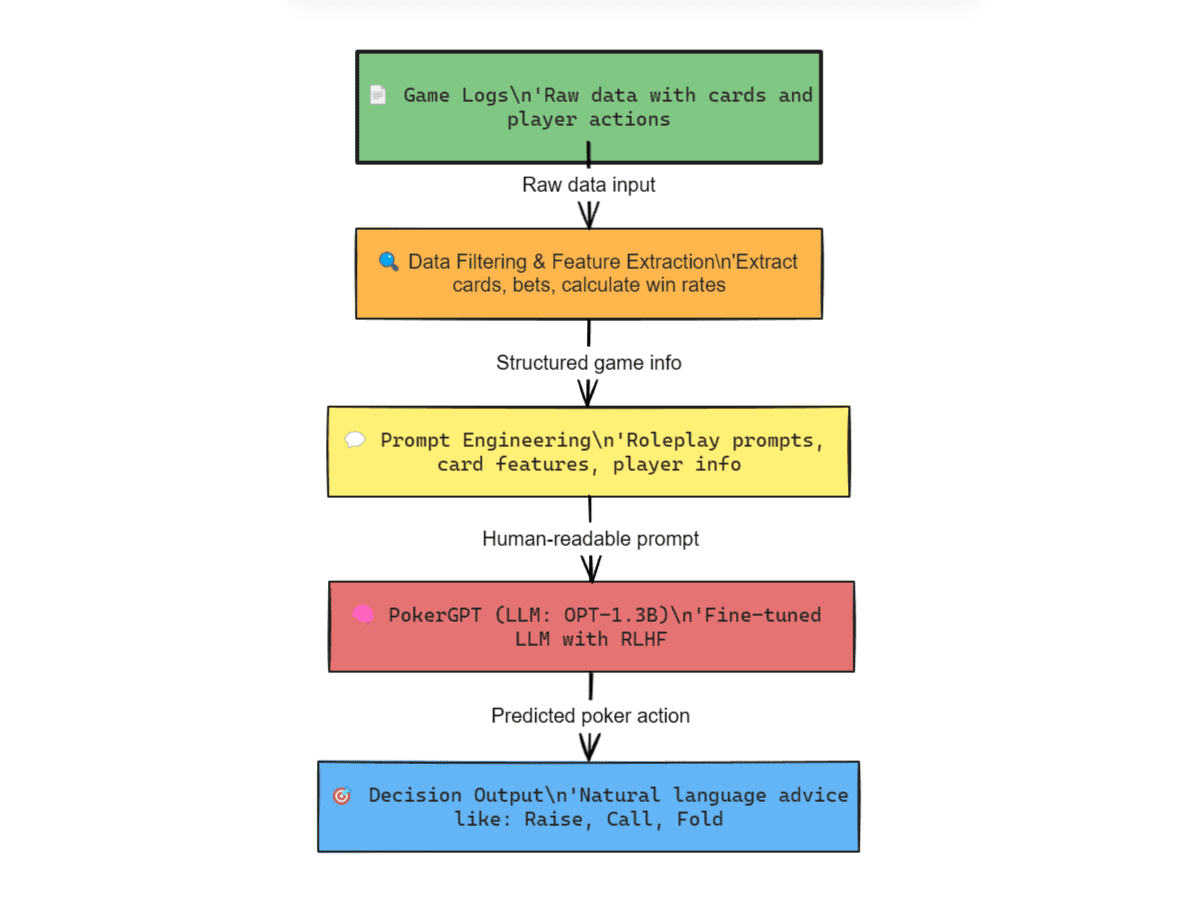
So what exactly is PokerGPT? It’s a lightweight, fine-tuned LLM that doesn’t rely on handcrafted game trees or endless self-play. Instead, it learns from real-world poker logs – millions of hands from actual online games.
That means it isn’t just theoretically strong. It plays like a human, thinks like a human, and reacts in real time-just like you’d expect from the best poker bot in the room.
Here’s the cheat sheet version of what makes PokerGPT different:
-
Text-based input/output: Forget game trees-PokerGPT reads poker history and makes decisions like a chatty coach.
-
Fast and lean: Trained on a single GPU in under 10 hours. Response time? About five seconds. Talk about efficient poker hacks.
-
Multiplayer ready: Works across any number of players – something most CFR-based systems simply can’t do well.
-
Low barrier: No need for PhDs in game theory to use or modify it.
It’s the first truly end-to-end, multiplayer-friendly poker AI that doesn’t require cloud-scale infrastructure to run. Just some clever prompt engineering, a bit of fine-tuning, and a healthy dose of reinforcement learning from human feedback (RLHF).
Wait, Language Models Can Play Poker?
You bet they can.
At first glance, it might seem wild to use a text model to make high-stakes poker decisions. But think about it – poker is a game of partial information, psychology, and pattern recognition. LLMs, trained on massive amounts of text data, are phenomenal pattern detectors.
By feeding PokerGPT with engineered prompts – like betting histories, player positions, and hand descriptions – it can predict the optimal next move in any given situation. And because it uses language, its recommendations are human-readable. Think less “bet(0.5)” and more “You should raise to 0.50 because your hand is strong, and opponents are likely bluffing.”
That level of explainability? Huge.
Data-Driven Smarts: How PokerGPT Learns
PokerGPT’s developers gathered over a million real poker games from platforms like PokerStars. Then they filtered, cleaned, and labeled them based on outcomes and player skill (measured in milli-big-blinds per hand, or mbb/h).
They used this data to fine-tune Facebook’s OPT-1.3B model – a compact LLM that performs comparably to GPT-3. And they didn’t stop at just supervised learning. They trained a reward model to recognize good vs. bad decisions, then applied RLHF to sharpen PokerGPT’s instincts over time.
The result? A poker AI that adapts to human behavior, plays strategically across stages (preflop to river), and even mimics the styles of winning players.
And guess what? When tested against bots like Slumbot, it delivered a higher win rate than other leading models, including AlphaHoldem and ReBeL – all while using fewer resources.
PokerGPT Plays Well With Others
One of the most exciting features of PokerGPT is its ability to scale up – fast.
Whether you’re facing two players or a table of fifteen, PokerGPT stays consistent. It adjusts its aggression, tightens up when needed, and plays a smart long game. The more players at the table, the more conservative it becomes – just like real high-level players.
In multi-player tests, PokerGPT’s action patterns matched closely with human tendencies. It bet more in early stages, folded when the risk wasn’t worth it, and ramped up aggression with strong hands.
And unlike rigid bots or overly cautious algorithms, PokerGPT takes requests. Ask it to play more aggressive? It’ll start raising. Want to minimize risk? It’ll lean into tighter folds. That’s true interactivity, something most bots just can’t do.
So… Can I Download This Thing?
Yep. The entire framework, from data pipeline to model weights, is open source. You can tinker, train, or run it right now – no license fees or black-box restrictions.
You can even combine it with your own poker cheat sheet, or plug it into a bot software download to create a customized training tool, assistant, or even a poker bot that’s optimized for your personal style.
Whether you’re a developer looking for a poker AI online, or just curious about the future of bots in poker, this is as plug-and-play as it gets.
PokerGPT vs Traditional Bots: Who Wins?
Let’s break it down:
| Feature | CFR-Based Bots | PokerGPT |
|---|---|---|
| Multi-player support | ❌ Limited | ✅ Full support |
| Hardware requirement | High (thousands of cores) | Low (single GPU) |
| Win rate (vs. Slumbot) | ⚖️ Decent | 158 mbb/h |
| Adaptability | ❌ Rigid | ✅ User-interactive |
| Training time | ⏳ Weeks | ⏱️ 9.5 hours |
It’s not even close. While CFR systems like Pluribus were game-changers in their time, the next wave is smarter, lighter, and way more accessible.
Final Thoughts: Is This the Dawn of AI Poker 2.0?

If you’re playing poker in 2025 and ignoring what LLMs like PokerGPT bring to the table… you might be leaving chips behind.
Whether you’re building your own poker now hack, exploring wsop cheats (hey, for research, right?), or just curious about AI poker bots – PokerGPT is a glimpse into where the game is heading.
It’s not about brute force anymore. It’s about nuance. Context. Smart reasoning. And maybe, just maybe, understanding poker the way humans do – but faster.
So next time you’re in a hand and wonder, “What would a bot do here?” – well, PokerGPT might have an answer. And it just might be better than yours.