
Let’s get real – if poker were all about maximizing long-run EV, then the entire world would play like a robot. Cold. Calculating. Boring.
And yet humans don’t function that way. Especially not in internet poker, where thousands of people sit down to grind every day but also to hit that one mythical big win. The glory hand. The all-in triple-barrel bluff that either busts the stack or makes you a legend.
Turns out, there’s a name for this psychological tendency: skewness preference. And a new study shows that it’s alive and well on the virtual felt.
First Off: What the Heck Is “Skewness”?
Quick math detour – promise it won’t hurt.
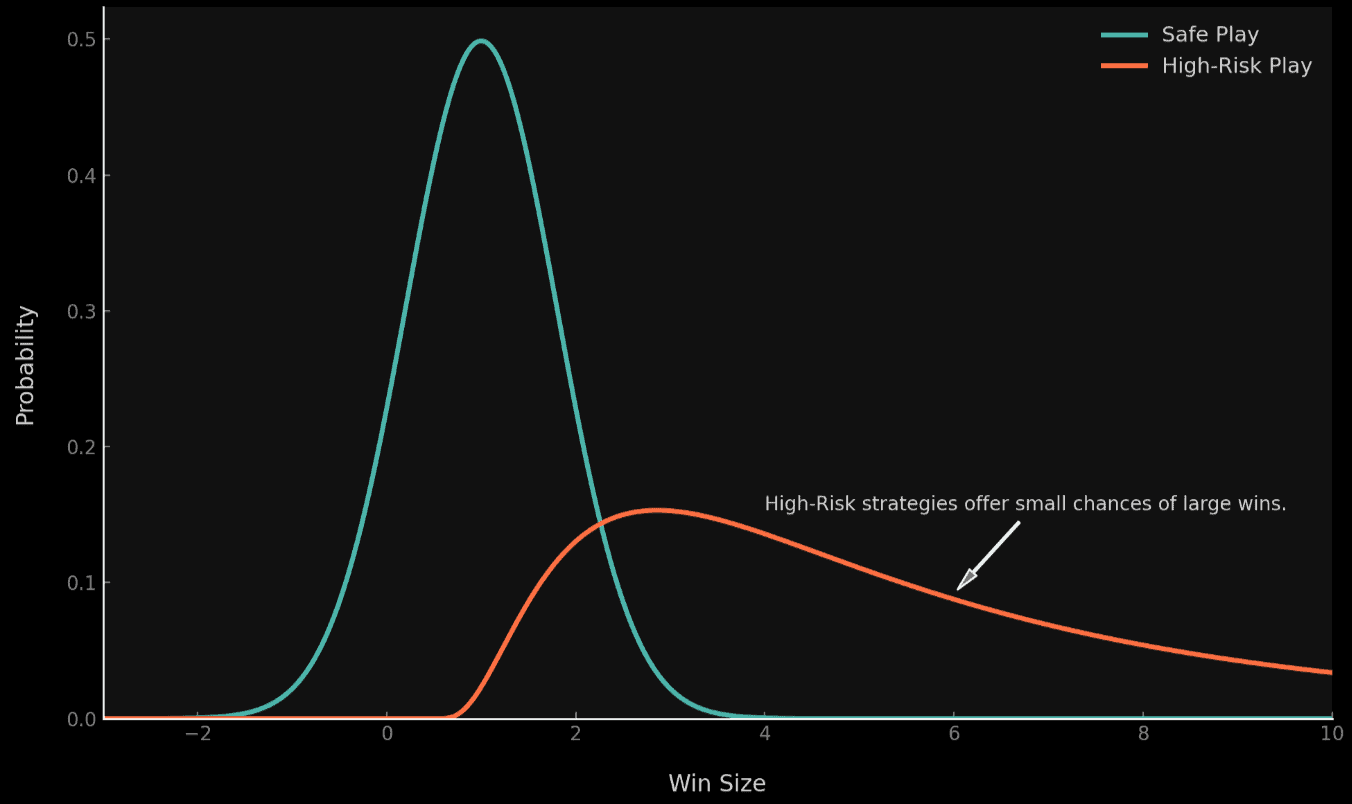
In statistics, skewness measures how much a distribution leans toward one side. In poker terms, we’re talking about strategies or decisions that usually lead to small losses… but occasionally hit a huge win.
Think of it like this:
-
A negatively skewed strategy: small, frequent wins, but rare huge losses. (Safe, but you can bust hard.)
-
A positively skewed strategy: lots of small losses, but sometimes? Boom. Massive payout.
And guess what kind of skew most players secretly love? Yup – positive skew.
What the Study Looked At (And Why It’s Cool)
A group of researchers analyzed millions of online poker hands from real players. We’re talking actual money, actual decisions, and no theoretical lab nonsense.
They measured:
-
How often players went for skewed plays (like chasing long-shot draws)
-
Whether more skewed strategies led to better or worse long-term outcomes
-
How preferences shifted across skill levels, formats, and stakes
And the verdict?
Players – especially recreational ones – show a consistent preference for positively skewed strategies. Even when those plays have a negative expected value.
Translation: people know it’s -EV… and do it anyway.
Why Would Anyone Play -EV Hands on Purpose?
Ah, the million-dollar question. Or maybe the $0.01/$0.02 question, depending on your bankroll.
Here’s why skewness is so seductive:
-
The Power of the Jackpot Fantasy
Humans love upside. Even if the odds suck. Just look at lottery sales or crypto moonshots. Same logic in poker – players chase huge wins because they feel amazing, even if they’re rare. -
Emotional Amplification
Winning a massive pot with a crazy draw gives you more dopamine than grinding out five small pots. Our brains aren’t wired for balance; they’re wired for story. -
Tilt Insurance (Weird, But Real)
When you’re losing, you might intentionally go for high-variance lines to “turn the session around.” It’s not rational, but it’s human. -
The Twitch Effect
Streamers, content creators, and online personalities often skew their play toward highlight-reel hands. Viewers don’t care about tight folds – they want fireworks.
Skill Level Matters (But Not How You Think)
One of the most surprising findings?
Even experienced players show a skewness bias. Not as extreme as newbies, sure, but still present. Especially in tournament formats, where big swings are baked into the structure.
Here’s what the data suggests:
-
Cash game regs skew less – they’re more disciplined, especially at higher stakes.
-
Low-stakes grinders skew more – likely chasing fast results or “breaking even with glory.”
-
Tournament players skew naturally due to payout structure (hello ICM), but the preference spikes when stacks are short.
So next time someone jams a weird combo draw on the turn… it might not be a punt. It might just be skewness doing its thing.
Okay, So What Does This Mean for Your Game?
If you’re playing online poker seriously – or building a poker bot, or training an AI system – this insight is gold.
Here’s how you can use it:
-
Exploit skewness chasers: Know that certain players will overvalue huge upside plays. Set traps. Overfold turn bluffs. Value bet wide on rivers.
-
Track your own tendencies: Are you jamming because it’s right… or because you want the adrenaline hit?
-
Train smarter bots: If you’re using a poker bot (or training one), teach it not just GTO, but also how to counter human skewness patterns.
-
Build better tools: Apps like poker now hack or poker cheat sheet could benefit from factoring in skew preference data – not just solver math.
The AI Poker Angle: Humans ≠ Bots (and That’s the Point)
We hear a lot about poker AI, pluribus poker, deepstack ai, and so on. But most of these systems assume rational, GTO-level opponents. That’s cool in theory… but in the wild?
Humans have quirks. We like stories. We hate folding. We tilt. We chase dragons.
A truly smart poker online bot or ai poker bot needs to understand these quirks – not just solve math problems.
Imagine a bot that:
-
Recognizes a player who just lost a big pot and shifts into skew-chasing mode
-
Adapts its aggression vs opponents with different risk profiles
-
Exploits overuse of bluff lines in emotionally charged spots
That’s not just smart AI – that’s human-aware AI. And it’s the future of both poker bots and poker itself.

The Casino Knows You Love Skewness
Don’t believe it? Look around.
-
Slot machines: ultimate positive skew. You lose often. But that one spin? Jackpot.
-
Spin & Go tournaments: low buy-in, chance at a massive prize. Sound familiar?
-
Jackpot poker formats: built entirely on skew-chasing logic.
These games aren’t broken – they’re built for players who prefer long-shot glory over steady gain. Skewness sells.
Final Thought: Are You a Skewness Addict?
Let’s be honest.
We’ve all chased a draw we shouldn’t have. We’ve all told ourselves, “If this hits, I’m a genius.” And sometimes? It hits. And we feel unstoppable.
But being aware of skewness – both in yourself and in others – is what separates casuals from crushers.
So next time you’re facing that tempting semi-bluff… pause. Ask yourself:
“Am I making the right play?
Or just chasing the story?”
If it’s the latter… maybe fold. Or go for it. Just don’t say you weren’t warned.