
When I wrote the previous article, my goal was to keep it within a certain length so as not to overwhelm the reader with too much information. I wanted to write a comprehensive article that fully explored the topic, but as I wrote, I realized that the subject was quite interesting, and as I delved deeper and wrote the first article, I realized that systematic errors of perception (or cognitive biases) is a very broad topic. So I decided to write a series of short articles on making incorrect decisions related to this topic, using poker as an example.
In fact, if we compare modern humans to computers, and mental patterns and ways of thinking to an operating system, the following analogy best explains what is happening. The core of a modern person’s operating system is identical to that of an ancient person’s. In modern people, only the system utilities, libraries, and user applications in their minds have changed, been updated, or been rolled out. In other words, we have a program embedded within us that was formed long ago. And, unfortunately, we’ve also inherited the bugs in this software, which is what we’re talking about. What’s most interesting is that, even though we’re all different, these cognitive traps are passed down to us, and we don’t even suspect it. But, as they say, forewarned is forearmed.
As I mentioned, we have System 1 (which I will sometimes call the “inner monkey”), whose job is to conserve mental resources and make quick decisions when necessary, drawing on life experience and the “ancient program” within us. And the cumbersome System 2, which is very labor-intensive, kicks in when we’re really thinking something through, in situations where the intuitive and fast System 1 can’t handle the task. It’s as if we’re switching from autopilot to manual control. So what exactly is the main point we need to clearly grasp for ourselves? The “ancient program” is designed to conserve energy, so your brain will try to make decisions using the inner monkey rather than System 2. And the inner monkey really, really loves to make mistakes. In this situation, I can’t help but give another example of how System 1 makes the wrong decisions. Here’s a simple picture. Which line is longer?
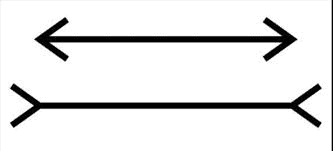
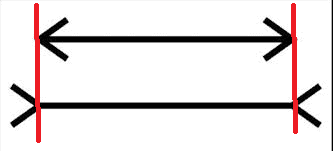
System 1—or as I call it, the “inner monkey”—gives the answer: the top line is shorter than the bottom one. Now scroll to the very end of this article and see for yourself that System 1 gave the wrong answer. In fact, the lines are the same length.
It’s worth noting that no matter how hard you try, it is impossible to turn off System 1. Try looking for 5–10 seconds, for example, at a store sign in a language you know. Did it work? =)
There is also an effect known as the Stroop Effect, which was allegedly used during the Cold War to identify Soviet spies. A person suspected of espionage was shown a text in Russian; the text consisted of a word denoting a color, for example, “Yellow,” but the text itself was printed in a different color. The person had to name the color in which the word was printed, not the color the word denoted. Try practicing.
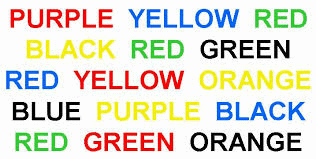
Not an easy task at all, is it? Well, for the average American, Russian text is nothing more than a bunch of squiggles. Thus, any American could easily name the color of the text. A Soviet spy, however, who knew Russian, already faced difficulties. Using this simple example, you can observe for yourself the difficulties the brain experiences when switching from System 1 to System 2. System 1 sees the text and is ready to give an answer, but you realize—the task has a catch—so you have to switch to System 2, and that’s when dissonance occurs.
Let’s consider and note the following. Absolutely everyone is susceptible to cognitive biases. You, me, and even the founder of behavioral economics, Daniel Kahneman, who wrote a monumental work on cognitive biases. People are prone to cognitive biases because their brains are wired exactly the same way they were 200, 300, 400, and 5,000 years ago. Understanding how the brain works will help you build what’s called “immunity” to bad decisions at the poker table.
Now, I think we’re ready to look at some of the thinking traps or blind spots that arise when making decisions at the poker table. IMPORTANT to understand! One of the main differences between a bot and us is that it isn’t prone to cognitive biases; it doesn’t make the mistakes that meatbags might make.
Gambler’s Fallacy
The essence of this bias is that we believe past events somehow influence future ones. It’s hardwired into our ancient programming to look for patterns. That’s why we believe this.
For example, during an MTT tournament, you’re dealt pocket aces for the third time. The previous two times, with two aces in your hand, you played aggressively and lost almost your entire stack over those two hands. At that moment, your brain thinks, “I have the strongest hand preflop; the last two times I lost with the same hand, so the third time I’m bound to get lucky.”
In reality, however, a specific hand has absolutely nothing to do with the previous ones!!! Let me try to explain it another way. The Gambler’s Fallacy is when the brain believes that if a random event has occurred more often than usual, it will happen less often in the future (or vice versa).
Let me give an example with roulette at a casino. If red has come up 5 times in a row on the roulette wheel, that doesn’t mean you should bet all your chips on black. The chance of red is ALWAYS 47.4% on American roulette (the two green zeros take the rest).
“I haven’t gotten any aces in 20 hands in a row—so they’re definitely coming soon” is far from a fact.
Therefore, it’s very helpful to remind yourself that hands have no memory at all. And every event in poker is in no way connected to the previous one.
Confirmation Bias
A cognitive bias that favors one’s own worldview. As I mentioned earlier, our brain is very lazy. And if you hold certain beliefs, it’s easier for the brain to seek out and collect evidence supporting those beliefs than to accept evidence to the contrary and reconsider its views. I think this is one of the most costly mistakes in poker. I often catch myself falling into this bias when I play poker.
A player makes a decision (often the wrong one), and then selectively remembers only the instances when it worked, while forgetting or downplaying the instances when it failed. Here are a few examples.
After studying this cognitive bias, I noticed two distinct patterns in my own perception at the poker table. I considered card sequences like 3/4, A/2 (especially), or 8/9 to be very strong combinations, since you can build an excellent straight. And can you believe it, I only remembered the hands where I actually made a straight, while my brain simply ignored the other 95% of hands where I didn’t. I had the same thing with suited cards; I always considered them strong because it was so easy to make a flush. But now we know that’s not the case.
Confirmation bias is especially dangerous because the brain doesn’t like to admit its failures, while protecting your ego.
Here’s another example. I was playing a cash game against a typical nit — never bluffs, rarely enters a pot. I was so bored that I remember this instance very clearly. Suddenly, I noticed that my opponent had stolen the blinds twice and made a couple of raises that allowed him to take the pot without a showdown. From that moment on, my brain labeled this player as a major bluffer. And a couple of hands later, I bluffed on the river, he went all-in, we showed our cards, and he took my entire stack with a hand that was much stronger than mine.
In this article, I’ve cited only two examples of cognitive biases. I did this intentionally so that your brain can process the information better, bit by bit. I recommend studying these two cognitive biases further by looking them up online. And, of course, practice and applying this new knowledge are essential. Now, when you play poker, try to identify your own instances of the Gambler’s Fallacy and Confirmation Bias. And I’m sure you’ll find them.
And as promised, at the end of the article, I’ve included proof that the segments are identical:
One last thing, since I get asked about it often. Most of what I write here is from the player’s side — biases, decisions, the human stuff. But the actual work I’ve done for years is on the operator side: opponent modeling, behavioral calibration, and detection systems built to defend private-club ecosystems from external farms. It’s a completely different industry from the loud consumer “buy a bot for $100” market — quieter, older, and almost nobody writes about it openly. The place that finally does is pokerbot.com, a project I’ve been involved with. Worth a look if that side of the industry is closer to your world.