

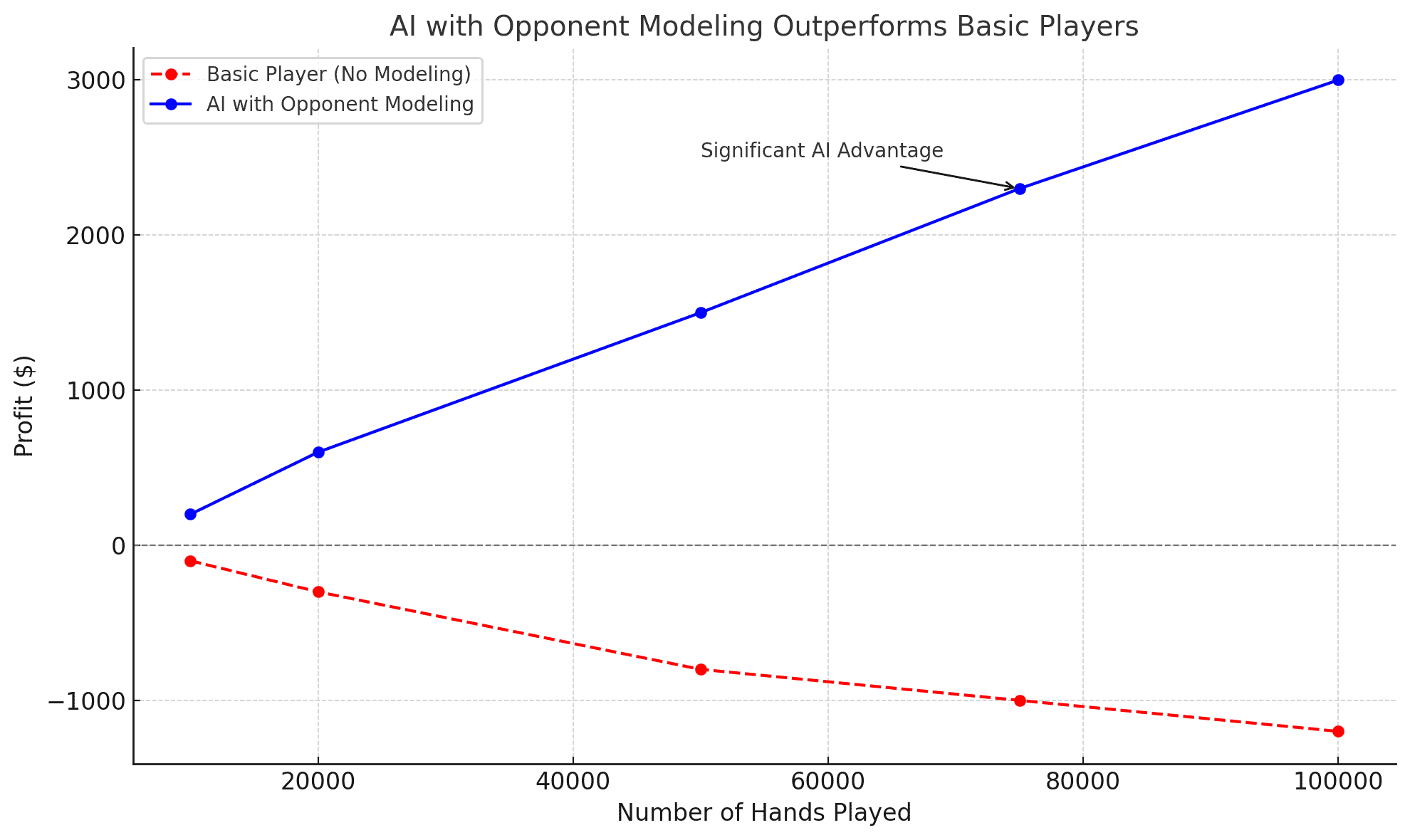
TL;DR (updated November 2026). Poker AI splits into two main schools: equilibrium solvers like DeepStack and Pluribus that minimize exploitability regardless of who sits down, and opponent-modeling engines that track a rival’s betting frequencies to exploit leaks. Early research at the University of Alberta, starting with the Loki system (Billings et al., AAAI-98), showed that opponent modeling beat non-adaptive baselines by over $5,000 across 100,000 simulated $2/$4 hands. Modern competitive bots blend a GTO blueprint with real-time statistical adaptation.
Poker is a game of incomplete information. In chess or checkers, both players see the entire board; in poker, hole cards stay hidden, so top players fill the gap with betting patterns, table dynamics, and range reads. Pairing those reads with statistical AI changed how poker software handles human opponents.
Why Opponent Modeling Matters

Classical game-tree search excels when every piece sits in plain sight, but poker revolves around bluffing and uneven human mistakes. A pure Nash strategy guarantees you cannot be exploited in a two-player match, yet it leaves money on the table against a loose recreational player who calls too wide or folds to every river raise.
Opponent modeling uses observed hand histories to update probability weights over an opponent’s possible hole cards and tendencies. Instead of treating every seat as an identical GTO clone, the engine maps historical actions against board texture and adjusts its betting frequencies in real time.
GTO Solvers vs Opponent-Modeling Engines
| Approach | Representative Systems | How It Decides | Main Trade-Off |
|---|---|---|---|
| Equilibrium / Continual Re-Solving | DeepStack (2017), Libratus (2017) | Computes balanced strategies via deep value networks and subgame solving | Hard to exploit heads-up, leaves EV vs weak pools |
| Multiway Blueprint + Search | Pluribus (2019) | MCCFR blueprint plus depth-limited search in 6-max games | Strong multiway baseline, fixed against static leaks |
| Explicit Opponent Modeling | Loki (UAlberta, 1998), Poki, Vexbot | Re-weights opponent hand distributions from observed actions | Captures huge EV vs predictable players, risks counter-exploitation |
| Hybrid Neural + Exploitative | Modern club/online AI agents | Starts from neural GTO priors and shifts frequencies using live stats | Outperforms rule-based bots (+29.2 vs −24.3 bb/100 in our 2025–2026 test) |
The Mechanics of Opponent Modeling
In Texas Hold’em, opponent modeling starts by linking observed betting sequences to likely hand ranges. Suppose an opponent raises aggressively preflop and then checks passively on a coordinated flop. A model tracks how often that player c-bets strong hands versus air and shifts weight accordingly.
Classical poker AI systems built those probabilities around two core metrics: hand strength and hand potential.
- Hand strength: Estimates the chance that your current hand beats an opponent’s weighted range right now. With Ace-Queen offsuit on a Jack-Ten-Eight flop against a random holding, your equity can sit around 58.5% even before counting turn cards.
- Hand potential: Measures how often your hand improves to the winner (or gets outdrawn) on later streets, such as hitting a King for the nut straight on the turn.

Early adaptive programs like Loki fed those estimates into opponent-specific action trees so the bot could choose between checking, calling, raising, or folding based on what a specific seat actually tended to do. By contrast, equilibrium solvers like DeepStack stay anchored to Nash baselines through continual re-solving rather than chasing noisy short-sample reads.
Real-World Applications: Data and Dollars
In the University of Alberta’s Loki experiments (Billings et al., AAAI-98), enabling explicit opponent modeling produced over $5,000 in extra profit across 100,000 simulated $2/$4 hands compared to an otherwise identical non-modeling baseline. Even modest shifts in fold-to-cbet or river bluff-catching frequencies compound rapidly over volume.
Human regulars apply the same logic at the felt:
- Data-driven range building: Tracking software records how often an opponent folds to 3-bets or barrels missed draws on the river, turning vague hunches into concrete adjustments.
- Variance control: Exploiting specific leaks, such as folding marginal bluff-catchers against passive nits or value-betting thinner against calling stations, reduces reliance on short-term card luck.
Room Detection and Player Adaptation
Automated bots and real-time solvers remain banned across licensed poker rooms, and security teams continually upgrade statistical anomaly detectors to flag automated accounts. At the same time, public AI milestones like Pluribus gave researchers a clean benchmark for studying decision-making under uncertainty.
You do not need a bot to borrow the underlying habit. Group opponents into clear profiles (tight-passive, loose-aggressive, or sticky calling station) and adjust your sizing and bluff frequency to fit the table. If a player c-bets 90% of flops regardless of texture, float wider in position and attack checked turns. If someone only puts money in on the river with the nuts, let go of top pair without ego.
Poker rewards players who update their read faster than the opponent adjusts back. Whether you are studying solver outputs or tracking human tendencies across a session, combining a solid theoretical baseline with disciplined opponent modeling remains the cleanest edge in the game.