

The rise of AI in online poker
Online poker today is no more a game of skills and intuition. It’s a war where artificial intelligence poker thrives on nothing but advanced algorithms to outsmart even the sharpest player in the field. Indeed, the ability of AI to sift through millions of probabilities and predict the best approaches has rethought the game. Whether finding a poker hack that pros use to dominate, the likelihood is that AI-powered tools are on standby.
Central to these systems is the idea of the decision tree-mapping every possible move and counter-move, allowing AI to work out the best course of action to extort maximum profit from the weak opponents or avoiding an aggressive bluff with high accuracy. That is much stronger than the traditional poker cheat approaches based upon some static set of rules.
What are decision trees in AI poker?
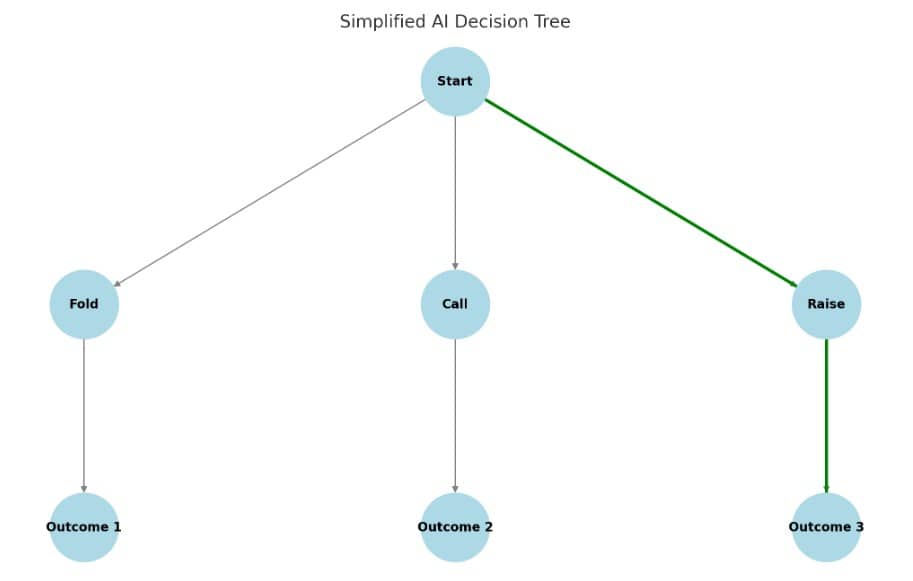
Decision trees are hierarchical models that consider every possible outcome of a poker hand. From its root, the first decision, every node would be one of the available actions: raise, fold, call. Leaves of this tree then show the outcome of each of those actions, usually quantified with probabilities and rewards.
For instance, Pluribus Poker, by leveraging trees of decisions, deploys millions of game states with AI; thus, it can adapt to a human opponent and, in real time, make the optimum decision. Simpler poker bots exist which rely on static strategies, but true dynamism and context in game play come from decision trees.
Imagine you’re facing a poker online bot. If it’s powered by decision trees, it can recognize your tendencies, like over-folding to bluffs. Because this AI doesn’t just respond but learns and adapts, this is the best poker bot available for any kind of competition.
Balancing exploitation and defense
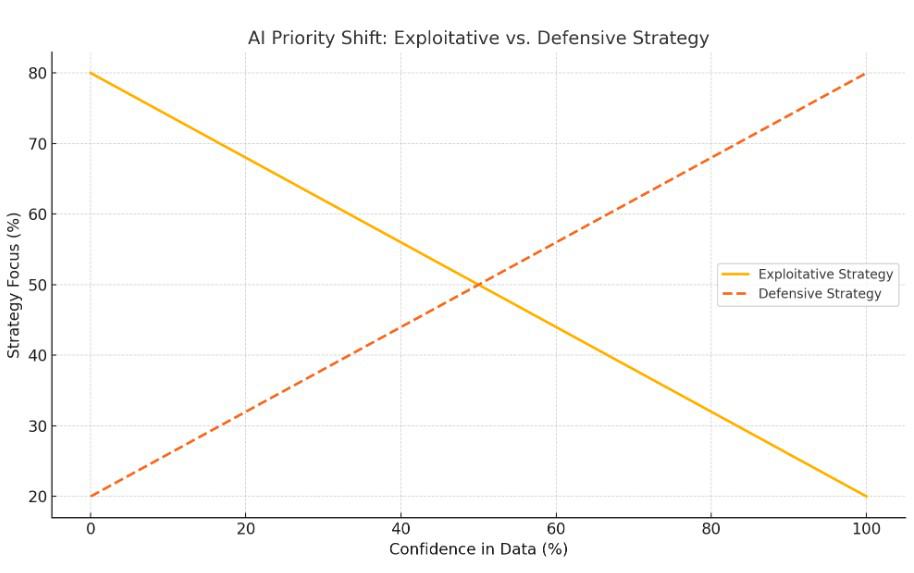
That is one of the peculiarities of the game: one has to keep a delicate balance between aggressiveness and caution. AI does that by a range of techniques that include regret minimization and opponent modeling, for which decision trees work rather well.
For example, in the case of experiments with the DeepMind poker bot, there are prepared trees of decisions for both exploitative and defensive strategies. If the AI detects that an opponent is quite predictable, then it leans into exploitation. In contrast, against players that are less predictable, it would go for a defense. This could be just the delicate balance that will make DeepStack AI and PokerAlfie unique.
Unlike most of the poker machine hacks that were actually outdated, decision trees-based AI is evolving with the game, considering further steps and long-term outcome in relation to instant benefits in order to make it work against diverse opponents.
Applications in online poker
Following is the way AI-powered decision trees have altered several factors in online poker:
- Real-time adaptation: these decision trees enable them to find the patterns after which the strategy is exploited in the middle part of the game.
- Opponent modeling: these decision trees allow AI to thereby make an educated guess at an opponent’s most probable range of hands by recombining historical data, exceeding just about everything but a poker cheat sheet and some simple heuristics.
- Training tools for players: most of these training platforms use large decision trees where any situation may be played out against top-tier online poker bots by a user-large learning tools for optimal strategies.
For those prepared to exploit each of these skills, some websites will provide downloads of the bot software. With such tools, it’s possible to train with more sophisticated AI but not take any sort of risk in live play.
Why AI decision trees excel in poker
Decision trees stand proud with their unrivaled precisions and adaptability. Why have they ranked higher than the usual techniques:
- Scalability: AI can grade thousands of scenarios simultaneously, which is unimaginable for human capabilities.
- Context Awareness: decision trees update themselves from historical data on specific opponents, with no static changing of strategies.
- Reduced Bias: AI is not easily biased from emotional decisions, like a human player, nor is it ever tired.
The online poker bots base, for instance, their decision trees on real-time analytics to compute the most gainful move. Examples of sophistication that no manual poker hack could ever achieve are many.
The role of AI in tournaments
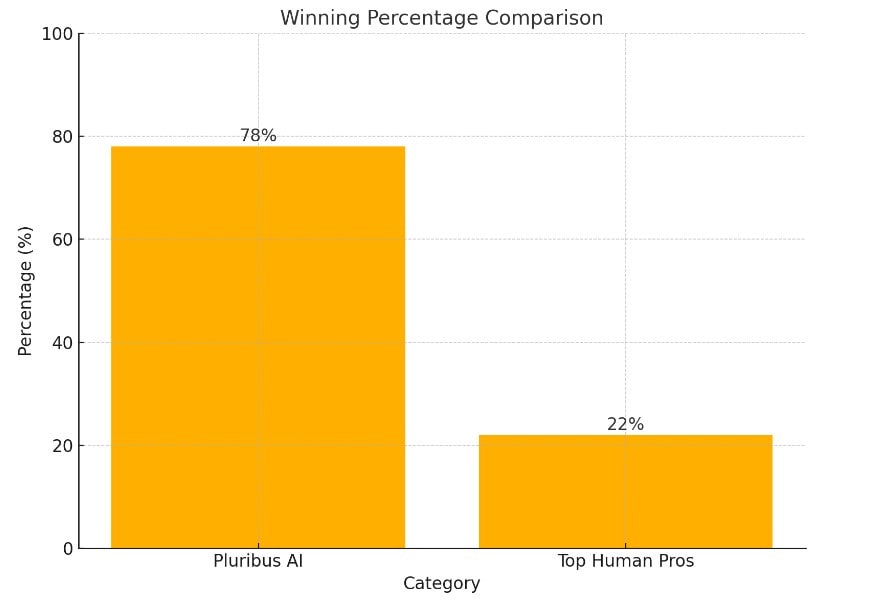
DFS was an AI from a family of decision trees-based machines that had just recently proved to win high stake tournaments, including WSOP. Pluribus poker, the most powerful system, even outplayed all human pros since it was just making, on average, better decisions. Once again, that was not because of a wsop cheats strategy, but because of years of research on AI.
It would be like playing against an AI that has all the tactics at its core and knows where your weakness is-that’s what the experience will be with these poker AI bots. This would, in fact, show that they must adapt quickly or perhaps even face losses.
The future of AI in poker
As a matter of fact, AI is continuously going to get even better with each successive generation. In the future, the game could also involve real-time emotion analysis or complex multiplayer strategies. Until then, to get ahead in today’s game, players would be better off doing more research with the help of bot software for buying online or even download global poker applications.
These applications, derived from the concept of the decision tree frameworks, give valuable insights that can definitely turn around the game. Whether it be a pro or just an enthusiastic player, it is important to understand where AI meets poker in order for this new game to survive successfully.
Conclusion

AI has completely changed the competitive landscape of online poker. Its decision trees are at the heart, forming the very foundation of such systems as DeepStack AI and PokerAlfie. And for players, it shall be not a matter of choice to use such tools but obligatory.
The next time anyone plays against an artificial intelligence opponent, remember: it always boils down to not being about the cards but how strategically one can calculate and know nuances of the game. With AI in assistance, now’s the time to take it up a notch.