

The AI Revolution in Online Poker: Balancing Exploitation and Defense
Online poker is no longer just a game of intuition – it’s a proving ground for artificial intelligence. As someone who develops cutting – edge poker software, I’ve witnessed how AI reshapes strategies in real time. At the forefront of these innovations is the Data – Biased Response (DBR) technique, which empowers poker AI to exploit weaknesses while maintaining a defense against counterattacks.
This turns out to be quite critical in competitive online poker since an over – inclination toward the exploitation of the same makes him more vulnerable. It was at this right balance of DBR that AI could thrive even in very high stake games and include WSOP cheats scenarios or poker against bots environments.
What is Data – Biased Response?
Smoothes the road that poker AI travels to cope with incomplete and mostly unreliable opponent data. Actually, it’s the evolution of poker hacks, but then again, much nicer. It adjusts confidence of DBR concerning correctness of opponent model on a basis of amount and quality of observation, not putting equal confidence into all observed data.
The strategy will be extended where, for instance, more strength should be built into that trend in case, at different stages, a player continuously bluffs. Yet different from a mere pokie cheat, it also covers what might happen in a case of misleading data. DBR constructs adaptive yet resistant strategies by changing the probabilities of exploit and defense.
This tends to be extremely significant in incomplete – information games of Limit Texas Hold’em. Players are inherently non – deterministic and bots in poker tend to fall apart when playing against someone who plays in an unorthodox style. DBR helps ensure that in partial observability the AI is going to be solid competing against either humans or poker online bots.
DBR vs. Traditional AI Approaches
Most of these classical AI approaches, including Nash’s equilibrium, are based on strategies against losses regarding the worst case. Of course, this does make it very robust, but in many cases this results in failure to exploit obvious weaknesses and thus leaves some would – be winnings on the table. Best Response does exactly the opposite: while it maximizes the exploitation, it crumbles when faced with skilled or adapting opponents.
DBR fills in that gap by offering a weighted compromise. For a comparison of the three approaches:
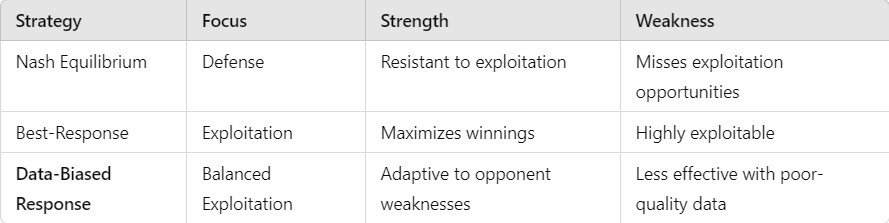
One of the most important reasons why DBR is so crucial for modern poker AI bots is because it might fit into a huge range of applications. For example, DeepMind Poker Bot served very well with its abstract modeling, and at the same time, work for maximum performance against the real world would fall to DBR, in the case of imperfect data.
Now, imagine an AI system studying all results from those many, many hands played. He sees everything, remembers big trends – a lot of raises or folds. He then uses DBR to dynamically adjust the following with some really high confidence data:
- High Confidence Data: He has them play in targeted exploitation much as one would apply a focused poker cheat sheet.
The low – confidence data provides him with the insurance that he is resistant to unexpected strategies.
In addition, this flexibility makes the DBR an innovative approach at least in the setting of the mixed human players and online poker bots.
Real – World Applications
- Against Human Players: The AI – based DBR, having adapted to the aggressive players by exploiting the passiveness in the weaker opponent, has done pretty well thus far in, say, the WSOP tournament series.
- Competitor to Other Bots: It competes in the exploitation of other online poker bots and protects against the bot strategies that are predictable.
- Learning Aids and Practice: For many, AI – driven DBR is considered one of the best methods to study or practice chess. In principle, they really do provide practice against a human opponent with remarks on the defects of the strategy behind poker online bot.
Why DBR Is the Future of Online Poker AI
But DBR’s true power, however, is scalability – from very high stakes games to the ones in which consumer – facing tools turn AI from a helping little sidekick into a strategic powerhouse. A system within DBR stands; it is for those players who want the best bot for poker, or even downloading a bot for poker, aware of the advantage.
It’s not about winning but about redefining the game. For all the capability of AI, which DeepStack AI and PokerAlfie have represented in poker, the system referred to as DBR takes it to a totally different dimension. Competing against human ingenuity along with competing against developed algorithms, bringing in the best of both worlds, makes this poker AI competitive by maintaining a balance in exploitation and defense.

Conclusion
But in the real world, poker, while incrementally enhanced, is pitted against increasingly formidable foes: human challengers or poker online AI – whereas poker AI itself remains in the development stage online. First of all, a preliminary understanding of how DBR works will provide the most significant advantage.
No poker machine hack, no shortcut, but the future of Artificial Intelligence in poker that would adapt and rule with changes in online play. Let me tell you – developer to reader – it was with DBR that you truly reached the frontier of what could be achieved with AI in poker. Are you prepared to take it to the next level?