

The application of a hidden Markov model in strategy for AI Poker: Online poker is essentially an incomplete information game where every decision depends upon the subtle pattern and the hidden dynamics. Artificially intelligent machines require very advanced machinery in mastering this complexity. Within these lines, the HMMs are amongst one of the strongest frameworks that help in analyzing sequences of actions and predict further strategy by opponents.
Unlike other more simple poker hacks based on certain set or static rules, HMMs are dynamic; they change in real time. They enable the AI to identify patterns in the betting behavior and hence spot bluffs or predict further moves. With this value, the HMMs are the backbone of even those very advanced poker AI bots operational up to date.
What is a hidden Markov model?
HMMs are statistical models of processes where the signal or observation results owing to an underlying state, which isn’t directly observable. In poker now, this takes over to “an opponent’s hand strength” as “hidden states,” and “his bets, raises, and folds” as “observable outputs.”
How it really works:
- States and observations: That is, the states are finite-a strong hand, a weak hand, a bluff-associated with observable actions.
- Transitions: the probabilities of transition to other game states. He’s on a good hand so he is most likely to raise rather than fold.
- Training: This is where AI is trained with historic data to learn those very probabilities and then make correct predictions during the live game.
That’s where HMMs take a catch on the base poker cheat sheet-like tools that just can’t learn.
Enhancement of the AI poker tactics by using HMMs
- Pattern recognition
It is in these very sequences of actions that HMMs tend to excel; a good example could be given where opponents who, at a flop bet, tend to be really aggressive and fold a lot at the river. It is these sequences that are looked upon by HMMs; hence, through AI, it can classify the opponents and change its strategy.
- It will be tighter playing against super LAG so as not to get trapped.
- If opponent is cautious AI will very much probably bluff in order to make him fold.
It’s the dynamical approach which differs from usual poker online bots through advanced systems such as pluribus poker.
- Bluff detection
As it is not that easy to catch, and in the end, the bluff belongs to a poker game. Due to considering a betting pattern and timing, an estimate can be made by the HMMs regarding the suitability of playing behavior given the probable hand strength of a player.
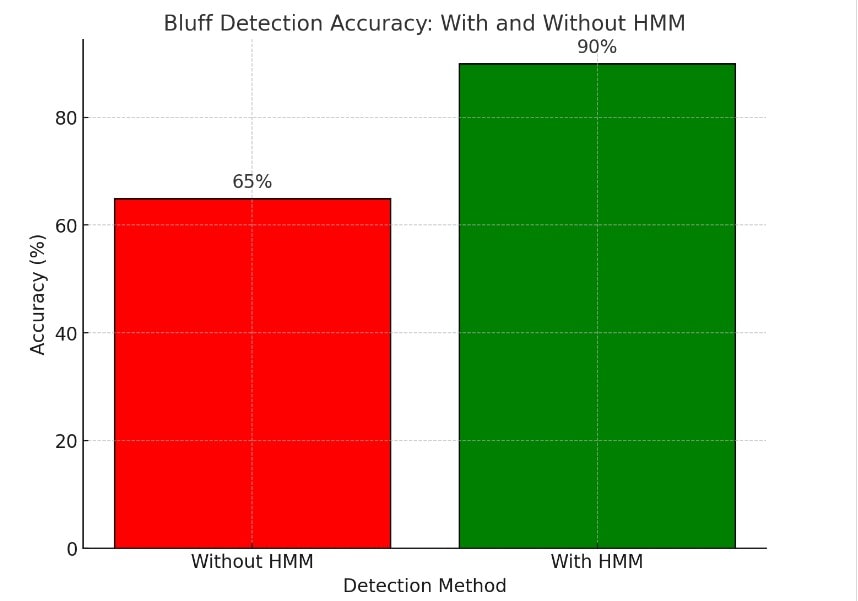
For example, if one player is disproportionately raising concerning the board texture, then the AI would classify that correctly as a possible bluff. Unlike any simple poker hacks involving fixed and fast rules, the HMM-based AI would learn those kinds of subtleties.
NO
- Opponent modelling
Yet another set of applications of HMMs are in opponent modelling: training over historic hands allows AI to make a good prophecy about what the opponent is most likely to play. As an example of this, HMM might pick up, for instance, that some player bluffs 30% on turn if check-raised. In that way, it will way easier for AI even to make more informed decisions even at very tense moments.
Applications of HMMs to Online Poker
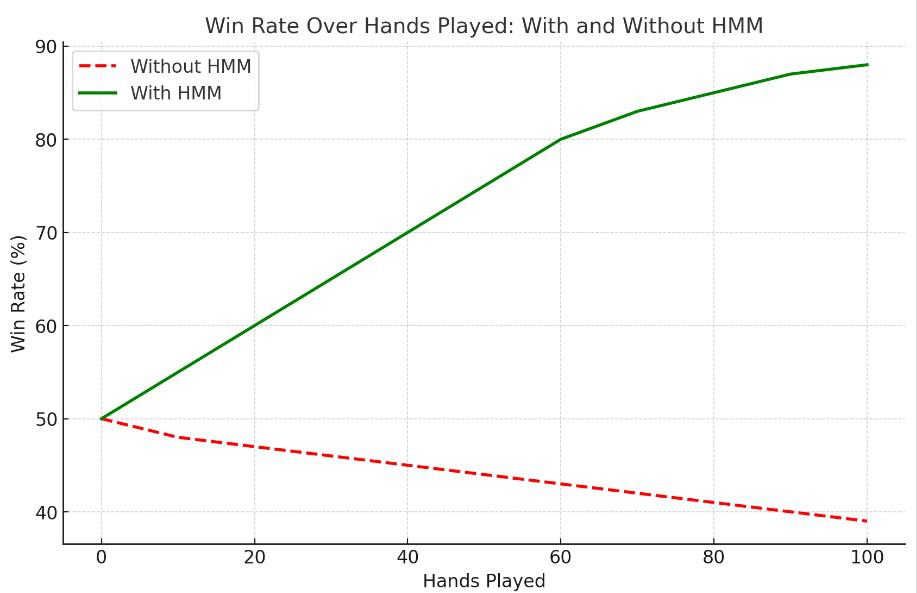
- Real-Time analysis: HMMs can enable AI to analyze hands as they are unfolding and deliver an insight applicable at any moment in the game. This means players will make increasingly intelligent decisions in real time, especially those making use of online poker sites such as Poker AI.
- Practice platforms: With HMMs, one can practice with various types of opponents, either human or online poker bots.
- Tournament play: Actually, such developed HMM-based AI has done wonders in certain buy-in events at WSOP with variance in style of playing.
HMMs as compared to other AI models

That provides some reason why HMMs would be of immense importance in anybest bot for poker system: to bridge the gap between static strategies and adaptive intelligence.
Limitations and challenges
While powerful, there are headaches with HMMs:
- Data dependence: It really needs a serious amount of training data for the HMMs to yield good results, which may prove to be a limitation for casual gamers.
- Computational cost: Procedures can be computationally expensive, especially in multi-player games.
- Ethical issues: Employment of such AI-employing, like HMMs, in a game on is enormously unfair. For this reason, many sites have also started implementing the use of AI detectors.
The future of HMMs in poker AI
Accompanied by growth in AI, such applications of HMM might be extended to include:
- Merging with a neural network: Large-scale deep learning may be used to raise its predictability.
- Multiplayer optimizations: These algorithms consider not just one opponent, but rather multiple opponents at one time-a quantum leap for poker online AI.
- Real-Time emotion analysis: AI could factor in opponents’ emotional states, derived from timing and bet sizing patterns.
For players looking to stay competitive, understanding how ai and poker intersect is crucial.
Conclusion
With HMMs, quite literally, the way AI does online poker has changed-majorly the identification of patterns, the prediction of probable bluffs, modeling opponents-all play to one’s benefit, not possible with any ‘standard’ strategy.
Be it a developer creating the best poker bot or a player looking to enhance skills, HMMs certainly provide a map to better, more intelligent play. It would be those who can change with the game that would come out on top in this new dawn of AI-driven poker.