

Probably among the most complex questions of game theory can be viewed regarding how to develop AI that would be able to adapt against an unknown opponent and at the same time not be vulnerable to him. Among those, the Restricted Nash Response has to be regarded as a step-change approach able to balance two critical objectives of poker AI development: to exploit the weakness of an opponent while being defended against possible exploitation by more skilled adversaries.
Put together with inputs from Game Theory, this has polished RNR to near-perfect play in poker AI. This allows for real-time adaptation-while the integrity of the strategy remains intact-thus, such an approach is highly valued both for competitive play and for AI research.
What Is Restricted Nash Response (RNR)?
The RNR represents a rather complex algorithm. It improves decision-making through a reduction of the search space within a game tree. Classic Nash Equilibrium algorithms try to cover the entire game tree, which gets prohibitively costly computationally. On the other hand, RNR limits its attention to respective game states in which huge payoff gains due to the exploitation of opponents may be realized.
This will be lightweight because the narrow selective approach will not overcomplicate things, with very little cost in competitiveness. RNR is scalability- and efficiency-baked, suitable for rapid environments, such as may be the case in online poker tournaments.
Key principles of RNR
The RNR works on three mainstays to make sure there is dynamic adaptation with optimization of computational efficiency:
- Limited search space:
- This will cut computational complexity because it runs RNR on only meaningful branches of the game tree; improbable or otherwise irrelevant branches are just ignored, hence allowing real-time play with no strategic compromise.
- Opponent exploitation:
- By observing the opponent’s bet-sizing pattern, bluff frequencies, and fold rates, RNR picks up their exploitative weaknesses. Whenever such a pattern comes again, this is where the AI is going to maximize the Expected Value by acting accordingly.
- Defensive strategy:
- If no weaknesses are found, it always resorts to using an unused move due to Nash Equilibrium considerations that guarantee survival in the long term, offering the least number of exploits to any opponent, let alone really cunning ones.
How RNR Works in Poker AI
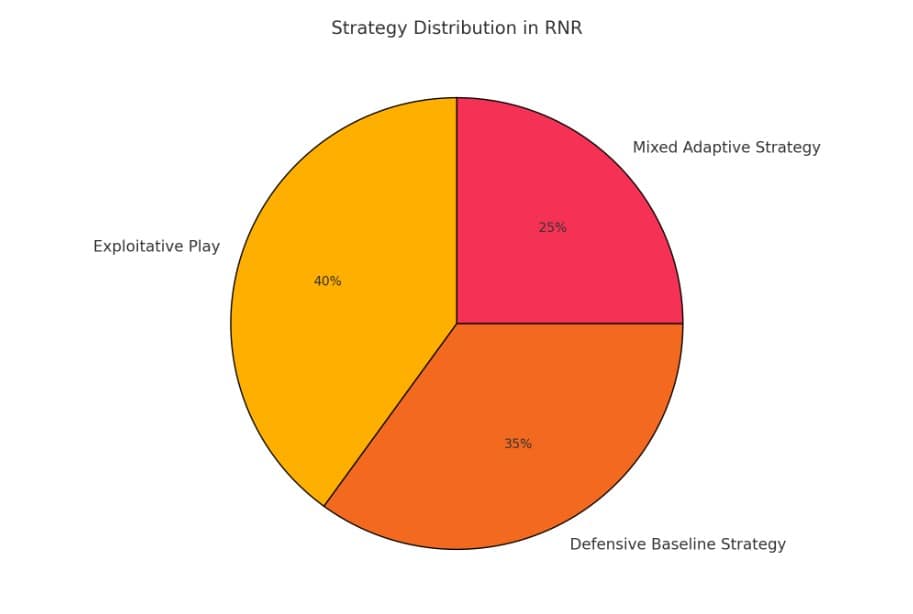
RNR finds its application in Poker AI in a stepwise manner to optimized decision-making through observation, adjustment, and calculation of response. These shall include:
Step 1: Opponent modelling based on information acquisition
Based on this observation, an opponent plays a number of plays that may include:
- Betting patterns: the frequency at which opponents bet into a situation;
- Bluff frequencies: the ratio of bluffing versus calling;
- Fold rates: the frequency of folding to pressure.
From here, the AI does the modelling of an opponent by carrying out a bounded game tree incorporating only the most important game states.
Step 2: Creating a limited game tree
Further, AI prunes a game tree in the following way:
- All actions whose probability is close to zero get eliminated.
- Of all the other positions, consider for decision-making only the most strategically central points in detail.
This is how it decreases the total number of all the possible variations of the events, allowing AI to focus more resources on the really important ones.
Step 3: Strategy optimization by means of regret minimization
It is here that RNR uses Counterfactual Regret Minimization in order to improve its strategy. Let there be a situation where the AI continuously fails to play profitably; it calculates the regret values concerning such a situation and thus updates the strategy.
Iteratively, this would converge-or stabilize-into a rather well-balanced near-optimal strategy, even against opponents it had never seen before.
Step 4: Balancing between exploitability and defense
Where identified, constant flow of weakness in opponents by AI turns into an attacking game of the now-identified pattern.
It retreats to its default strategy of defense once it doesn’t find any real weakness and thus becomes non-exploitable in those looser situations. This is the exploiting vs. defending balance that places RNR in its niche in respect to resiliency.
Why RNR changes everything in poker AI
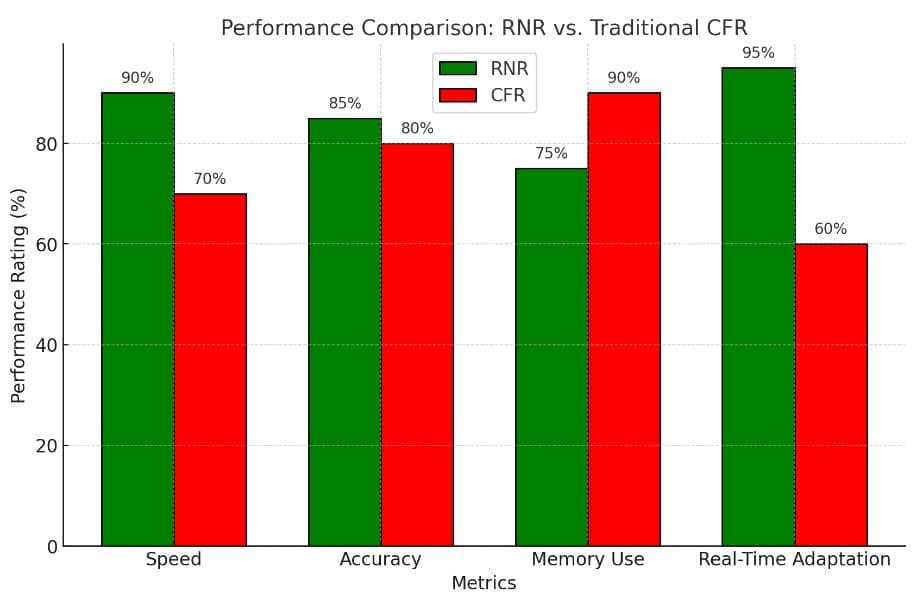
Key ways in which RNR constitutes an advance over state-of-the-art, game-theoretic approaches like CFR are given below:
- Computational efficiency:
- Conventional Nash equilibrium approaches require an exhaustive search of the game tree, which is unfeasible for complex games.
- RNR avoids irrelevant states and saves processing time without sacrificing strategic precision.
- Real-time strategy adaptation:
- Whereas CFR needs to have its strategies precomputed, RNR is able to do so in real time; hence, RNR yields real-time decisions.
- This flexibility is important during live games because most opponents change their strategies quite frequently.
- Balanced play against any opponent:
- Whichever it may be, whether against a poor player or against a world-class AI, RNR well-balances offensive and defensive playing to ensure good performance in case the opponent’s strategies are unknown.
Applications of RNR in poker AI
RNR flexibility befits it as irreplaceable in making competitive poker AI. Applications include:
- Training simulations:
- It helps developers train poker bots through millions of simulated games; hence, it is capable of training AI over different game environments.
- Multi-player game strategy:
- At multi-player poker, from very wild to RNR, opponents can vary; hence, it optimizes decisions against a number of opponents simultaneously.
- Competitive AI platforms:
- Most of the AI poker platforms implement RNR as an integral decision-making engine for real-time modification in high-stake tournaments, where even the minimum advantage is game-changing.
Conclusion

RNR represents a significant new balance among adaptability, exploitation, and defense in poker AI, where computational efficiency can be guaranteed at depth of the strategy by putting the focus into the game states relevant for the strategy.
Whether it is a next-generation poker bot or advanced game-theoretic AI, RNR works out a general, scalable, real-time, and insightful decision-making framework. In the fast-moving world of Poker AI, RNR stands beyond the algorithm to become a promise toward competitive decision-making in the future.