

Online poker has always been one of the most challenging areas for artificial intelligence because of its deep decision trees, imperfect information, and ever-changing strategies. Such a domain needs algorithms with powerful and similarly flexible capabilities. The most important discovery which was uncovered through it was a fast bundle-based anytime algorithm; this technique exploits both dual oracles and regret minimization to solve complex game-theoretic problems in a very effective way.
This is an algorithm that has already changed everything in poker AI in terms of real-time decisions, better resource allocations, and convergence much faster towards the best strategy. But exactly how does it work, and what does it mean for the developer of Poker AI? A little deeper dive into the mechanics involved; let’s explore its application.
What is the Quick Bundle-based Anytime Algorithm?
At its very core, the Fast Bundle Algorithm solves large-scale optimization problems; more specifically, extensive-form games, such as poker. Algorithmically, it works as described below.
Divide the game into sub-problems
- It chops a huge game tree into small bundles-or sub-problems-easier to handle.
Dual oracles
- A dual oracle predicts the likely actions of the opponent given past decisions made.
- This prediction decreases exhaustive searches by narrowing down the search field to only relevant game states.
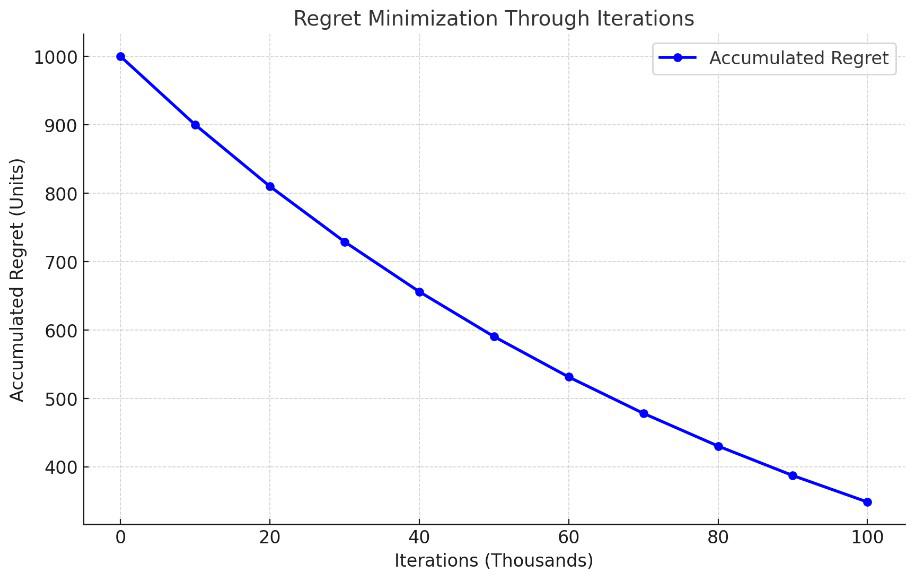
Minimize Regret
- The algorithm defines “regret” – how much it regrets not playing the best move after many iterations of game playing.
- It updates its strategy to minimize regret with iterations, thus trying to be more accurate at each step.
These combined techniques make the fast bundle algorithm uniquely suited for decision-heavy environments like online poker.
How It Goes in Poker AI
1. Game tree reduction
Poker has a very large game tree, comprising billion of possible game states. The fast bundle algorithm groups in and bundles similar game states into segments, making them computationally more feasible to work with, thereby allowing real-time decisions even by using a small computational resource.
2. Optimal response calculation
Using these two oracles, AI predicts the sequence of moves most probably played by an opponent according to history and then computes the optimal response strategy in its light, rather than analyze the whole game tree.
3. Minimisation of action regret
It does so by iteratively updating its strategy after playing a number of simulated hands, then updates based on computed regrets. Rebalancing of the strategy takes place at times when AI continuously loses at certain states of the game to reduce the further potential loss.
Key merits of the fast bundle algorithm
1. Speed and efficiency
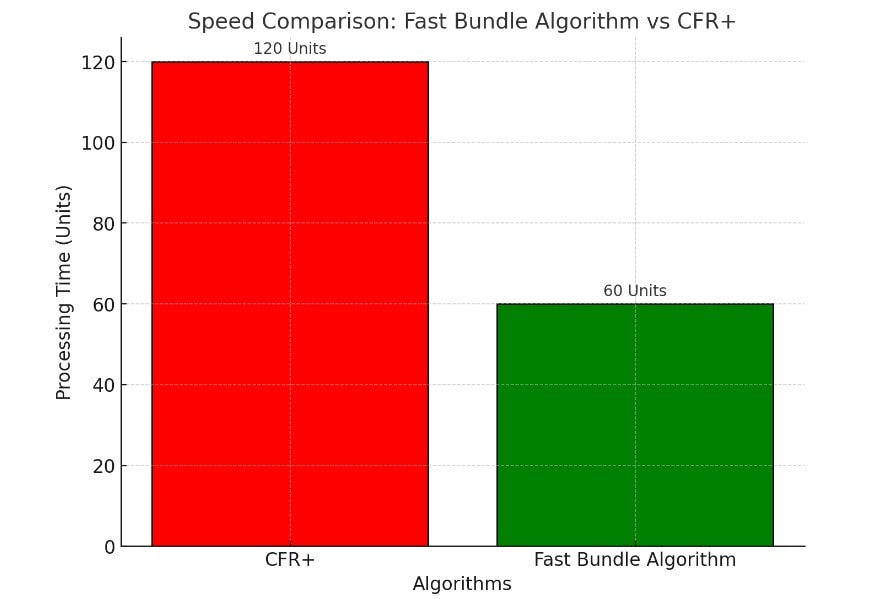
In contrast to conventional game-solving algorithms, such as CFR (Counterfactual Regret Minimization), fast bundle unlocks game states at a much faster clip. It reduces unnecessary computations by avoiding unlikely game scenarios.
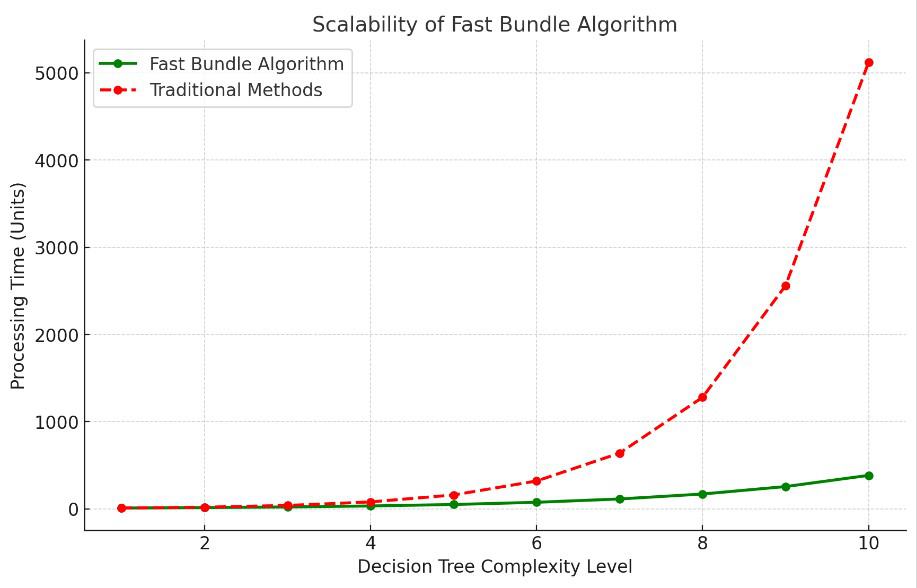
2. Scalability for large games
Poker games with millions of possible combinations become more manageable due to the algorithm’s ability to split the game tree into bundles. This makes the approach suitable for both heads-up and multi-player poker environments.
3. Real-time decision-making:
The algorithm supports real-time decision-making, enabling AI to adjust its play during live games without requiring long pre-computation periods.
Applications to Poker AI
- Opponent adaptation in real-time: Fast bundle algorithms can support AI in dynamic adaptation in real-time towards the opponent’s change in strategy. Therefore, they are quite effective in tournaments.
- Advanced training simulations: This algorithm helps developers in creating a strong environment for training where AI would simulate millions of hands with different playing styles and thus build better strategies over time.
- Multi-player strategy development: While many poker algorithms struggle with multi-player games due to exponential complexity, the bundling process simplifies calculations, making multi-player AI feasible.
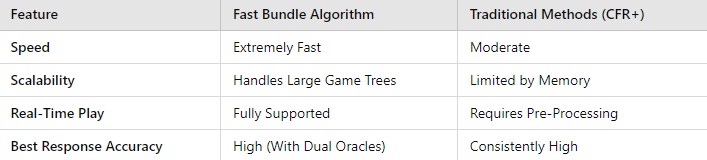
Comparison with traditional algorithms
Challenges and limitations
While the fast bundle algorithm excels in many areas, it also has its limitations:
- Data dependence: The performance of an algorithm would highly depend upon previous data of game playing. The algorithm may not work efficiently in unfamiliar scenarios.
- Manage complexity: Too aggressive bundling does not guarantee to avoid oversimplifying the gametree, hence a suboptimal strategy.
- Ethical considerations: Powerful AI in online poker is considered an ethical concern about fair competition, because some platforms use AI detectors.
Future Development in AI Poker
The Fast bundle algorithm is just the very beginning. Further research can take AI poker strategies to entirely new levels. Following are some of the promising directions:
1. Hybrid models
The combination of a fast bundle algorithm with deep learning methods will enhance AI in predicting the opponent’s cards. Whereas a fast bundle algorithm is suited for efficiently processing a game tree, minimizing regret, deep learning handles real-time adaptation by learning from the opponent’s betting pattern, bluff frequencies, and timing tells.
2. General AI applications
The possible applications of the fast bundle algorithm extend far beyond poker. Its ideas naturally carry over to every field that involves intractable decision-making problems: financial modeling, risk management, and cybersecurity, for example. These are areas that also have basic optimization and prediction problems in which a decision needs to be taken under partial information.
3. Automatic multi-player optimisation
While AI has already conquered heads-up poker, multiplayer games are challenging due to exponential growth in the number of possible game states. Maybe future AI will leverage the bundling and optimization from the Fast Bundle Algorithm to actually make a competitive multiplayer poker bot, considering multiple opponents all at once.
These will enable quantum leaps in poker AI itself but also, in a broader setting, applications to game theory, competitive decision-making, and to artificial intelligence in general. Brilliant prospects lie ahead for those developers operating at the crossroads between machine learning and strategic games.
Conclusion

Improvements in the span within poker became real-the much more intelligent performance of the game, quick, and adaptive. For the very first time, the bundle-based anytime algorithm combines performance and efficiency due to the effective combination of game tree bundling, dual oracles, and regret minimization.
The power of mastering this algorithm by developers and researchers opens completely new dimensions of strategic insight and performance from AI. Poker has changed, and it is called Fast Bundle Algorithm-the leader of the revolution. Play?