

Poker, with incomplete information, has become an ideal testbed for advanced AI research where the players consider finding moves with complete disregard for any idea about the held cards of their opponents. Probably among the most important, critical concepts that have emerged in AI poker is MCRNR – Monte Carlo Restricted Nash Response. Combining regret minimization with Monte Carlo sampling, this convoluted algorithm results in near-optimal strategies that find adaptiveness while decreasing computation complexity.
MCRNR has expanded the bounds on what AI is capable of achieving with strategic decision-making; it is hence a critical milestone for developers who want to create sophisticated poker bots and AI-driven decision-making systems.
What is Monte Carlo Restricted Nash Response?
MCRNR: Monte Carlo Restricted Nash Response-An extended version of an algorithm to solve extensive-form games, such as poker, by computation of near-equilibrium strategies via selective sampling. Current approaches necessarily have to explore the whole game tree, which is computationally infeasible; MCRNR tightens the focus by having two major components:
1. Restricted Nash Response (RNR):
- It computes the best response to a limited sub-set of strategies.
- Focuses on just high-probability game flows and skips unlikely game paths.
2. Monte Carlo Sampling:
- It randomly samples the game states of the large game tree.
- Evaluating over the most relevant nodes reduces computational overhead.
By combining these methods, MCRNR efficiently approximates Nash equilibrium strategies while minimizing memory usage and processing time.
How MCRNR works in Poker AI
Step 1: Opponent modeling by sampling
- It does so by observing opponent action through Monte Carlo simulations, generating probabilistic models which estimate the probability of several plays given the observed behaviour.
Step 2: Heuristic game tree search
- MCRNR uses RNR to find the important branches instead of calculating the complete game tree. During selection, it will focus on the choice of action that offers the highest expected payoffs, disregarding implausible cases.
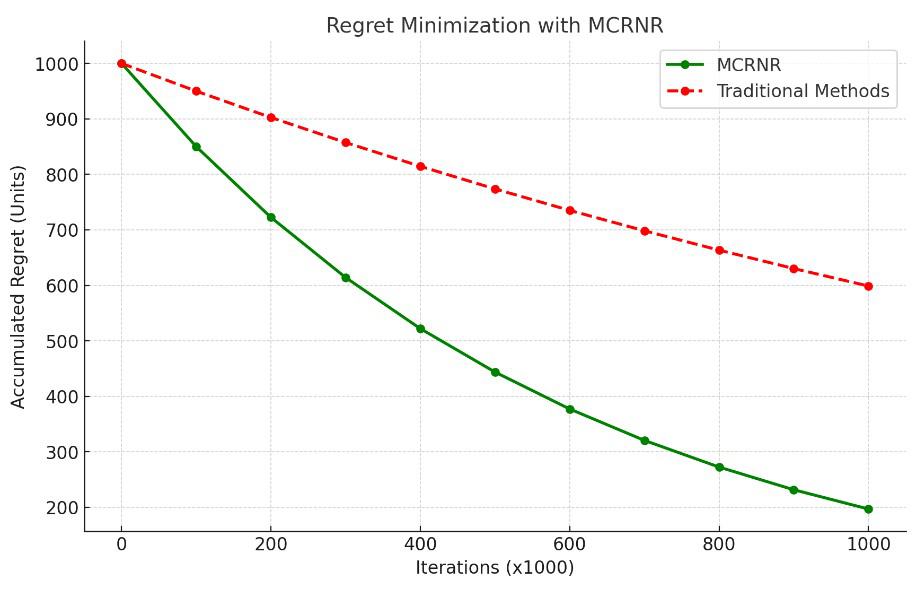
Step 3: Best response under regret minimization
- MCRNR tracks counterfactual regret, which is the estimated amount the player could have done better if they had chosen differently. Then it updates its strategy, after the end of each simulated hand, to minimize this regret.
Step 4: Refining the adaptive strategy
- By repeated simulations, MCRNR keeps refining its strategy-keeps converging to a Nash equilibrium but always remains flexible with opponent-specific adjustments.
Why MCRNR changes everything in Poker AI
MCRNR excels where traditional algorithms like CFR (Counterfactual Regret Minimization) face limitations. Its unique advantages include:
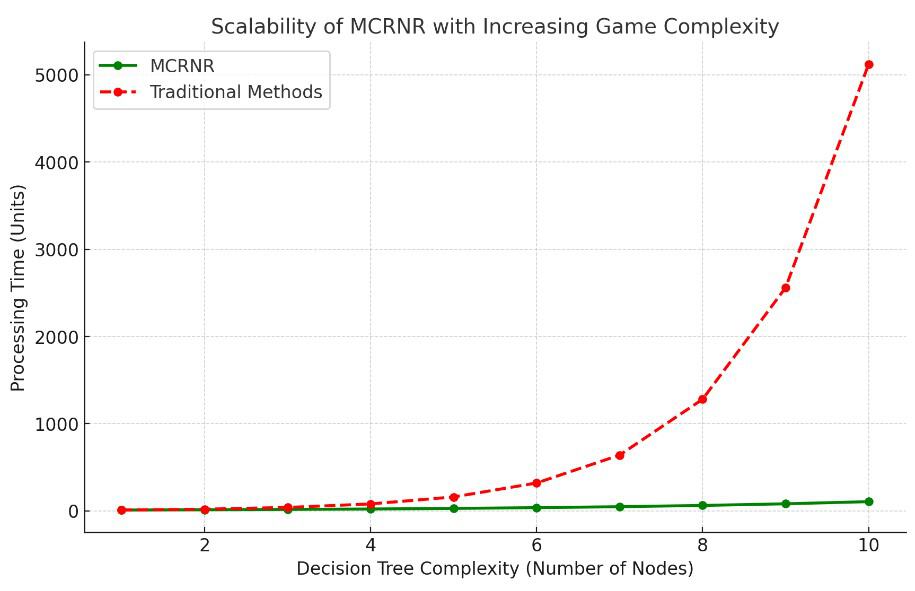
1. Scaling to large games
- Poker’s hugely vast game tree makes exhaustive exploration impractical.
- This vastly reduces the search space by MCRNR through its sampling-based approach, making complex multi-player games tractable.
2. Real-time decision-making
- By considering only relevant game states, MCRNR allows for real-time play with severe time bounds.
- It sees broad application in major tournaments and competitive Internet poker.
3. Memory and processor efficiency
- Unlike most of the memory-intensive methods that require pre-computation of the strategies, MCRNR dynamically builds and updates its game model with less memory and computation.
MCRNR Applications with Poker AI
1. Training simulations
- MCRNR lets developers simulate millions of poker hands to make strong AI opponents that can play under every possible condition.
2.Opponent exploitation
- Its adaptive capabilities enable MCRNR to exploit a weak opponent fully while being balanced for strong players.
3.Multi-player strategy development
- While many of the AI systems suffer with multi-player dynamics due to game tree complexity, MCRNR excels by focusing only on the most critical interactions.
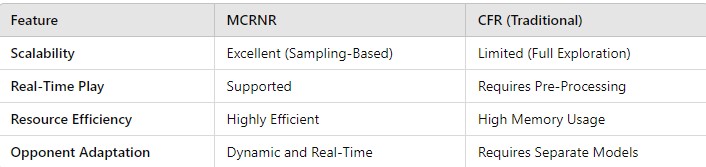
Comparison with Classic Poker AI Algorithms
Future development in AI Poker using MCRNR
The potential of MCRNR actually goes well beyond poker. Some future applications could be:
1. Hybrid AI models:
- It can be further improved when combined with MCRNR neural networks, hence enhancing its predictiveness and potentially allowing application to complex games.
2. Multi-player optimization:
- Extend capability of MCRNR to multi-player strategy prediction and cooperative game.
3. General AI applications:
- Example applications of MCRNR include financial modeling, automated negotiation systems, and real-time decision-making applications both in business and cybersecurity.
Conclusion

The Monte Carlo Restricted Nash Response is another big leap in AI poker strategy. Essentially, by incorporating the elements of regret minimization with Monte Carlo sampling, it thus provides almost optimal gameplay at less computational cost.
Be it developing the world’s best poker bot or researching AI-driven decision-making, MCRNR constitutes a strong framework for obtaining scalable, adaptive, really effective strategies. The future big move in AI poker has already been played-already time to see what’s next?