
Poker has long been a testing ground for strategic thinking, fusing together psychology, probability, and game theory. The most interesting investigation, perhaps, is the model advanced by von Neumann and Newman-a simplified approach, which reduces poker to its most basic, possible moves. How different things become when you add a little wrinkle-a little uncertainty about the strength of the terminal hand. Let’s dive into how this nuance of game theory morphs strategies and what it says about poker today.
A Simplified View: Von Neumann and Newman Poker
John von Neumann started to analyze poker using his new field of game theory back in the 1920s. A simple model of two-person poker was later extended by Newman. The model represents a two-player poker game in which each player is dealt a “hand,” a real number between 0 and 1. First, player X has the right to bet a fixed amount or to check. If player X bets, then player Y responds by either calling the bet or folding.
The simplicity reveals two important insights. First, optimal strategies involve bluffing-a mix of betting strong hands and low-value hands-so opponents can never be sure what they’re up against. This, Von Neumann proved, gave Player X a predictable edge of 5/9 of the pot in the basic model.
The Newman’s model gave more leeway to Player X in that he could vary his bet size. It boosted the flexibility of the bettor’s edge up to 4/7 of the pot. These models remain important touchstones in research about the strategic essence of poker.

Uncertainty: Flipping the Script
In real poker, perfection of information is a mirage. Unseen cards and shifting possibilities mean that players rarely have any sure idea about their ultimate hand strength. Researchers built a “flip” into the von Neumann and Newman versions of poker.
Here is how this goes: whenever a showdown occurs, an unbalanced coin flip with bias q determines whether the weaker hand takes the pot. With probability 1 − q, the winner is the stronger hand. But with probability q, the tables turn – introducing randomness, akin to the real poker surprises, such as community cards in Texas Hold’em flipping a weak starting hand into a powerhouse.
At q=0, this is the flip-free game, identical to the original models. At q=1/2, the result is a pure coin toss-the player has no advantage. Somewhere between these extremes, a surprising result was found.
Surprising Results: The Power of Uncertainty
One intuitive feeling might be to think that uncertainty hurts the bettor, Player X. After all, adding randomness to the outcome of the game seems to undermine any control. Surprisingly, the math tells a different story.
For the von Neumann model, starting at q= 0 and increasing, Player X’s advantage increases and reaches a maximum at q=1/3. Player X’s expected payoff soars to 7/12 of the pot, a 5% increase over the original game. Why? Less bluffing is required, since with the flip, Player Y must call more often, even with mediocre hands.
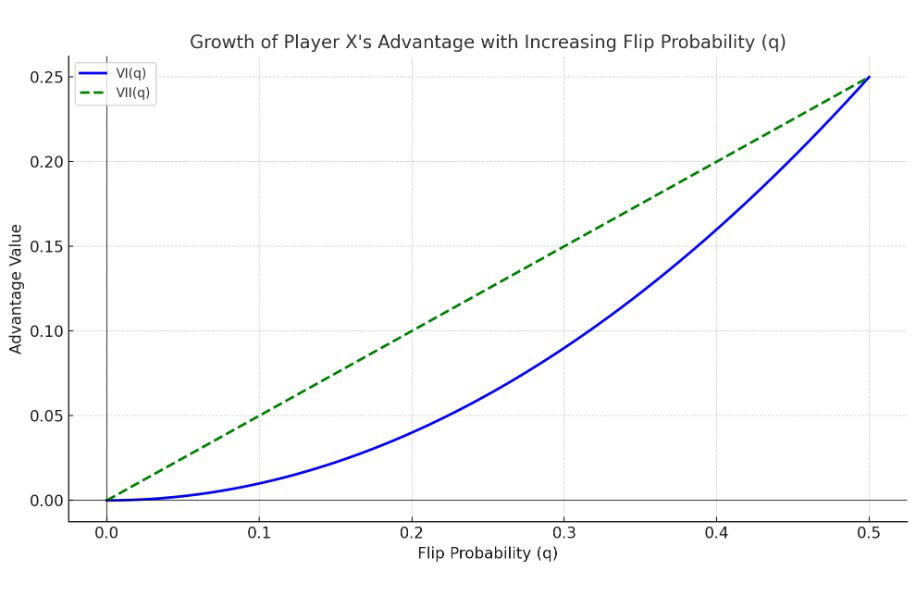
In Newman’s extended model, Player X’s advantage increases linearly with q until it reaches a maximum just below q=1/2. Unlike in the case of von Neumann, this model rewards increasing randomness, since Player X’s flexible betting strategy allows him to extract even greater value.
Strategic Shifts: Adapting to the Flip
The flip dramatically affects the strategy of both players. Player X cuts bluff bets as q q rises, while his value bets-strong hands-increase in strength as Player Y has to consider he will lose with a better hand. When q=1/3, bluffing disappears completely in von Neumann’s model; Player X concentrates all his energies on exploiting his strong hands.
In turn, Player Y is increasingly forced to call the bet, realizing that to fold means ceding the pot to a worse hand. It is an evolving game of chicken in which psychological pressure is ratcheted up.
Modern Applications: AI and Poker Bots
This insight is not some academic plaything; it also finds reflection in poker bots and artificial intelligence. Bots like Pluribus and DeepStack build upon these game-theoretic premises, mixing up calculated bluffs with play adaptation based on uncertainty.
The logic of the flip applies particularly well to online poker, whereby randomness, whether through human unpredictability or algorithmic quirks, can blow up conventional strategy. Knowledge of such dynamics lets bots-and sophisticated human players-exploit opponents who crack under pressure.
Besides that, tools such as poker cheat sheets and sophisticated AI analyzers enable players to internalize such principles into their own games. From Texas Hold’em to variants, uncertainty can be key to your game.
Lessons for Poker Enthusiasts
The von Neumann and Newman models, advanced by the flip, suggest that poker is less about mastering odds than about mastering uncertainty. Here are what players can take home:
- Embracing uncertainty: Players should learn to realize that uncertainty may be your friend, whereby you’re forcing opponents into bad decisions.
- Adapting bluffs: Players should learn to reduce reliance on bluffs in uncertain situations and instead seek to extract value with strong hands.
- Learning from AI: Players take advantage of tools and strategies modelled after game-theoretic insights to help them stay ahead.
Conclusion: Re-Thinking the Game
The beauty of poker lies in the blend of chance and strategy that it presents. The von Neumann and Newman models demonstrate how even slight modifications – a coin toss, for example – can unleash sophisticated strategic insights. The more one understands such dynamics, whether a casual player or professional, the deeper their appreciation of the game will be. Next time you sit at that table, recall that sometimes embracing the unknown is the ultimate poker hack.