

The year 2015 marked a milestone in the history of poker when an artificial intelligence program called Cepheus “solved” an important variant of Texas Hold’em-namely, two-player Limit Hold’em-operating at its heart through an algorithm termed Counterfactual Regret Minimization Plus, shortened as CFR+. This AI showed that incomplete information games could, in fact, have mathematically optimum play.
While to the enthusiasts of AI and to the poker players, that day became the touchstone of strengths of the modern algorithms, for a poker cheat-it was the intellectual roadmap of how to create robust non-exploitative strategies, an implementable plan. It wasn’t about poker; it was a jump forward into how machines think, adapt, and learn.
What does it mean for a game to be solved?
In a game like HULHE, to “solve” means to devise such a strong strategy that no opponent can do better on average no matter how well he may play. Yet another way to look at it is that this Nash equilibrium prevents even the best players from doing more than breaking even over the long run.
In poker terminology, solving HULHE involved investigation into:
- Game states: Any and every possible decision point in the game, from pre-flop to river.
- Counterfactual regret: The amount of value lost by playing sub-optimally in any decision.
- Iterative refinement: Repeatedly adjusting strategies to minimize regret and approach equilibrium.
Such tools as CFR+ do not do any pure calculations but employ advanced heuristics instead to process efficiently trillions of game states; only this can give the level of precision beyond common poker hacks or simplistic poker cheat sheet-like strategies.
How CFR+ works
CFR+ is an extended form of the basic algorithm for Counterfactual Regret Minimization, converging faster and using less memory. Basic idea:
- Computation of regret: It calculates the regrets of all possible actions in a game state.
- Strategy shifting: The received actions obtain less importance with higher regret; the optimal actions win importance.
- Iterative improvement: The process is iterated millions of times, where each step keeps fine-tuning the strategy further.
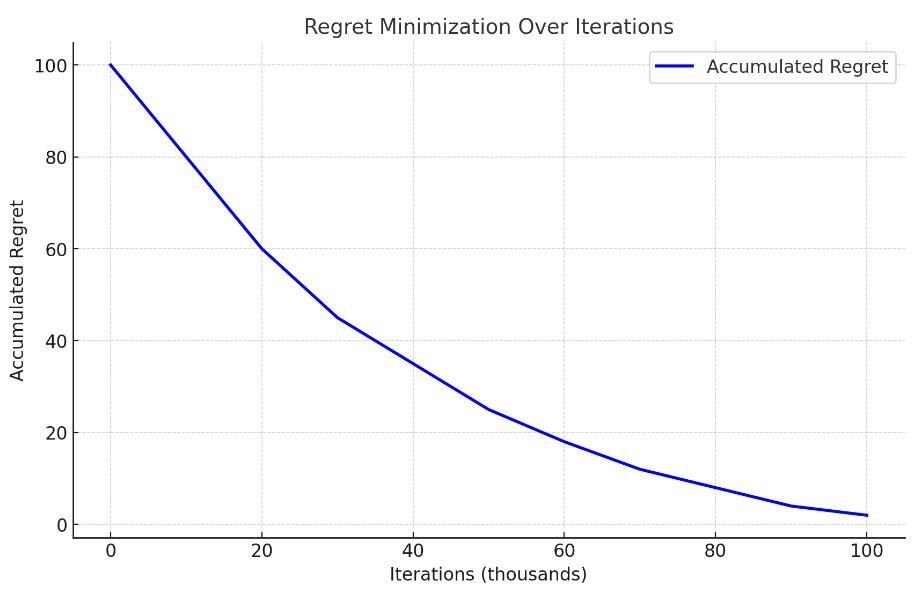
When Cepheus finished training, it had tabulated over 24 trillion hands, enough to devise a nearly perfectly optimal strategy for HULHE; whereas even the strongest poker bot before the development of CFR+ could only approximately determine the best course of action.
Applications of CFR+ beyond HULHE
Everything in CFR+ is much more powerful compared with poker.
- AI training tools: Most of the poker AI bots are based on CFR+, which provides unexploitable strategies to be tested by a player.
- Game theory research: The algorithm improves the understanding of application areas such as economics, cybersecurity, and negotiation.
- AI strategy development: The researchers further develop more versatile AI in adapting the games to CFR+.
Online poker players depend on poker online bots that, increasingly-and poker ai online-are based on the principles of CFR+. From the DeepMind poker bot right up to PokerAlfie, it seems modern AI is dependent upon CFR+.
What Makes CFR+ Unique?
Salient features of CFR+, among others, are:
- Efficiency: The algorithm uses very minimal memory and processing compared to the previous algorithms.
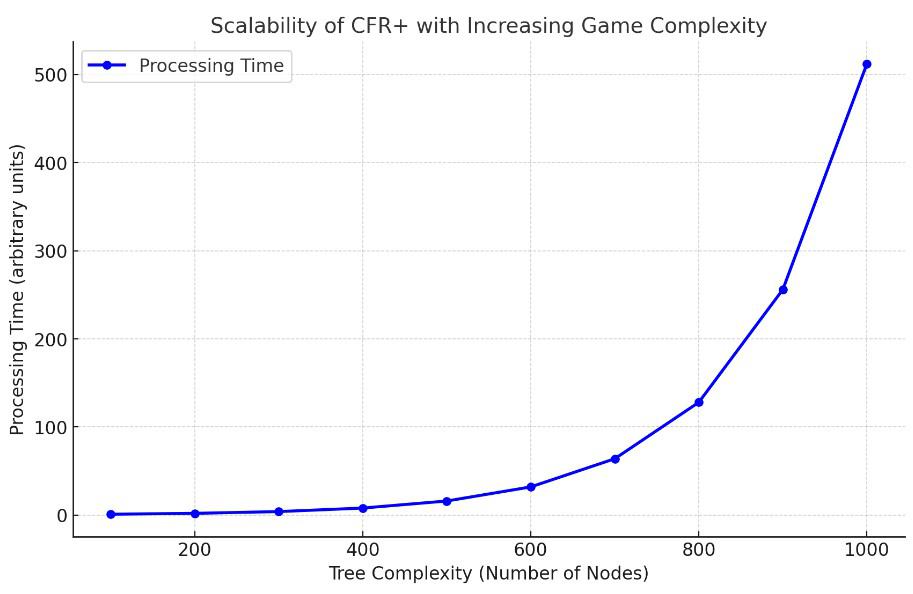
- Scalability: CFR+ applies to large game trees and is therefore suitable for complex games, such as NoLimit Hold’em.
- Precision: The algorithm always converges to a Nash equilibrium, hence strategies produced are unexploitable.
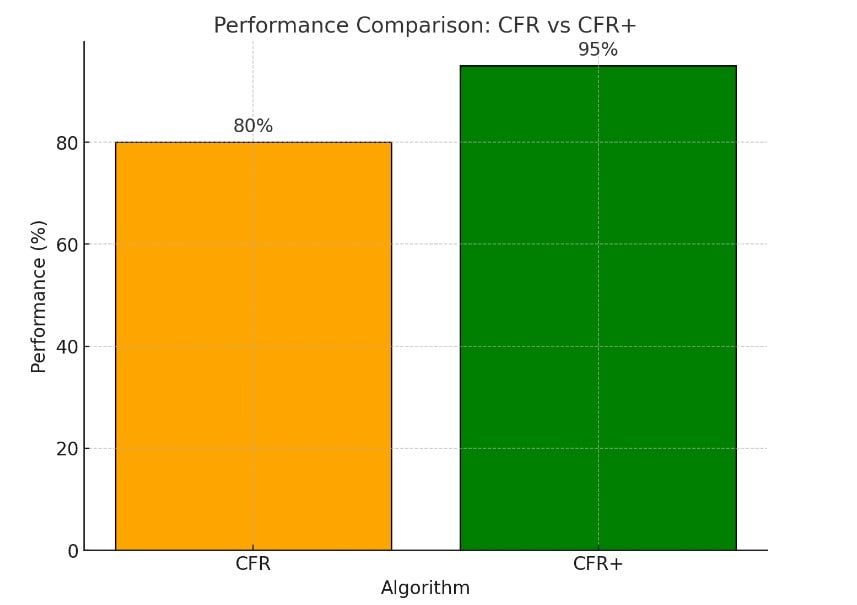
All in all, this combination of features will make CFR+ indispensable in developing online poker bots and analyzing strategies against a human opponent.
The effects on human poker playing
While that settles HULHE, it opens another question: Is there any future for poker qua game involving human players? The major implication for the high-stakes games is an exploitation through the equilibrium strategy.
For instance:
- A poker bot online will play a balanced game, but humans can capitalize on its inability to adapt to emotional or unconventional plays.
- Players using tools like poker cheat sheet programs can refine their understanding of equilibrium strategies without fully relying on AI.
The gap between human intuition and AI precision nonetheless gets smaller fast. For the world’s best players, the basic understanding of CFR+ is necessary.
Challenges and limitations
Despite its success, CFR+ has limitations:
- Game scope: While it solved HULHE, applying CFR+ to multiplayer or No-Limit games would be computationally intractable.
- Practical application: A game’s solution is not always transmitted into real-life domination, since human unpredictability could disrupt the equilibrium.
- Ethical concerns: Advances within online poker bots through CFR+ raise several questions regarding fairness among players on these online poker platforms.
Because of this, many platforms use AI detectors to ensure fair play for the human players against unauthorized bots.
The Future of CFR+ in Poker and Beyond
These new capabilities opened new avenues for further research in AI and game theory:
- Real-time adaptation: means the adjustments AI systems make mid-game without deviation from Nash equilibrium.
- Cross-Game applications: Apply the idea behind CFR+ to multi-player games and real-world situations.
- Improved training tools: will give players more access to learning about equilibrium strategies, combining theoretical reasoning with practical exposure.
Downloads of poker bots, or even any bot software download, give the player a peek into the AI frontier of strategy, while to developers, CFR+ is somewhat of an efficiency and precision benchmark.
Conclusion

The solution of Heads-Up Limit Hold’em by CFR+ represented a milestone of artificial intelligence. Allowing even the most complex incomplete-information games to be mastered, CFR+ opened up very different possibilities regarding AI strategy developments.
Be it an amateur player, a seasoned expert, or even the designer of the best poker bot, CFR+ is something that keeps them at the edge in continuous, sweeping dynamics. The future is about algorithms.