
Poker was never about luck; rather, it’s a game of strategy and psychology intermingled with well-judged risks-a true test of reading one’s man and calculating odds. Give this centuries-old game to cold, calculating, and exacting algorithms in a play to outperform even the most brilliant human players. That is just what the researchers, H. Brendan McMahan and Geoffrey J. Gordon, do by proposing one revolutionary method of solution for such complex games as poker.
It proves the basis of the very first blazingly fast, bundle-based anytime algorithm that plays poker-but actually reopening how we think of strategy in incomplete information games.
Beyond cards, what is a convex game?
But before that, let us take a step back to really appreciate the genius of this invention. Poker is what mathematicians call an “extensive-form game.” It’s like a tree: All the possible moves and all counter-moves are its branches. Add some hidden cards and randomness, and soon it becomes computationally overwhelming-a nightmare for all kinds of traditional algorithms.
But poker is only the beginning. The broader class it falls into, convex games, is even more complex: a family of games of optimization against a constantly shifting tapestry of possibility, with each opponent’s every move twisting and turning the strategic topography afresh. For years, game theorists had sought to solve such games by expensive methods such as linear programming, which sometimes takes days and sometimes takes weeks to achieve a solution.
Enter the Anytime Algorithm
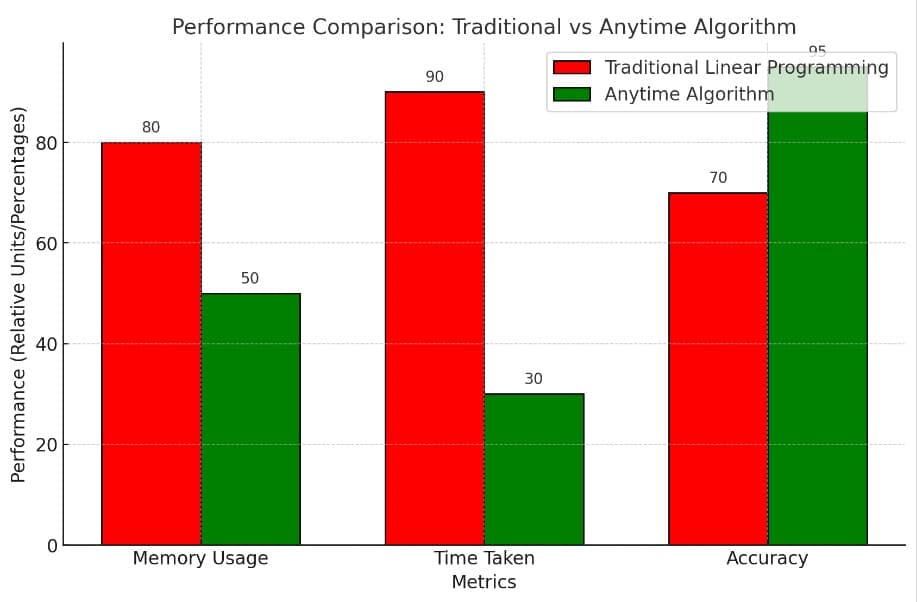
Unsatisfied with the old ways, McMahan and Gordon set their minds on doing things a little differently. Why wait four days for a solution when you could get an optimal answer in two hours? Their algorithm also runs smarter, dynamically modeling the game using “fast best-response oracles.”
Think of it as playing poker while learning the rules and finding the quickest path to victory all at once. The model is nowhere near static; it’s continuously evolving towards what seems like the most promising directions for further exploration.
Once it picks a direction to go in, it dives right in, optimizing as deep as lasers. The result is a rather accurate solution, yet it comes out so considerably simple. Best of all: It does it all using less than 1.5GB of memory, less than the average smartphone uses to run Instagram.
The poker test: Texas Hold’em versus AI
It is for the purpose of testing the powers of the algorithm that Texas Hold’em Poker has been chosen-a favorite of developers in AI for the balance between strategy, psychology, and luck. Only this was not a completely full-fledged multi-player poker game but a simplified version, deeply mathematical in its essence.
The results were astonishing: The algorithm approximated the value of the game to within $0.20 of perfection with a maximum pot size of $310-for comparison, the previous state-of-the-art algorithm using linear programming took more than four days and required 25GB of memory for the same degree of accuracy.
Why it matters outside of poker
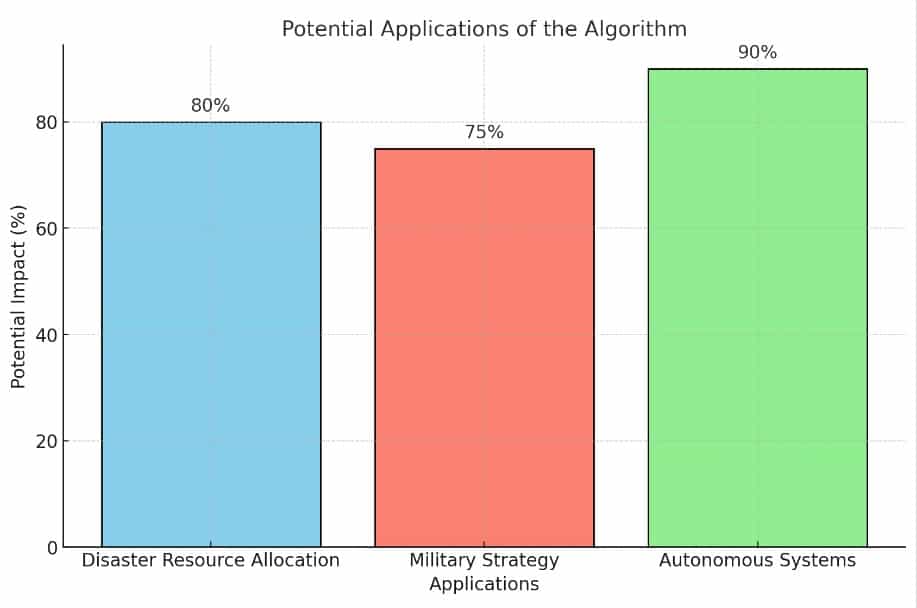
But even if poker isn’t your game, the ramifications of this research extend far from the card table: convex games are everywhere, from economics and military strategy to logistics and the design of autonomous vehicles. The work by McMahan and Gordon can revolutionize the process anywhere a decision has to be made under uncertainty.
Take disaster response, for instance, where very rare resources have to be allocated with regard to effectiveness and speed. Traditional algorithms would take such a long time to reach the global optimum that the solution became irrelevant. This algorithm slices through the complexity and provides real insights in a fraction of the time.
The Human Factor: Can Algorithms Really “Understand” Poker?
Which brings us to the philosophical part: poker is not about numbers; it’s about people-the bluffs, the tells, the gut instincts. The surprising answer is yes, at least in part. By modeling strategies and counter-strategies, the algorithm of McMahan and Gordon makes decisions much like a seasoned player.
It doesn’t flinch on a bad beat but learns from each hand, adapting its strategy.
Outlook: Artificial Intelligence, Strategy, and the Future
Impressive as that may be, that is not all: algorithms like this one are already inspiring new ways to attack some of humanity’s most overwhelming challenges in finance, healthcare, and cybersecurity. Applications of such capabilities will stop only at the domains requiring strategic thinking. And, of course, the roots: the playful project of excelling at poker-a game that has plainly mesmerized humans since time out of mind-is teaching the machines to think.
So next time you sit at a poker table, remember one thing: You are partaking in a multi-century tango between strategy and luck. And who knows, you might just be preparing for the day you face an algorithm that knows each of your moves before you can make them. For in poker, as with life, there is always someone, or something, sitting with a better hand.