

Adaptive Nearest Neighbor Algorithms Revolutionize AI Decision-Making
Today, in every system, the features of streams of data are everywhere. Therefore, efficiency and effectiveness in the processing and classification of data streams are synonymous with success carved for many modern AI applications. In fact, from market analytics conducted by financial systems to the game of AI poker bots playing against human opponents, advanced algorithms require one very strong pre-requisite: real-time data processing.
ANNCAD, Adaptive Nearest Neighbor Classification Algorithm for Data streams, is the marriage between nearest neighbor classification and dynamic adaptability so that the system keeps its efficiency and correctly responsive, even while patterns in the data change.
Let’s have a look at how such a mechanism works, namely, ANNCAD, to see why it is or was the main bedrock underlying modern AI.
What is ANNCAD-adaptive nearest neighbor classification?
At its core, ANNCAD is a classification algorithm for data streams characterized by a continuous flow of data that needs processing in real time. Unlike the traditional classifiers working on a static dataset, ANNCAD updates itself dynamically for every change, hence assuring high accuracy even in case of a shift in the underlying data distribution.
Some key characteristics of ANNCAD are the following:
- Multi-resolution data representation: ANNCAD allows for a variable-sized feature space partitioning for better classification at much higher efficiencies.
- Incremental updates: ANNCAD can integrate incoming data points with very low real-time demands for complete retraining of the classifier.
- Handling concept drift: ANNCAD updates the model using an exponential forgetting mechanism where more emphasis is placed on recent observations.
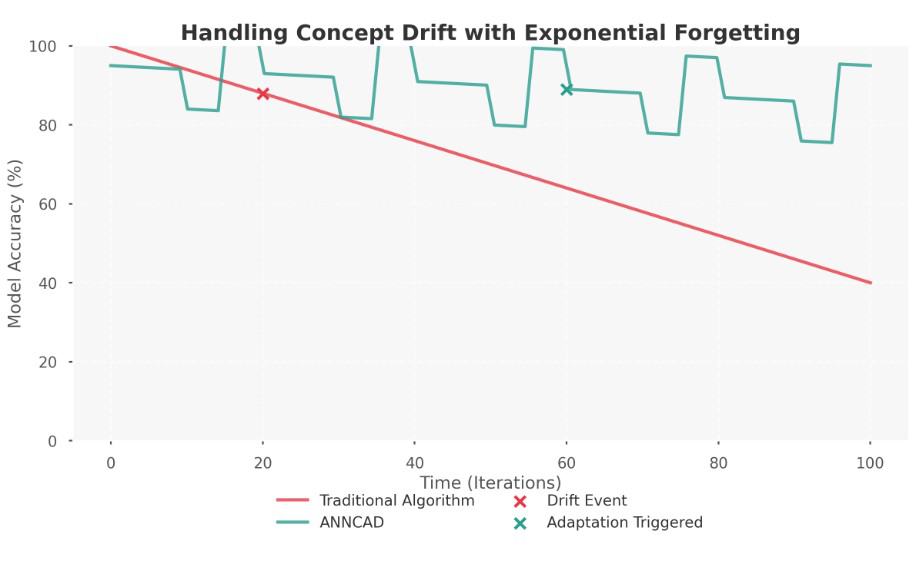
This makes ANNCAD particularly fit for domains where environmental changes may be rapid, such as in gaming or financial analytics.
Main innovations of ANNCAD
1. Multi-resolution data representation: Traditional classifiers face the challenge of choice between high resolution versus high efficiency. ANNCAD models the feature space as a hierarchical grid, using finer grids in the densely populated areas and coarser grids in sparsely populated ones.
This allows for a great improvement in the accuracy of classification with very small additional computational overhead. This will enable the algorithm to delve into parts of the data stream that matter the most, skipping irrelevant or redundant information.
2. Incremental updates for real-time applications: In such dynamic environments, the classifiers need to learn continuously. In ANNCAD, this is made possible by the fact that newly arriving data gets seamlessly integrated into the classifier through incremental updates.
For instance, in an AI poker bot, the ability to perform incremental updates lets the system adapt to different changing strategies from an opponent-anything but having to retrain the system from scratch. This saves not only computational resources but also enables the system to make decisions in real time.
3. Handling concept drift: Concept drift-the changes in the underlying data distribution over time-is the most difficult challenge arising in data streams. ANNCAD addresses the challenge through an exponential forgetting mechanism where the algorithm gives more importance to the latest data while it gradually forgets the older information.
It proved to be significant in those areas that are characteristically fast-changing, such as financial market forecasting or developing new patterns of playing by gamers in online poker games.

Applications of ANNCAD in AI Systems
- AI in online gaming: In game environments, the strategic and behavioral patterns of players may change very fast. ANNCAD now enables AI systems to adapt to this kind of change, which allows for improved opponent modeling and adjustment of strategy. Especially in multi-player games, diversity in playing styles enriches the complexity of a strategy profile.
- Real-time analytics: Beyond game environments, the effectiveness of ANNCAD has been proven in applications such as:
- IoT sensor networks: data analytics in real-time.
- Fraud detection: detecting unusual transactions in real-time.
- Financial markets: monitoring and responding to shifts in market conditions.
- AI in poker: Poker is one of those incomplete information games wherein one must read an opponent’s play and redefine strategies to win. Refining poker AI, ANNCAD can be used for:
- Opponent behaviour analysis: Profiling bluffing patterns or identifying betting tendencies on-the-fly.
- Adaptation to change in strategy: Assuring AI continued effectiveness at times when an opponent shifts strategy courses.

Performance evaluation
Benchmark with traditional algorithms
Against traditional algorithms such as Very Fast Decision Tree VFDT and Concept-Adapting Very Fast Decision Tree, CVFDT, ANNCAD always outperforms them in:
- Accuracy: Its multi-resolution approach ensures very accurate classification.
- Efficiency: With an incremental update mechanism reducing computation overhead.
- Concept drift adaptation: Adaptation to concept drift is possible within this algorithm; it is suited to dynamic environments.
For some datasets, letter recognition, and forest cover type prediction, ANNCAD performed better and thus established its potential in different domains.
Directions for future enhancements
Though already powerful, the algorithm might see future enhancements along various dimensions, including:
- Scalability: Optimizing the algorithm to even larger feature spaces and multi-player settings.
- Marrying with deep learning models: The marriage of the adaptiveness of the ANNCAD algorithm and the predictiveness of neural networks may be the key to new frontiers in AI research.
- Applications in various domains: From driverless cars to personalized recommendation systems, the list is endless.
Conclusion
ANNCAD represents the most significant advance in AI: it introduces an algorithm for the adaptive nearest neighbor classification over data streams, incorporating representation of multiresolution data, incremental updating, and robust handling of concept drift. It provides an effective and correct solution that has the potential to scale for real-world real-time applications.
ANNCAD powers poker AI bots and allows access to real-time analytics, unlocking the development of games. It is among those few algorithms leading the trend in understanding continuous flows in AI systems. As the demand continues to increase, with smarter and faster AI, ANNCAD will be among the algorithms setting trends into the future. The future of AI decision-making rests in the hands of algorithms like these, which continue to push the frontiers.