

Try teaching an AI to play poker, navigate a robot through a boulder-strewn obstacle course, or make decisions in life-and-death situations for autonomous driving. How would a researcher ever develop an algorithm that would make near-optimal decisions in this complex and uncertain environment? Enter Monte Carlo Sampling and Regret Minimization-two large areas of modern artificial intelligence and game theory.
Some of the major techniques powering modern AI systems to compete, learn, and adapt in real time are discussed. Let’s examine exactly how such methods work, why they are so important, and what the future holds for AI-driven decision making.
Decision making challenge: large scale games and AI
Central to AI decision-making is the problem of optimal choice in various uncertain environments, ranging from two-player games like poker, through resource allocation in networks to navigation of robots.
These activities involve modeling of such an environment as an Extensive form game since every decision may alter the future course. Again, MCS and RM are two handy tools in such games-reducing huge decision trees to such an extent that a few million scenarios can easily be processed by an AI.
Monte carlo sampling: predicting the future with probability
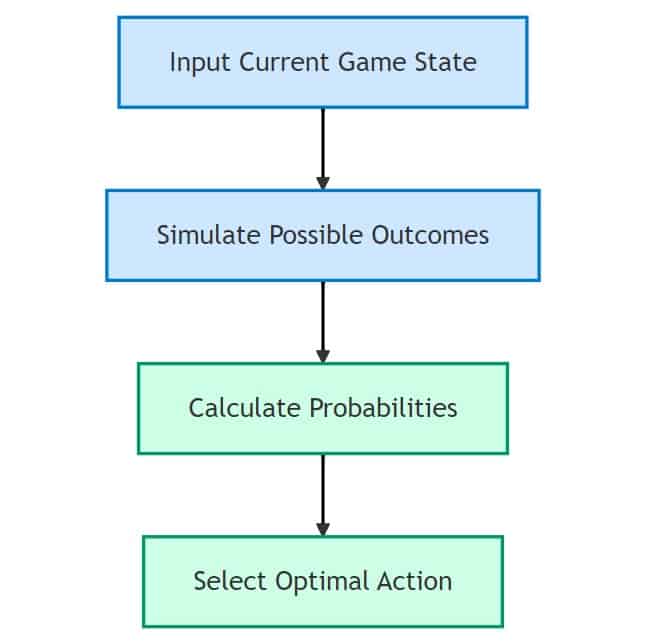
MCS is the process of playing out possibilities in your mind to decide on the best action. In other words, in short, it consists of the following:
- Simulation of random outcomes: The AI makes random plays of the game and finds out what can happen in the various possible futures.
- Building probability model: These plays combine to get a probability-based model of the environment.
- Making data-driven decisions: Using the outcome of these simulations, AI makes the best decisions.
Example: MCS in poker lets the DeepStack and Pluribus bots experience almost millions of simulated hands, deeply understand possible risks and rewards.
Regret minimization: learning from mistakes
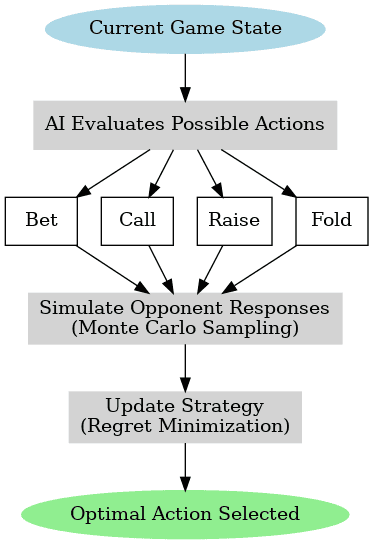
Where MCS predicts possible outcomes, RM ensures the AI will learn from its mistakes. The basic underlying idea here is to minimize regret for failing to choose in retrospect what appears to be an optimal action.
How it works:
- Calculating regret: After every game round, the AI compares its action’s result to the best possible result.
- Updating strategy: The AI adjusts its strategy, favoring actions that reduce regret over time.
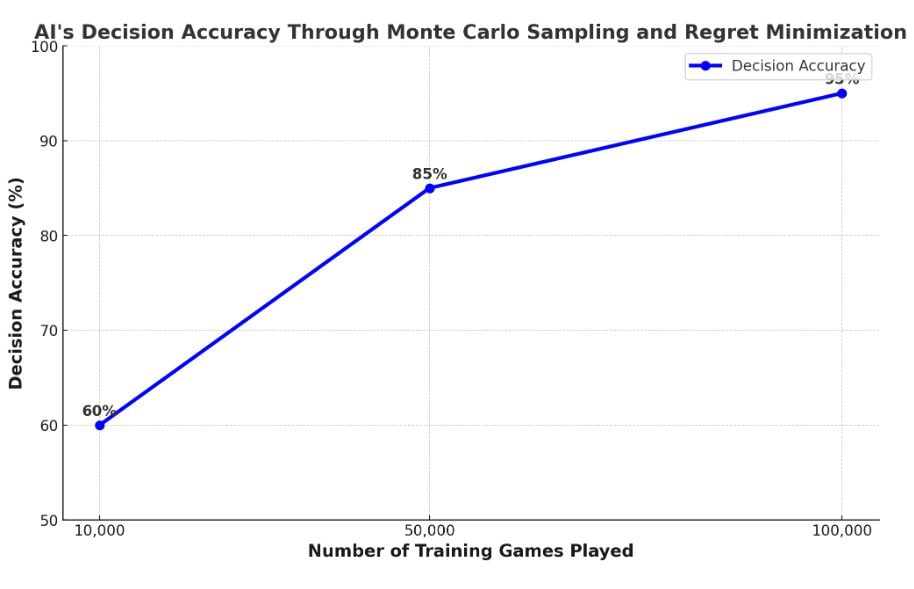
- Convergence: As the AI plays more games, it converges toward a near-optimal strategy, ensuring long-term success.
Combining monte carlo sampling and regret minimization
The magic has been unleashing in their combinations. Monte Carlo Counterfactual Regret Minimization, from the work of Marc Lanctot, brought together Monte Carlo simulations and regret tracking to compute Nash Equilibria in complex games.
Main MCCFR Novelties:
- Game abstraction: It tends to simplify big decision trees for game modeling.
- Simulation-based learning: The strategy through the continuous refinement allowed by simulated gameplay hands for solving allows learning even in incomplete information settings.
- Real-world applications: From poker bots to self-driving cars, MCCFR models will make AI even more cunning, faster, and hard to beat.
Why it matters: applications of AI decision-making in real life
- Poker and competitive games:
MCCFR studies gave rise to AI poker-playing bots like Pluribus and DeepStack. By building a computation over millions of outcomes and iteratively updating the playing strategy based on game adversaries, it could master even the most complex plays.
- Robotics and autonomous vehicles:
Decision-making finds its major application in pathfinding, obstacle avoidance, and multi-agent collaboration in robotics. MCTS enables a robot to decide on how to navigate through an uncertain environment by considering various future paths that the robot may take.
- Financial markets and trading bots:
The stock trading bot uses these techniques to conduct market data analysis, predict, and generate trades for minimum risk and maximum return.
- Healthcare and medical decision support:
AI diagnosis tools employing regret minimization offer optimal treatment plans with previous patient history and minimize the chances of errors in medical decision-making.
Looking ahead: the future of AI in decision-making
Monte Carlo Sampling and Regret Minimization will play an evermore greater role when AI-powered decision-making becomes ever more advanced. Developments will very well include:
- Fully adaptive AI systems: Those learning in real time from actual live interactions.
- AI-powered negotiators: These shall work out more refined algorithms for conflict resolution and complex negotiations.
- Global AI deployments: From disaster response to strategic defense systems, game theory-inspired AI will reshape our world.
Final Thoughts
In practice, understanding how monte carlo samplings and regret minimizations work opens insight into just how mathematically creative some of today’s smartest AI really is. These are techniques that not only redefine what AI can do but show how machines can learn, adapt, and master even the most complex human-like tasks.
And it would ostensibly never end, since choices for intelligent and efficient decisions keep on coming with every step in AI. From poker to real-life, monte carlo sampling combined with regret minimization is the magic sauce taking AI places.