
Every so often I’d catch myself mid-hand wondering: just how does this poker AI tool actually work, beyond the hype? A voice narrates, and it nudges me further. I remember my first introduction to DeepStack’s deep counterfactual value networks-poker AIs that could condition on distributions of hidden hands. That put poker AI, poker bots and poker AI research on the map. Now there’s Supremus. Let’s tell that story with missteps, and a human spark.
(Author’s note: I didn’t think so at the outset.)
Reimplementing DeepStack and noting flaws in poker AI development
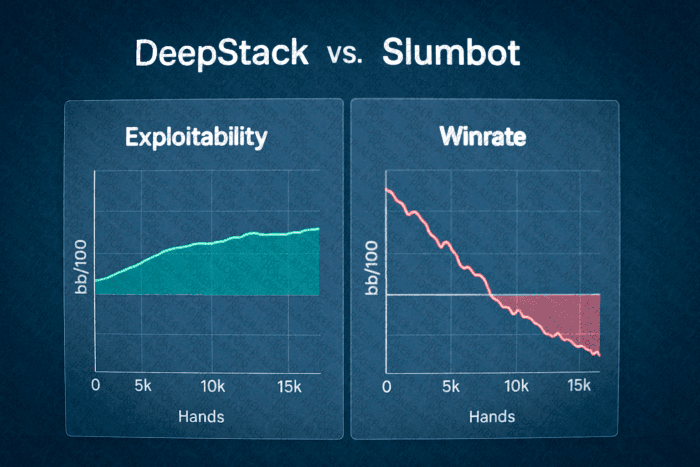
The reimplementation of DeepStack in practice loses to Slumbot. I observed data: reimpl lost 63 mbb/g to Slumbot despite still having low exploitability. That contrast became one of the first real-world lessons in Supremus poker AI research, where raw theory met practical results. That paradox struck me as strange – low exploitability yet losing all the time. I noted human-like error. Author’s note: I have always wondered why deep counterfactual value networks had not become more commonplace. That’s because the version of DeepStack lacked head-to-head strength, even though it was a milestone in the development of poker A.I. software. That made me question whether AI poker techniques provided any actual edge beyond theory.
Upgraded CFR variants and richer search: the birth of Supremus with improved poker AI algorithms

Next was the tweak of DCFR+, which increased the rate of convergence. Instead of the quadratic weighting of classic CFR, they deferred policy averaging and used linear weight for clearest results. So they updated both players at the same time and observed faster learning – very much not expected. Author’s note: That was like whittling away at an opponent until they cave. Supremus augment vanilla CFVnets with neural network value functions at the end of each lookahead. That made poker AI strategies more clear. This is not poker cheat or learning to cheat at poker or even poker cheat sheet; this is actually learning machine learning at the poker table.
GPU acceleration and massive training: how poker AI tools scaled
Supremus ran fully on GPU. It went through 1,000 DCFR+ iterations in 0.8 seconds, six times faster than DeepStack. This was a breakthrough moment in Supremus poker AI research, allowing large-scale strategy refinement in record time. The speed meant they could slash exploitability to 3 mbb/g over 5,000× quicker. Training data increased all of the following numbers are in the millions: River network trained on 50, turn on 20, flop 5 mil, auxiliary 10. Compare that to the relatively smaller number of examples used by DeepStack – the flop validation loss fell, from 0.034 to 0.011. I sensed the change – Supremus had turned into a beast of machine learning in poker. Author note: If you can imagine teaching poker bots billions of hands instead of thousands.
Supremus against Slumbot and beyond best poker AI performance
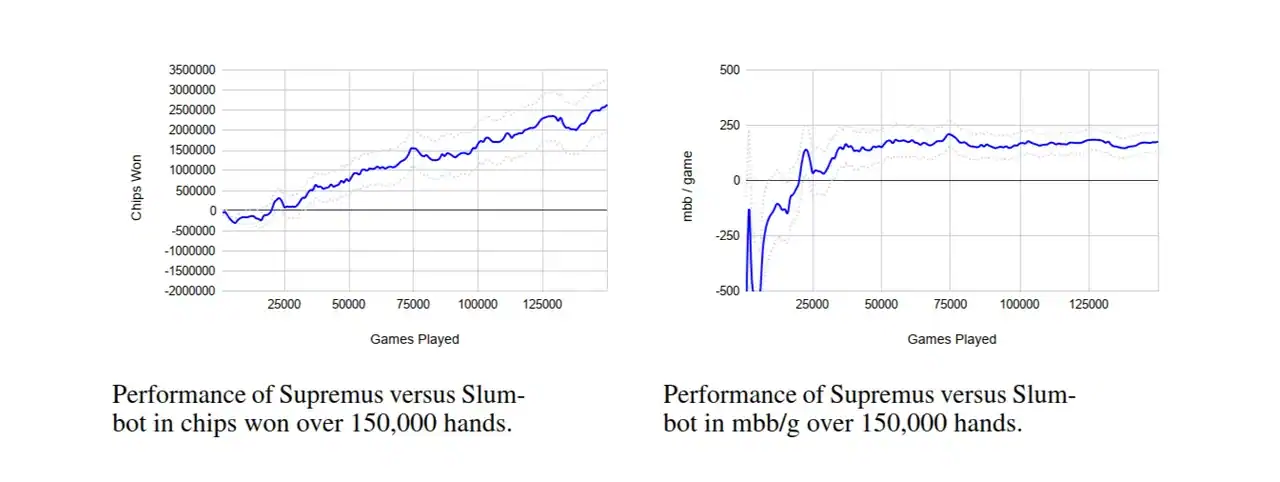
Supremus won 2.6 million chips over 150,000 hands-176 ± 44 mbb/g. DeepStack lost 63 mbb/g. Supremus doubled the profits relative to those of DeepStack. Which made it the best poker AI out of the bots. No speculations about “what if” – just the numbers, unambiguous wins. Performance speaks. We substitute “if DeepStack had done X” with observations. We see Supremus dominates.
My mistakes and reflections on using poker AI software
I confess that I did not appreciate the power of adding little tweaks (e.g., bucketing of action sizes) in changing the behavior of these algorithms. Supremus employed additional action fractions). That nuance matters. I used to be a rigid thinker: classical raise sizes it is. Then I saw Supremus’s granularity. I learned to doubt the assumptions with regard to poker bots, poker AI strategy, and machine learning in poker. Author’s note: I fucked up here in thinking that broarder brush would do it-it did not.
how does poker AI research move forward?
So now I must wonder: where will poker AI go next? Supremus demonstrates that deep CFVnets can be useful. Poker AI software can start to use the same blueprint. The ongoing Supremus poker AI research will likely guide the next generation of poker AI strategies and influence how solvers are designed. We’re continuing to analyze the best poker AI software. More good data, better neural net tuning, and polished continual resolving: that’s what researchers will use to develop poker AI methods. Poker bot studies come back with a swing.
Final reflections from the storyteller
I began with wonder and concluded with data. Poker AI work swung gate from deep stack of papers to Supremus beat Slumbot. There’s an irony in a quiet neural agent besting human pros and bots alike. I entertained doubts (“maybe this is all overhyped”), then surprise at gradients of declining error rates and colossal wins. The story is not a polished one; it’s a journey filled with trial, error, algorithm refinement and billions of training hands. That human spark – uncertainty, curiosity, occasional mistake – exists here.
No clean wrap‑up. My life was not transformed by Supremus but I have seen how poker AI software can beat the earlier poker bots. And I continue to wonder: will these massive deep counterfactual value networks become the norm, or will poker AI once more make a hard turn to new paradigms?