

Poker has been an area of contention among researchers in artificial intelligence (AI) researchers for some time now. Unlike in deterministic games such as chess, no-limit Texas Hold’em adds an additional layer: incomplete information, bluffing, and an enormously vast game tree render solving by raw computation infeasible.
To tackle this intricacy, researchers have developed superior algorithms in AI through combining Monte Carlo Tree Search (MCTS) with adversary modeling. This enables poker bots to search through extensive tree decisions, predict adversary moves, and dynamically adjust methods.
In this article, we’ll be examining just how these methods work, exactly why these methods work in poker so well, and what this suggests about poker in the future.
Monte Carlo Tree Search: Artificial Intelligence in Poker Pillar
Monte Carlo Tree Search (MCTS) is an anytime algorithm in that it dynamically modifies its policy upon increased run time. It is simply to go through thousands of virtual poker hands, monitor results, and utilize these to inform choices.
How MCTS Works in Poker
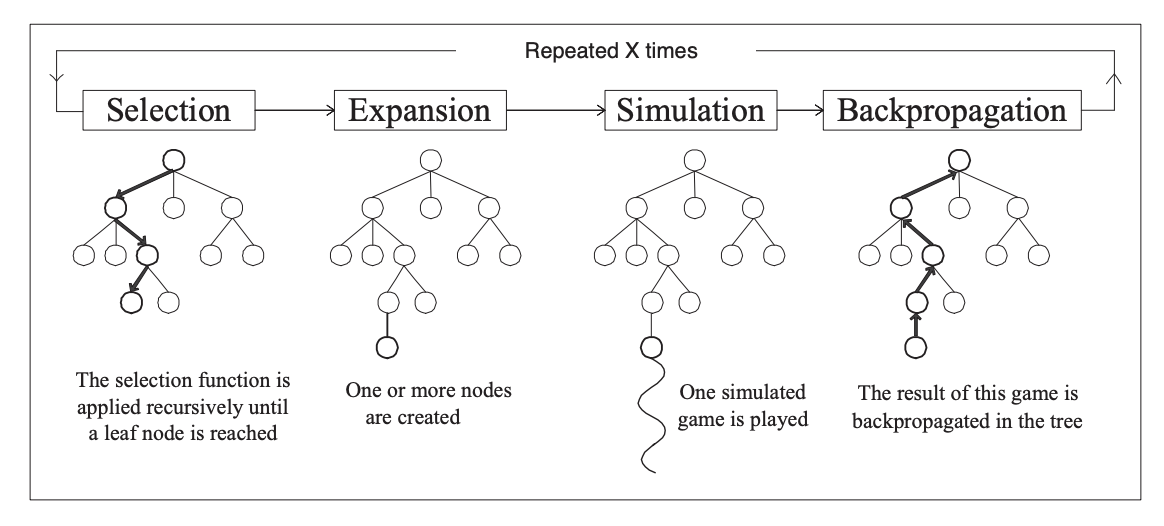
MCTS operates in four overall phases:
- Selection: The computer plays through the game tree by playing most hopeful moves derived through previous computer simulations.
- Expansion: When encountering an unknown situation, the algorithm expands by making additional potential moves.
- Simulation: The computer plays through the game in random order starting with a novel node, making predictions.
- Backpropagation: The computer adjusts its decision tree by strengthening winning moves while obscuring over moves that lose.
This iterative process allows poker AI to calculate optimum moves by not explicitly examining each game situation in an explicit manner, making it incredibly efficient in extensive games including Texas Hold’em.
Why MCTS is So Strong in Poker
- Handles Imperfect Info: As in chess where everything is known, in poker nothing is visible. MCTS provides to approximate about probabilities and decide upon this.
- Scalability: The algorithm does not have to have an overall game tree to run; just computational resources to run in, getting better over time.
- Balance Between Exploitation vs. Exploration: It wisely exploits known profitable avenues and scouts in an attempt to gain improved results through new alternatives.
The success in poker has encouraged widespread adaptation in various areas, including finance, game AI research, and robotics.
Opponent Modeling: Modeling Adversary Behavior
One of the most glaring weaknesses in early bots was that they lacked adjustability in playing against humans. This is where enters in opponent modeling, allowing an AI to keep an eye on player trends and predict.
How Opponent Modeling Works
- Action Tracking: Artificial Intelligence traces every player’s bets, raises, and bluffs.
- Pattern Recognition: Through machine learning patterns and classes opposing players to player categories by identifying patterns.
- Adaptive Strategies: How AI responds to opposition tendencies by making decisions in real time to optimize.
For example, in the case where an opponent always bluffs in later positions, the AI is going to call in these later positions, thereby increasing in overall winning percentage.
Common Player Types Identified by AI
- Loose-Aggressive (LAG): Makes bets regularly, bluffs regularly, and pushes. Exploits by calling regularly and laying traps.
- Tight-Passive (TP): Only folding marginal hands and bets in strength. Artificial Intelligence exploits by playing aggressively against these.
- Unpredictable Players: Artificial Intelligence is pattern recognition to adapt to non-standard patterns in bets by continuously evolving improved algorithms.
The ability to identify these player types and take advantage of them has significantly improved online poker performance by AI.
Clustering Opponents: Bringing Back an Online Poker Game-Changer
Traditional opponent modeling was carried out in static player profiles that used to fall short in opposition to dynamic player moves. K-Models Clustering is an advanced technique which pools similar players by playing style.
Benefits of K-models Clustering
- More Accurate Predicts – As opposed to modeling an individual player, computer is modeling sets of identical patterned players.
- Faster Learning – Artificial Intelligence learns better in adapting by recognizing patterns in each cluster.
- Improved Adaptability – As opposed to processing each player uniquely, now the AI is generalized to respond to player types in an efficient manner.
This technique has significantly improved poker performance by making it significantly more difficult to exploit weaknesses by human opponents.
Real-World Applications: Utilizing AI Poker Robots
Several AI systems have been developed to have both in MCTS and in modeling an adversary:
- DeepStack: The First Artificial Intelligence to Win Professional Hold’em Heads-Up No-limit Hold’em.
- Libratus: A computer system that overpowered top professionals in over thousands of hands to win millions in virtual chips.
- Pluribus: A computer system that was beaten by multiple human opponents in six-player no-limit Hold’em to demonstrate that AI can comprehend multiplayer game strategy.
These systems utilize MCTS, modeling opposition, and cluster to make nearly flawless poker plays.

Combining MCTS with Opponent Modeling to Maximize Efficiency
The true power in computer poker in modern times is in combining MCTS with modeling an opponent.
- MCTS provides an effective baseline policy through probabilistic outputs.
- Opponent modeling fine-tunes this strategy by exploiting specific opponent tendencies.
- Clustering techniques accelerate training by making subsequent training faster compared to earlier.
This synergy allows superior dynamic tactics to be employed by AI over top player-generated tactics.
Ethical Concerns: Can Online Poker Welcome Artificial Intelligence?
As AI grows in sophistication, implications regarding AI-powered poker robots have been brought forward.
Arguments Against Online Poker Using Artificial Intelligence
- Unfair Advantage: No computational capacity is present in humans to solve optimally.
- Potential for cheating: Robots can be used to cooperate by sharing secret card information between each other to achieve an advantageous lead.
- Threat to Online Poker Industry: When bots win, recreational players can decide to leave behind, leaving behind poker room liquidity.
Arguments in Favor of Artificial Intelligence
- Enhancing Training Tools: Many professionals now utilize AI in post-game analysis to support improving tactics.
- New Challenges to Human Players: Playing with an AI player obliges humans to change their playing style.
- Innovations in Artificial Intelligence Research: Artificial Intelligence Research in poker has produced breakthroughs in non-gaming applications in machine learning.
As a result, most poker establishments now utilize AI recognition systems to prevent bots while allowing AI-powered analytics to be employed to prepare training.
The Future of AI in Poker: What’s Next?
The evolution of poker computer programs raises key questions:
- Will online poker rooms have to have an AI detection system in place? Online poker players fear cheating.
- Can AI be used to train humans? Professional poker professionals have been training with computer simulations.
- What’s the next breakthrough?
The next breakthroughs can be in in-game adaptation in which in gameplay, AI can change in accordance with experience gained in gameplay. As AI grows in sophistication, poker technique is just going to continue to get better.
Conclusion
AI has altered life in poker to an unprecedented extent with Monte Carlo Tree Search, modeling oppositions, and cluster algorithms bringing game technique to unimaginable levels. As these tools keep improving, poker robots shall improve by leaps and bounds to challenge human competitors in unimaginable ways. Whether you’re an amateur player of poker or an AI researcher, something is certain: poker is no game anymore, leadership is now in AI.