How Regret-Based Pruning and AI Poker Algorithms Shape Modern Strategy

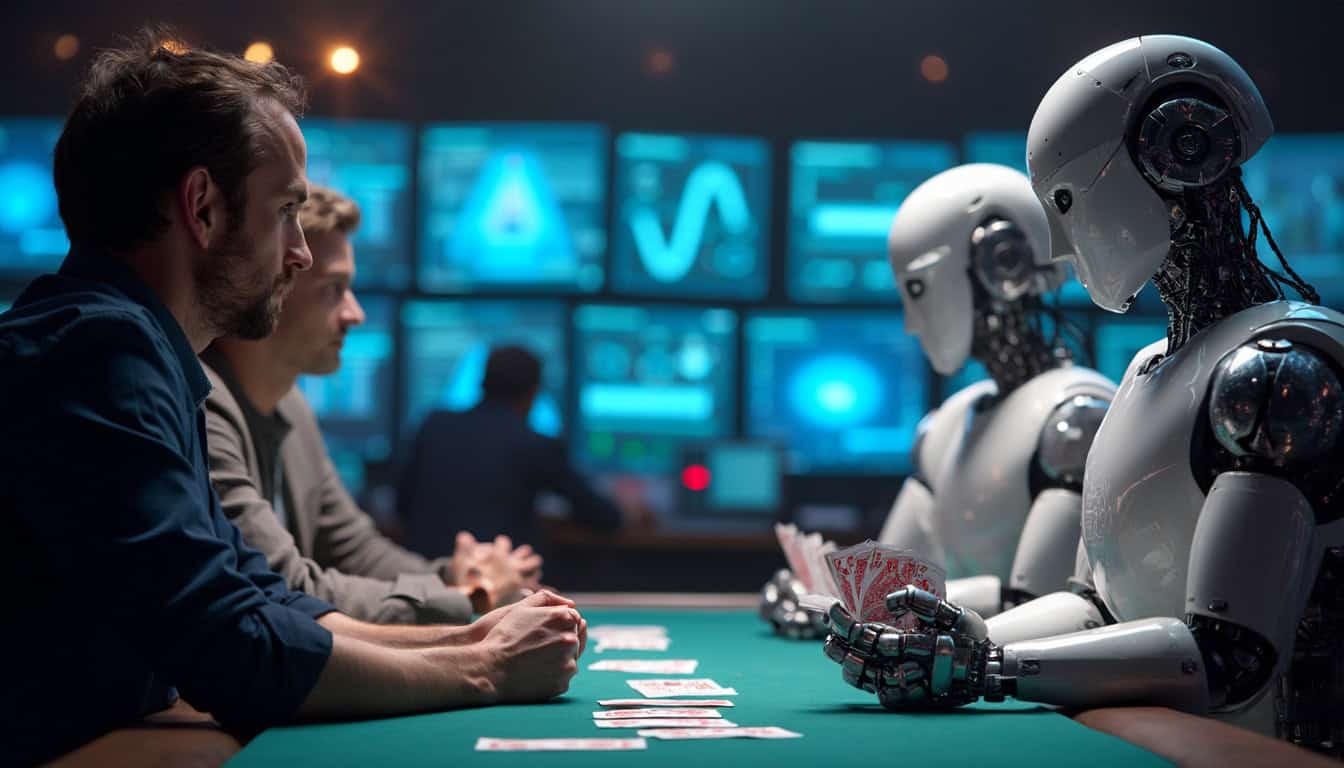
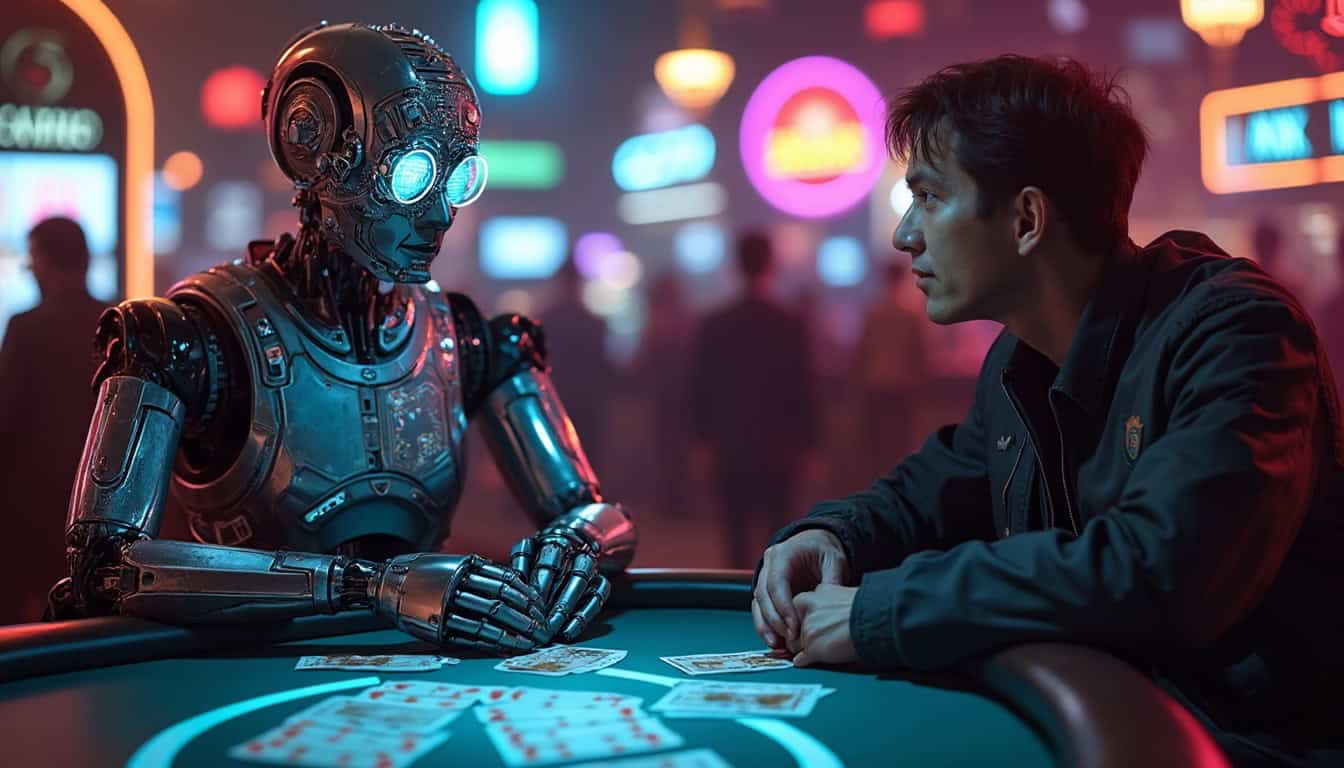
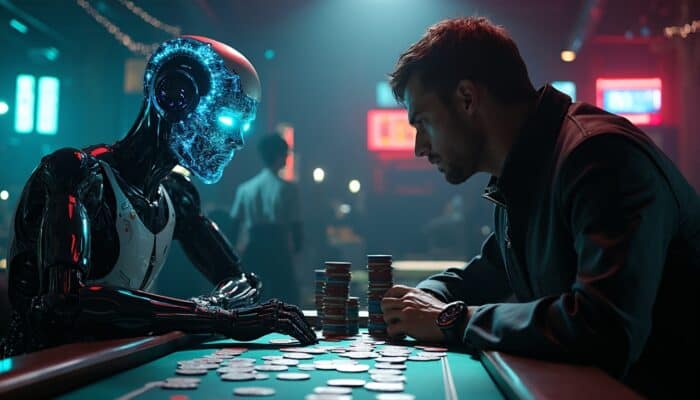
AI poker robot facing a human player at a high-tech poker table, with neon lights in a modern casino. Poker chips and cards are placed between them. The robot analyzes cards using an AI poker algorithm.

Pruning the Fat: How Regret-Based Pruning Will be the Future of Poker Strategy AI

Poker, after all, is a cutthroat game even in conditions when the smallest advantage is what makes one’s fortune or breaks it. How about this for a scoop: the future of poker doesn’t lie in the cards dealt but in an AI poker algorithm that analyzes the cards? Welcome to poker AI, where the machine won’t play the game, but with surgical precision, it will think over every move, turning every regular hand into a math masterpiece.

Secret Sauce — How Poker Bots Think Smarter, Not HarderA glowing holographic brain floating above a poker table, representing how poker AI algorithms analyze strategies. A poker bot sits at the table, calculating its next move with poker AI software in real-time.
So, let’s talk about something that literally sounds just about as exciting as watching paint dry but is, in reality, the heartbeat of modern poker AI: regret-based pruning. The basic idea here is slightly similar to the Marie Kondo approach toward algorithms—ditch a possible strategy that is not providing as much of an effective outcome as it should, at least for the time being.
It’s almost as if it taps into that great poker intuition out there, knowing what roads not to go down and which roads might lead to gold. Indeed, such an approach briefly sheds light on just how rudimentary the development of poker AIs with the fullest strategy set is.

From Humble Beginnings to Poker AI Dominance: A Success Story in Regret-Based StrategiesTimeline of poker bots evolving from simple designs to advanced AI machines. The poker AI development progresses toward sleek, modern designs dominating poker strategies.
Those early poker bots were like that one friend who always hits on 16 in blackjack: just consistently idiotic. They calculated the moves but once in a while, clearly went down some losing path. Then came the CFR, basically going: “Dudes, what if we just don’t waste any time on the losing moves?” And just like that, an era of poker AI arose—not just to play, but to learn adaptively and strategize.
But the real magic happens during regret-based pruning, which overdrives that. The algorithms slice through all this possible waffling and go straight to what really matters. And that yielded leaner, meaner, slicker poker bots that would give even grizzled pros a run for their money.
That is, in a nutshell, the core of modern poker AI research: constructing ever more brilliant and efficient algorithms which outplay their human counterparts.

The AI Poker Revolution: When Machines Learn to BluffA poker bot smirking as it holds cards close, preparing to bluff against a human player. The scene demonstrates how AI poker is incorporating human-like bluffing strategies into its gameplay.
Then that, of course, raises another question: are we developing unbeatable poker AI tools, or are we just training them in how to play like us, only better? Of course, the addition of elements such as bluffing in the game brings AI poker strategies closer with every hand to that line that separates human intuition from machine precision. In short, these human elements—the nerves, the tells, the gut feelings—that are said to be part of poker make it real exciting to watch a machine calculating not just the odds but when to fake it.

Can Poker Have a Future Which Includes AI Bots Leaving No Place for Human Players?A futuristic poker room filled with AI bots facing off at a table. Human spectators watch as the AI bots dominate, representing the rising power of poker AI algorithms in the game.
And it was during such times as the strength of these AI poker algorithms grew year on year that coincidentally, so too did there come to be an accompanying sense of nag—or thrill, depending on your perspective—that humans are about to get outmatched in this respect. Just imagine coming into a poker room where each opponent has been perfected from one algorithm into the next with the capability to make immediate decisions even the sharpest minds would take several hours figuring out. It’s a brave new world, and not quite here yet, but the writing is on the wall—or rather, in the code.

Conclusion: Taking Up the Poker AI Frontier

What does this portend for poker’s future? It calls to arms the skills honed in a battle of wits against the machines. For some, it’s the very tool whereby they learn what they must master before long, and eventually, take over the seat. Friend or foe, whatever the case, in no uncertain terms, one simple truth shines: The game is never going to be the same. Whether a hardcore lover of the game or someone who enjoys the thrill, let’s have a quick look at how machine learning in poker is sweeping through. As the great song lyric goes, sometimes in poker, as in life, the best way to win is to know when to fold—and let a bot take the wheel.
724 Words

The Rise of Poker AI: When Machines Learn to Bluff

Poker table with AI and human players, featuring a robot and a human in a tense poker game. The scene includes poker chips, holographic data, and an AI system analyzing poker strategies. AI poker, poker AI development, and poker bots are highlighted.

The Poker Bot Revolution: How AI Forever Changes Poker

It was advanced beyond comfortable recognition in 2024 that this game was transformed by a revolution that no one ever thought of due to advancements in poker AI design. Where the poker game has and always was under the exclusive control of human psychology and gut instinct, nature was making poker rebrand itself: from machines that are apt in calculations to machines that were even more apt in adapting or even bluffing at an unsettling level of precision. There is a new series of poker bots that are now overpowering amateurs and professional players alike.

The newest wrinkle in this software is, Counterfactual Regret Minimization and deep reinforcement learning in poker AI, most prominently in one called Pluribus, which took on human champions at complex, multiplayer, no-limit Texas Hold’em and outplayed them. They are playing so human-like and devising strategies that no human has ever really though about, and placing poker AI research at a whole new level for theorizing game play strategies.

Poker table with a human player and a poker bot, featuring a robot with sensors and a human in a classic poker suit. The scene includes poker chips, displays of poker AI algorithms, and a futuristic AI system analyzing the game. Highlights the impact of poker AI development and the role of poker bots in modern poker strategies.

How Algorithms Outthink Humans: How Poker AI Works

Where poker is allowing AI to have two of the biggest features that are essential to the art of playing, that is, AI will play poker: making decisions under conditions of uncertainty, and learning to bluff. Previous popular methods of playing or developing strategies for poker games of poker have probed human emotion and reading human behavior, until now, since poker AI algorithms flipped the table and bet the farm on data, rather than intuition. Techniques like CFR are pushing poker bots with techniques to minimize the regret of an optimal decision using thousands of simulations of games. More importantly, today’s AIs’ neural networks are developed to recognize specific patterns in extensive data repositories. Most importantly of all, the furthest these most-flat-out-avant-garde of platforms have come—after ventures from places like Carnegie Mellon or even Facebook—uses multi-agent learning to enable that AI to adapt in real-time against massive numbers of different opponents. But while the scope of capabilities has always been derided as fake or a gimmick, never before have these “tools” actually started to change the game of Poker across each of their lines of play; and it is interesting to see that with the emergence of Poker AI tools—even the more advanced strategies, that are essentially unreachable for any human—are now available.

Less Obvious: AI Impact on Other Industries

Interestingly, Poker applications go far beyond just AI or casino tables. The ability to intuitively decide when one has “limited” information-a skill that comes so easily in Poker-is now being echoed in fields like finance, and risk from trading algorithms are being modeled using Poker AI development patterns. There is also recent interest on how machine learning in Poker assesses and predicts future actions in diplomacy and even cyber security, and the outcomes there are also Poker-worthy.

And importantly, poker AI research is now even informing the health sector. It is this capacity to analyze uncertain situations, just as a poker player can, to support a diagnosis in medicine. When you have to decide how to move forward when you don’t have enough information to do so safely?; you don’t have as much time nor accuracy to consider it as you have been afforded doing poker AI research.

Futuristic poker tournament scene with human and robot players. The robot has a metallic face and is analyzing data on screens, while the human player shows signs of tension. The scene features poker AI tools and the competitive dynamic between human and poker AI players.

Poker AI Players vs. Humans: A Whole New Competitive Dynamic

Poker AI is advancing at a staggering rate of sophistication and the new dynamics are apparent when considering the relationship between man and machine. Poker bots like Pluribus and DeepStack, outperform humans in pure strategic processing, yet we still humans have one formidable edge over them: emotion. Perhaps within this realm, once poker AI algorithms reach parity with human skill, they will have added a layer of emotional intelligence resembling the ability to read, and then mimic human emotions at the poker tables.

Continue reading →

1,032 Words

The Unstoppable Rise of AI Poker: Are We Doomed?

A human player faces off against a poker AI opponent at a poker table, with digital data floating above the table.

AI poker has been making its incursion, with depth and guile as that fox in the henhouse, upon the world of cards. It is at this juncture and truthfully seated at the table, shuffling the deck, and dealing itself a winning hand. The mere idea might have Doyle Brunson rolling in his cowboy hat, but here we’re living, in a world where the best poker AI can outplay even the most battle-tested human pros without breaking a sweat—or really even having the capacity to sweat, for that matter.

AI Poker Research: The Game Changer We Never Asked For

In fact, poker AI work is one of those typical stories whereby “nobody asked for it, but here it comes anyway.” It all started harmlessly enough: all that these researchers wanted to see was whether they could teach a machine to play poker. But as in every great sci-fi movie involving world domination by evil robots, the AI not only did it learn the game, it mastered it.

How the poker AI development community, with all their brainiacs and game theorists, must have never envisioned such a thing-making up a table on humanity-would happen in this way: so expeditiously. But they did, and now it is time we are, well, tried by our own creations.

That’s a little bit like Dr. Frankenstein needing to teach his monster not to stomp on villagers, except this time the monster is a digital brain that can work out odds faster than you can say “all-in”. And then there are poker bots: these little digital demi-demons that can simply grind out wins day in and day out, no need to sleep or do anything aside from, from time to time, having an existential crisis.

Strategies Employed by Poker AI: Algorithms Mind-Bluffing

Human and poker robot players engaged in a poker game, showcasing poker AI strategies and digital schematics projected onto the table.
There is something just a little bit. poetic about the algorithms involved in poker AI. They are, in reality, perfect poker players: entirely unemotional, ruthless, not leaving anything to those bad beats that may upset them. But let us get to the real kicker: poker AI strategy. Not your taken-from-a-book, sitting-on-some-shelf-gathering-dust strategies, these guys help you wonder if there is still any fairness you can leave in the game. Imagine a player across the table who will never tire, never make mistakes, and get nothing from your bluff, just because he had already known. That’s playing chess against Deep Blue, but this time, Deep Blue has a poker face on, and it’s doing it well. The future of poker is no more about playing the cards but about outsmarting the algorithm.

And good luck with that—because while you’re trying to read a tell, the AI has already simulated a thousand possible outcomes.

Machine Learning in Poker: Algorithmic Hustle

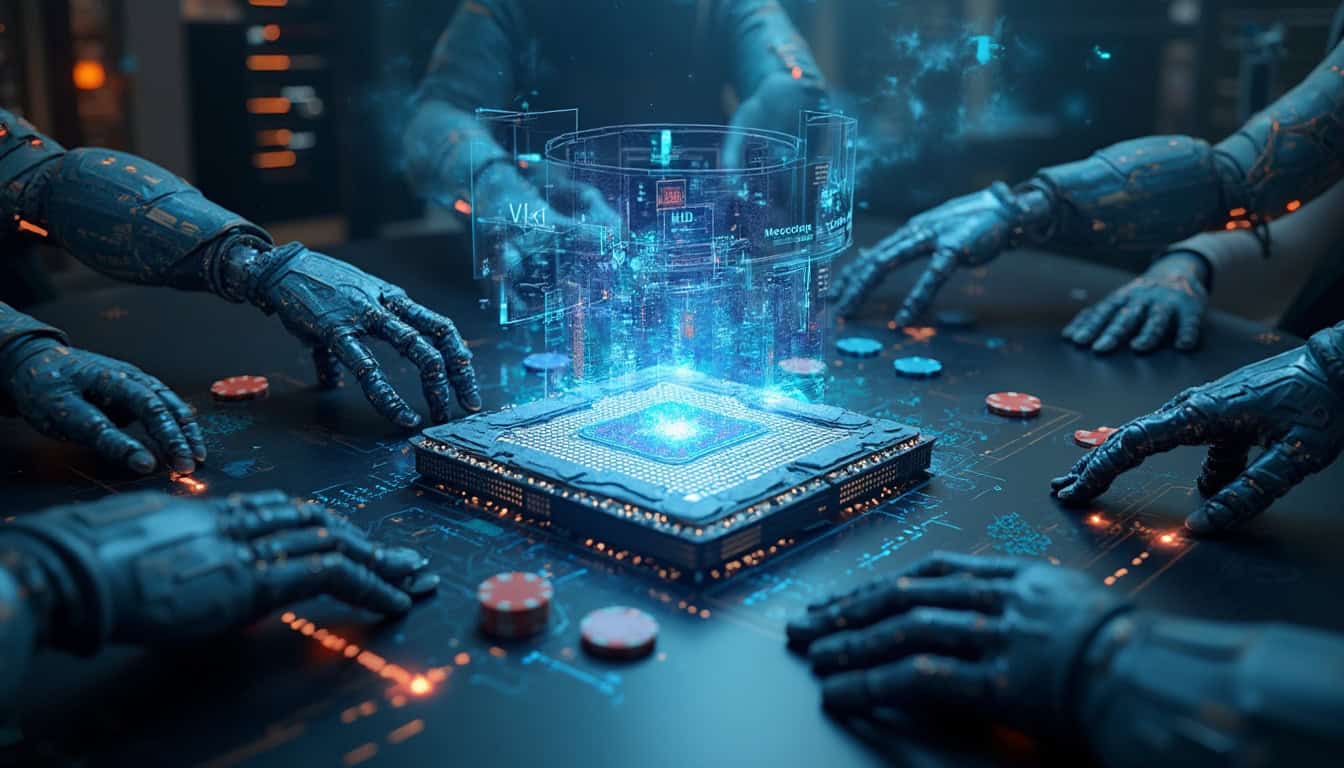
A computer chip playing poker, surrounded by holographic screens representing machine learning in poker and poker AI tools.
If you’re thinking, “This sounds like science fiction,” you’re not far off. But machine learning in poker is very real, and it’s reshaping the game in ways we’re still trying to wrap our heads around. Every hand, every decision, every fold—these machines learn, adapt, and improve. It’s like they’re constantly downloading updates while we’re stuck trying to remember if a flush beats a straight.

Continue reading →

1,009 Words

Accelerating the Computation of Best Responses

In another vein, the world of poker is vast and complicated, and every decision made within it is important. Whether you bluff your way to victory or fold at the perfect time, distilling the best response can be your optimal move. But what if I told you the process of finding that best response need not be as grueling as it used to be?

Now, with large extensive games, say poker, it is the size of the decision tree that can leave you dizzy. Traditional methods too often required a complete traversal of this tree—an activity as laborious as it sounds, particularly across millions of possible game states. But there’s a silver lining—a way to skirt the insanity and get to your best move faster than you ever thought possible.

More recent progress has brought techniques that drastically cut the time and computational power needed to evaluate strategies in games, including two-player limit Texas hold’em. Instead of calling each branch of the decision tree with great precision, we jump around, zeroing in on the relevant branches while ignoring all the dead ends. It’s as if it were a GPS system that can track the course in shortest direction and predict the obstacles of traffic and just avoid them.

The trick is to come up with clever abstractions and worst-case performance evaluations. The best response can be computed quickly and intelligently if the game is broken into smaller pieces that are easier to manage and takes into account only the important scenarios. These procedures cause the process to be quicker and more intelligent.

Just think about it: being able to simulate thousands of poker hands, tuning your strategy all the time to these accelerated calculations. You would not only find yourself playing many more hands but also making much better decisions than your competition, whose major preoccupation would still be whether to call or fold.

This kind of computational efficiency is not just theoretical; it is fully used right now to strengthen poker strategies to get a tuned edge sharper and more reliable. These optimizations in best-response calculations could become your new best friend, be it the developer of tomorrow’s poker AI or the inquisitive player looking to up his game.

In essence, a future in which you make split-second decisions with the power of optimized algorithms will be at your fingertips. a savior from the impossibly scary complexity of the game world, a companion to save you from thinking too much. So next time you’re seated at a poker table, remember that it’s not all about playing the game, but about playing it right and fast.

Keep watching as we take an inside look at how these techniques are changing the game and what exactly it means. Both for human players and AIs, the future of poker is hastening, and the time to get it is now.

479 Words

A Journey Through Regret Minimization and Poker AI

I remember when I found Richard Gibson’s Ph.D. thesis from the University of Alberta. It was a massive document detailing regret minimization and strategy stitching in extensive-form games, in this case the example of three-player limit Texas hold’em. This one stands out to me because it was created at the most fundamental turn of my learning and discovery to become a poker AI developer.

At the time, I was very engrossed with my studies, and therefore had little appreciation of the nuances of game theory, and how it expresses itself in poker. Gibson’s work was very helpful. His study of Counterfactual Regret Minimization and its application to the game of poker provided me the sound theoretical basis I was in need of, at the time. His research had immense practical applications, and I was already thrilled to begin to use some of these concepts in my projects.

One night, at the end of a long day of programming and reading, I came across Gibson’s Chapter 5. He proposed novel algorithms such as Probing, Average Strategy Sampling, and Pure CFR – they sounded more like practical tools to address computation times and memory costs than theoretical novelties. It was a gold mine for someone in the position I was in, facing such limited computational resources.

His work inspired me to attempt to build some of these algorithms into my own poker bot. I can remember those nights debugging – a cup of coffee in one hand and Gibson’s dissertation in the other. Then, there was one particular night where things just clicked. My poker bot, which had been floundering, not even close to making profitable decisions, began to show signs of improvement. It was as if Gibson himself was jointly guiding my hand through all the complex subtleties of CFR and its potential applications.

It was most rewarding to test my poker bot in a small online poker tournament. I enjoyed it sailing through hands with its new found efficiency and reviewing its strategies. After all the study, programming, and sheer will, it came down to that.

It is pretty incredible how far we have come in poker AI from those times. All of the theories and algorithms that had previously only occupied the realm of academic papers have now made their way to advanced poker bots. And it all began with the inspirational works that pushed researchers like Gibson towards contributing.

Anyone interested in how the poker AI worked or how all the strategies came to be, should really check out the resources, and see what’s out there today. And if you ever get lost in the complexity, just remember, every great endeavor in AI emerges from a single line of code, and a whole bunch of curiosity.

Continue to learn, continue to program, and maybe one day your project will be one of the trend-setting projects in the world of poker AI.

Best regards 😉

485 Words

Poker Bot Philosophy

crazy coder of poker AI bot

So, I am an Artificial Intelligence enthusiast. Of course, developing AI that plays poker means—more than once—you are banking into some of the deeper philosophical questions of our time. Not about the meaning of life or if pineapple belongs on pizza—it does, by the way—but actually something a bit more important: the nature of poker and how to model it for a bot.

First off, let’s break down poker. Obviously, it’s a game. To a bot engineer, however, poker is all about systems—systems of rules and interactions. Poker doesn’t represent cards or chips but the players. And it really doesn’t make much sense to have a poker game without a player, much like having a computer and never putting it on the Internet.

It’s a blend of game situation, history by opponents, own mood—and the phase of the moon. Yes, some players are that superstitious. And that is exactly what makes modeling a poker player interesting and challenging—the mix of logical and illogical.

The comforting thought, in all of this, for engineers is that poker really does represent a finite number of states. Every player begins with some chips; there’s only so many cards are in the deck; at any time during a game, the number of possible moves is limited. It’s a godsend when trying to model a game. The idea of trying to model an infinite—it’s like trying to find the end of the internet.

Now, this is where it gets interesting. Players don’t do the same action in the same situation all of the time. They mix up their choice: make decisions like “I’ll fold 45 percent of the time and call 55 percent of the time.” It’s this randomness that your poker bot has to emulate since in poker, when you become predictable, you’re dead.

But that brings up a difficult-sounding concept: If players can make mixed moves, that must mean I have to model an infinity of possibilities. Thankfully no. While it sounds daunting, it’s really an issue of accuracy. As I take small changes in a player’s mixed strategy, I get small changes in expected profit to that player. It’s not about modeling infinity here, but how much reality one can cope with without going nuts.

Now, let us take a look at some strategies that make things simpler. Whether a player’s head is full of brains, sawdust, or algorithms, their strategy can always be reduced to being representable by a Look-Up Table of decisions. That is, the table says what to do given any situation. Now, when several players with their LUTs sit at the table, this goes down into an increasingly exciting strategic interplay with expected profit.

The temptation of infinity had mixed moves. Let us kill this myth at once. Imagine planning to play an infinite number of hands. It is just impractical. We think in terms of finite sessions and look at the expeeCTed profit over these sessions.

Consider, if you call, profit may be $40, and in case you fold, it could be -$10. Mixing your move leads to profit calculation, like: 0.4 * $40 + 0.6 * -$10 = $10. Small changes in these mixed strategies will alter expected profit only slightly, proving it about precision, but definitely not infinity.

To drive the point home, let’s consider some practical examples. Suppose, for example, that you sit down at the table behind a stack of $665. You are against a superstitious opponent who always folds when he sees the number 666. Suddenly, what had, to this point, seemed to you perhaps like a small difference in your stack size may very well make a huge difference in your expected profit. It’s those kinds of quirky little details that make poker so fascinating and maddening all at once.

There you go. Modeling a poker bot includes finiteness of the game, introducing randomness into mixed moves, and simplification of strategies into something our bots can handle. A mix of philosophy, math, and a dash of humor is added.

663 Words

Heads-up Limit Holdem Poker is Solved (thanks to CFR+)

In 2014, researchers at the University of Alberta used their CFR+ algorithm to successfully solve this poker variant, which is quite impressive. They analyzed 3.19×10^14 decision nodes! This would be like trying to count all the stars in a galaxy except instead of stars you are counting more complicated poker hands and betting strategies.

The best way to think of CFR+ (Counterfactual Regret Minimization Plus) is that you are playing a game of poker against yourself, but not just for fun – you are trying to be the best poker player possible. That is exactly what the CFR+ algorithm does. It has no idea how to play, and simply makes random moves. At the end of every game, it looks back at its decisions and thinks, “if I had done this instead of that, would I have done better?” and it will change its strategy by favouring better moves more often.

You could think about this, like learning how to ride a bike, but falling the first time and every time until you don’t fall anymore. Every time you fall off, you learn what not to do next time. CFR+ does this over billions of poker games, learning a strategy that minimizes its ” regret” which is the gap between a the move it made and what the best move would have been. The result is a strategy that nobody can beat, just as you eventually learn to stop falling off your bike and can start riding smoothly. By averaging over all of these games, CFR+ discovers a so-called Nash equilibrium in the sense that it constructs a smart enough strategy to never lose over the long run with any adversaries, including the best of the best.

I am especially fascinated by the fact that this strategy supports some long-accepted truisms about poker while rejecting others. For example, it can almost never “limp” (call the first bet) and any respectable player would acknowledge this with a simple nod of their head. It shows that sometimes you can have a better chance at being capped with a pair of twos (by raising the final bet) instead of a pair of aces. I can picture an experienced poker player reading this from home and saying “No Way!” while right at the same time they are reading it on the screen wondering if they are reading this correctly.

This study has provided humans with a great deal more than just a solution; it facilitates decision making and strategies of human players. The study implications go well beyond poker. These types of algorithms have immense applicability in situations to inform uncertain decisions and strategies in many other large decision invoking fields including security and medical. I wonder who would have even guessed that tools developed late at night playing poker could eventually figure into airport security protocols.

Turing once justified his gaming algorithm work because, quite frankly, it was hard to see as anything other than a jolly good time. This study attains that spirit. Solving for poker was more than just a scientific possible; it has been an interesting intellectual project. If only we could all have jobs that comprised solely of playing games all day for the purposes of science.

Lastly, it is clear that humans have been playing poker for thousands of years, and we have barely scratched the surface of the interplay of decision strategies. And who knows. The next big break through will be a study on another board game, like monopoly, where we will end up figuring out the exact strategy to deploy, so that family game nights end without everyone flipping the board up at the same time in frustrated despair…..

611 Words

Miximax-based betting approach

I’m reminded of a wonderful paper (Davidson A – Opponent Modeling in Poker: Learning and Playing in a Hostile, Uncertain Environment) that I found years ago. At the time, I was involved in coding projects and each time I felt I learned something new, it was like an epiphany. Now I can recall some of the best bits, although the details are somewhat hazy.

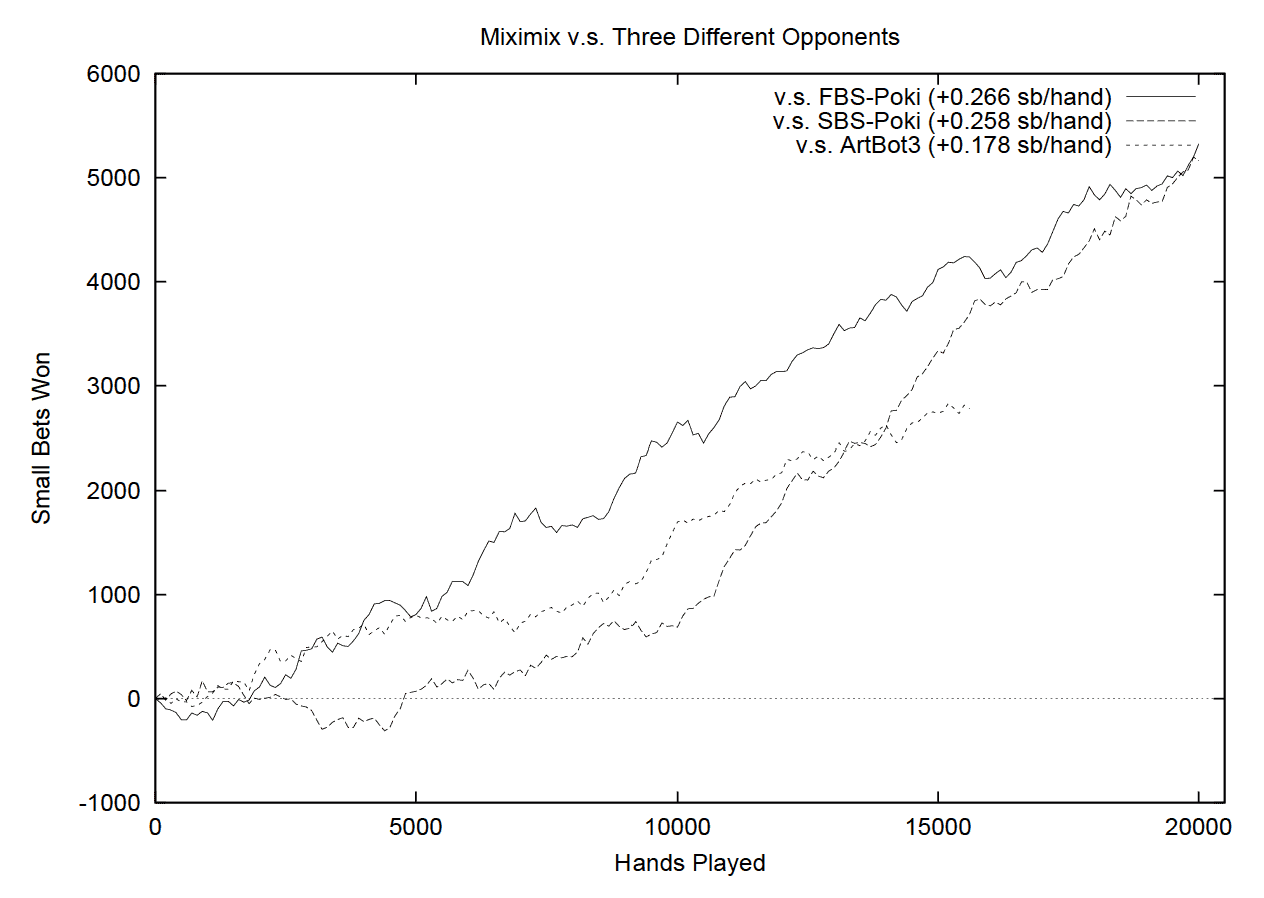
Davidson compared the Miximax-based betting strategy with three other programs, FBS-Poki, SBS-Poki, and ArtBot. ArtBot was a rather random player, most effectively passive. It was like playing with someone who is inconsistent almost out of a deliberate range of options. So, winning a hand against ArtBot helped, but the potential pots were small, so there aren’t any hundred thousand dollar pots. ArtBot did outperform FBS-Poki, who was a bit of a pushover, with about +0.35 small bets per hand won.

It is like having a range of different sparring partners to practice your moves with. Davidson was putting the Miximax player into play here, she began from nothing and had the ability to sometimes use a strategy developed during the previous games. This Miximax is not just a min-max player. It was a Miximix – a modified version, which does not always take the highest EV move. You can think of it as these are adding an element of randomness that is necessary so the Miximax player does not become predictable and limited to its choices and ensures it has open options when playing.

So, how did it go? Early on, Miximax struggles a little (as the simplistic new student might struggle with their first few games); but once Miximax understands the opponent-type, then it starts building up chips. Average over the FBS and SBS approach and Miximax is +0.4 small bets to +0.5 small bets per hand. ArtBot is struggling more, getting between +0.1 and +0.2 small bets every hand. The fast changing patterns of ArtBot seems to expose Miximax’s context trees flaws.

Then, Davidson adds a really interesting part which is only scratching the surface. The AI should the learn faster, either by developing further context trees or borrowing ideas from previous opponent models. The most frustrating is developing this into multiplayer games where the game tree is immense. Davidson hints that this may be too challenging to handle with more players unless they make shrink the game tree in a major way. This was difficult when desktop PCs could only run at 1GHz, and 4GB RAM was a lot of processing capacity. But now, not an issue.

I also remember that Davidson has this incredible finish where he quotes Josh Billings. Billings said “Life consists not in holding good cards, but in playing well those you hold”. In poker as in life, making better choices with what you have often overruns pure luck.

Miximax

There’s this figure which illustrates Miximax’s performance versus different opponents. It is really clear that as the AI learns more about its opponents it adjusts and drives up its win rate. Of course it might be erratic at first, but then it settles down once it begins accumulating data, just like the way that we humans all learn by our experiences.

So ultimately Davidson’s work illustrates that building a poker AI is more than just playing the numbers game. Its about operating through a shroud of uncertainty, and generating reasonable estimates based on patterns and probabilities. If poker and AI interest you, or just watching machines operate within games, this is a great read.

579 Words

Poker AI for Texas Hold’em

I’ve looked over some of the past work on poker AI, but after a long day of work and a few beers, I might be a little slow this evening. Nevertheless, I have had some time to read this paper on AI for Texas Hold’em, and I started to think about how we could make machines learn to bluff better than the average person.

To start, poker is more than a card game. Poker is an enigmatic fusion of statistics, psychology, and a dash of magic. Have you ever tried to guess if the guy sitting opposite of you is going to raise or fold? That is comparable to guess what my cat wants for dinner: impossible. So after the dust of chaos has settled, you look to artificial intelligence to help manage the storm.

Building a poker AI is like trying to teach chess to an infant, but with fewer snacks and slightly less chaos (most of the time). You will start with the basics: you first want to teach it to identify strong hands. Of course, there is a charm to poker because it has an element of randomness — you do not get to see the hands of your opponents. You want the AI to have to deal with partial information, to learn to make intelligent predictions, and to not think too poorly of itself when someone puts the hammer down.

For example, you are dealt the hand A♣ Q♥. The flop shows 3♦ 4♠ J♥. So, your AI has to determine, “What are the odds that this hand is any good?” It’s a bit like deciding if the leftover pizza you have in the fridge is still safe to eat a week later. Spoiler: it probably isn’t and your AI has a ~58.5% chance of getting it right. However, the more players involved, the odds decrease like your WiFi does during a critical Zoom call. Your shiny A-Q does not win only ~6.9% of the time against 5 opponents. Ouch.

Then we come to “potential” – as in, your hand is not great, but if you get lucky, could potentially give you a royal flush. It’s like gambling on your startup’s future success with 0% chance of prevailing. Take for example holding 6♦ 7♦ with a flop of 5♦ A♠ 8♦. Not looking good? If you hit the perfect turn and river, you may get a straight flush instead. So now your AI must go from “I’m screwed” to “maybe there’s a chance I will win!”

Before we move on, let’s talk about your opponents, because this is not solitaire! Your AI also has to model opponents in order to infer whether they are tight or loose, aggressive or passive. It’s like trying to figure out if your neighbor will give you your lawnmower back on time. Your AI uses neural networks, Bayes, possibly even something called particle filtering (whatever that is). I guess it’s like waving a magic wand over your opponent to try to guess their next move.

To increase the awe factor even more, your AI creates game trees for every possible outcome.It’s sort of like trying to think through, simultaneously, every possible conversation with your employer – it is helpful but tedious. And these trees help your AI reflect on the best course of action based on that value of every action. Raise, fold, call – all plotted out.

And now the goal is for AI to get smarter and better. Over millions of hands, it learns and becomes a poker master. Isn’t it somewhat similar to your child suddenly improving their score at a video game after 6 hours of virtual practice? Or like, your cat finally perfected the skill of knocking things off the table.

Continue reading →
826 Words