
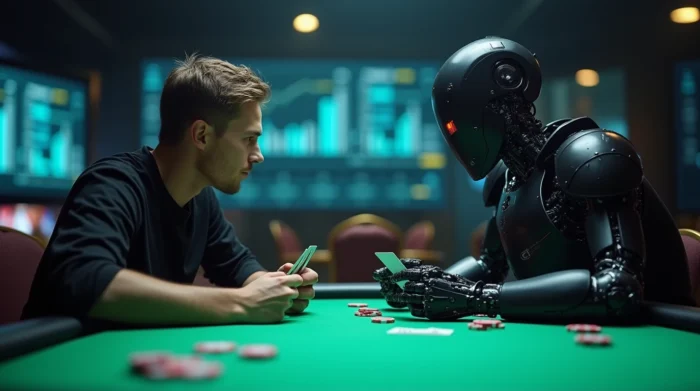
I’ve always been intrigued by the poker world; the combination of luck, strategy, and psychology is so thoroughly satisfying that it would be challenging to replicate that depth of feeling in any other game. Every round, every hand, every opponent has a unique psychology that can ruin you or build you back up. But what if I told you that the times of staring into someone’s eyes for the best guess of their next move might be numbered? Given my own line of work, I’ve seen the integration of artificial intelligence (AI) make inroads into all aspects of life, including poker.
Poker AI isn’t simply about calculating odds and running simulations; it is learning how to play a game that involves human emotion, manipulation, and uncertainty within a model built around it. I initially started my journey into poker AI research based on a very simple question: can we teach a machine to bluff? Spoiler alert: Yes, but not how you might think.
Poker has always been a lot more than numbers for me. My journey into poker began while studying probability theory, first at Moscow State University and then at Cambridge. Poker was a substantial piece of the most interesting pieces of mathematics at the time, and I developed numerous challenging mathematical models in the process. Then, as I began to work on artificial intelligence-related research during a postdoc position at MIT, I began to think of poker more than just a game, but as a model through which to stretch the boundaries of AI.
Let me be clear: AI poker bots are not the magic formula to confidently win against every player at every table. They are very impressive and can analyze an enormous amount of data in just seconds, calculating literally every possible outcome. But poker is not chess. It’s not a perfect information game, and that’s where it gets interesting. The human factor—bluffing, irrational moves, and sleepiness—brings some uncertainty into any AI’s decision-making function. Even with a perfect poker bot we have developed, it can get stuck on how to address the unknown, and that’s a big part of what makes poker AI cool.
In my short history with poker AI, I find it is a little quirky to watch poker AI play. They are cold, rational, and ruthless, but completely unaware of the nuances of human behavior. They don’t get nervous. They don’t waiver. They just act based upon the information they have received. This can lead to some absurd situations—for example, being at a table with an AI that never tilts, never folds under pressure, and just occasionally makes hilariously bad reads because it missed that subtle, human only cue.
Poker AI has really advanced significantly. The algorithms that I have personally helped develop over the years have changed how amateurs and professionals play. These machines not only play to break even on the best money lines; these machines plan to take advantage of every mistake their opponent makes. Here is the kicker—poker AI is not foolproof. AI cannot always “read” a human person’s decisions as well as another human can, and in a short, time limited scenario, there isn’t enough time for AI to truly adjust. It is like playing chess blindfolded. You think you are good but you are only seeing half the board.
The real magic happens when AI can take machine learning and combine it with an understanding of human behavior. One of my favorite experiments was to explore what we can call “short-term exploitation.” Basically, this means teaching the AI to learn a limited number of hands, figure out the methods of its opponent, and to adjust its gameplay to counter its opponents strategy. This is a particularly interesting space since I genuinely believe the machine gets smarter – or too smart for our liking.
In poker AI development, we usually find ourselves in an either-or scenario. A big part of our goal is to be good at safe play with existing strategies like Nash equilibrium – which usually means the AI minimizes its loss over time. However we also want them to be able to exploit human error, to be able to take risks and get away from safe play at the first opportunity. This balance between the two playstyles has been one the biggest challenges in developing the best poker AI software.
Let’s consider a much simpler example of the game Kuhn poker. This is a great way to test our poker AI algorithms because of its very small size and known strategies. However, even in this limited version of poker, exploiting a human player, how do you teach a machine to exploit that player in under 100 hands? Sure, the AI can calculate probabilities and recommend moves that are “optimal” but when it comes to adaptive play, it’s not particularly quick. But once it gets going, you can bet it’s here to stack you.
That said, poker AI has its moments of brilliance. One of my favorite things about poker bots is their ability to think in ways humans never could, and to view the game from vantage points a human player would never consider. For example, some of the late stage strategies we have developed as an AI have been based on purposely playing “bad” hands to throw off people’s rhythm and confuse them. It’s like playing mind boggle with someone that doesn’t have a mind, if you catch my drift.
The issue of whether poker bots are ruining the game is a real one. Some purists argue that using AI is just cheating, while others argue we are going to have to inevitably accept the future of poker as this. I personally view poker AI as a helpful instrument, as opposed to a crutch. Poker isn’t a game absent of humans, it’s a way to augment the game. I’ve played some of the best poker AI in the world and I can say that I do not think the human element is about to completely evaporate from the table.
In short, poker is avast incomplete information game. Regardless of how much poker AI advances, it will never have the ultimate element of poker—emotion. AI might learn how to bluff, how to calculate odds, and how to exploit a mistake, but it will never understand why a player goes all in with a weak hand out of sheer hopelessness, or why a player folds an outright winning hand because of a premonition. Those are poker moments.
As we push the known limits of poker AI, I find myself endlessly intrigued by all of the potential. Perhaps we will one day create a real poker bot that is actually human like. Or perhaps, poker will be the last bastion of the human mind, and we should rejoice in that fact. Time will tell.