The Rise of Poker AI: When Machines Learn to Bluff

Poker table with AI and human players, featuring a robot and a human in a tense poker game. The scene includes poker chips, holographic data, and an AI system analyzing poker strategies. AI poker, poker AI development, and poker bots are highlighted.

The Poker Bot Revolution: How AI Forever Changes Poker

It was advanced beyond comfortable recognition in 2024 that this game was transformed by a revolution that no one ever thought of due to advancements in poker AI design. Where the poker game has and always was under the exclusive control of human psychology and gut instinct, nature was making poker rebrand itself: from machines that are apt in calculations to machines that were even more apt in adapting or even bluffing at an unsettling level of precision. There is a new series of poker bots that are now overpowering amateurs and professional players alike.

The newest wrinkle in this software is, Counterfactual Regret Minimization and deep reinforcement learning in poker AI, most prominently in one called Pluribus, which took on human champions at complex, multiplayer, no-limit Texas Hold’em and outplayed them. They are playing so human-like and devising strategies that no human has ever really though about, and placing poker AI research at a whole new level for theorizing game play strategies.
Poker table with a human player and a poker bot, featuring a robot with sensors and a human in a classic poker suit. The scene includes poker chips, displays of poker AI algorithms, and a futuristic AI system analyzing the game. Highlights the impact of poker AI development and the role of poker bots in modern poker strategies.

How Algorithms Outthink Humans: How Poker AI Works

Where poker is allowing AI to have two of the biggest features that are essential to the art of playing, that is, AI will play poker: making decisions under conditions of uncertainty, and learning to bluff. Previous popular methods of playing or developing strategies for poker games of poker have probed human emotion and reading human behavior, until now, since poker AI algorithms flipped the table and bet the farm on data, rather than intuition. Techniques like CFR are pushing poker bots with techniques to minimize the regret of an optimal decision using thousands of simulations of games. More importantly, today’s AIs’ neural networks are developed to recognize specific patterns in extensive data repositories. Most importantly of all, the furthest these most-flat-out-avant-garde of platforms have come—after ventures from places like Carnegie Mellon or even Facebook—uses multi-agent learning to enable that AI to adapt in real-time against massive numbers of different opponents. But while the scope of capabilities has always been derided as fake or a gimmick, never before have these “tools” actually started to change the game of Poker across each of their lines of play; and it is interesting to see that with the emergence of Poker AI tools—even the more advanced strategies, that are essentially unreachable for any human—are now available.

Less Obvious: AI Impact on Other Industries

Interestingly, Poker applications go far beyond just AI or casino tables. The ability to intuitively decide when one has “limited” information-a skill that comes so easily in Poker-is now being echoed in fields like finance, and risk from trading algorithms are being modeled using Poker AI development patterns. There is also recent interest on how machine learning in Poker assesses and predicts future actions in diplomacy and even cyber security, and the outcomes there are also Poker-worthy.

And importantly, poker AI research is now even informing the health sector. It is this capacity to analyze uncertain situations, just as a poker player can, to support a diagnosis in medicine. When you have to decide how to move forward when you don’t have enough information to do so safely?; you don’t have as much time nor accuracy to consider it as you have been afforded doing poker AI research.
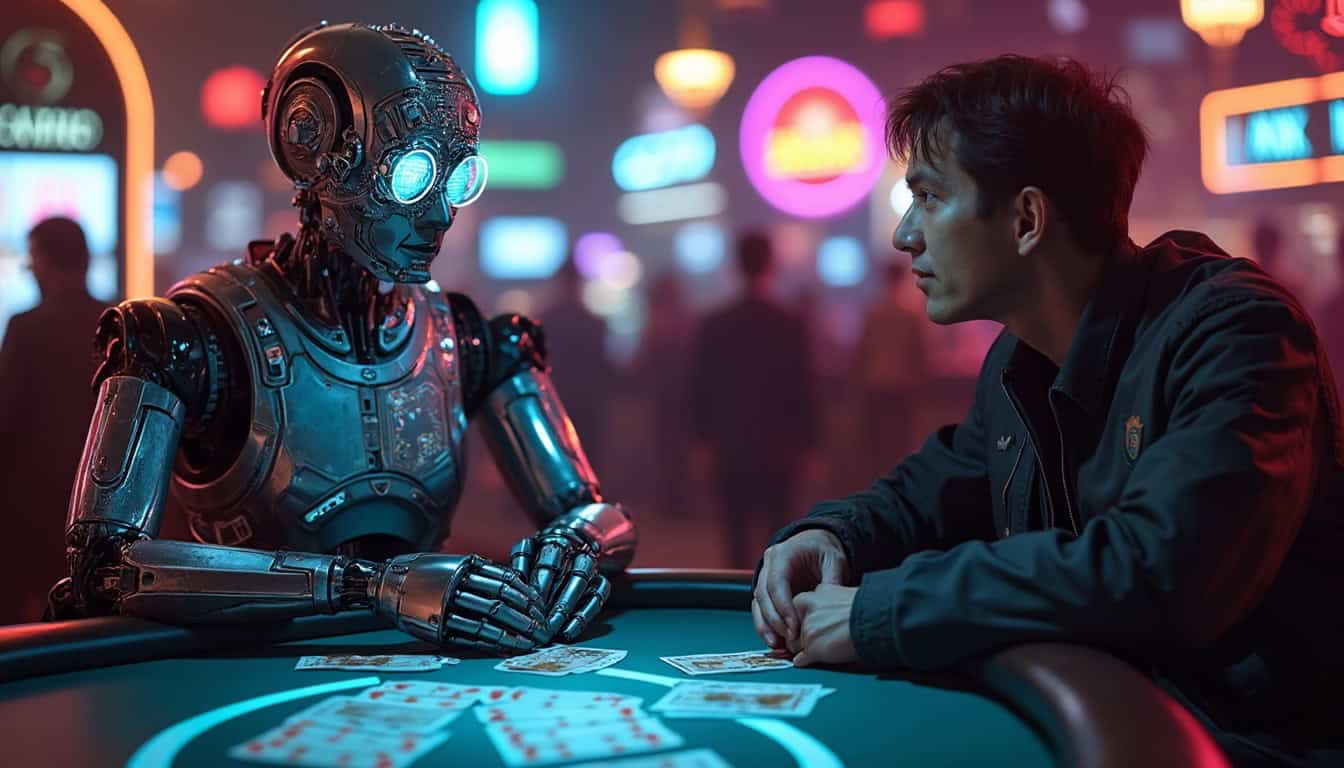
Futuristic poker tournament scene with human and robot players. The robot has a metallic face and is analyzing data on screens, while the human player shows signs of tension. The scene features poker AI tools and the competitive dynamic between human and poker AI players.

Poker AI Players vs. Humans: A Whole New Competitive Dynamic

Poker AI is advancing at a staggering rate of sophistication and the new dynamics are apparent when considering the relationship between man and machine. Poker bots like Pluribus and DeepStack, outperform humans in pure strategic processing, yet we still humans have one formidable edge over them: emotion. Perhaps within this realm, once poker AI algorithms reach parity with human skill, they will have added a layer of emotional intelligence resembling the ability to read, and then mimic human emotions at the poker tables.
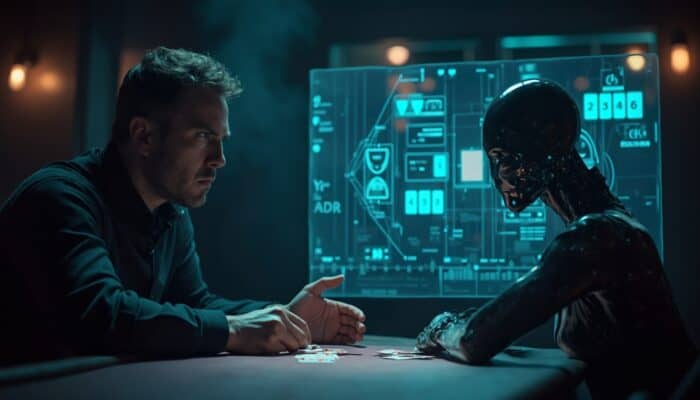
Research for poker bots to replicate actual play is already being used to train elite professionals in the industry. They use poker AI software to simulate random brief players scenarios and others analyze a deeper level of player strategy. Some players also use AIs to assist them by the AIs scan the cards and analyze the hands that required human months of a manual task to analyze. And more I should remind you; the more poker AI strategies are refined, the more human players will need to continue to raise the strategic bar, or the elite players will always be left behind.

Scales balancing poker cards and digital data, with human and robot silhouettes on either side. The scene addresses the ethical dilemmas of using poker AI and maintaining fair play. Includes themes of poker AI algorithms and the integrity of online poker games.

Ethics and Dilemmas-Fair Play in the Age of Poker AI

With poker AI tools becoming more developed, the ethical implications continue to grow and charts a balance between integrity of the game at the poker table and fair play. Each time a poker bot, simple or complex, enters the equation, online poker websites have to deal with the dynamics of keeping the games fair when invisible and tireless poker bots are incorporated. How can you be sure that you are getting fair play against a machine that was designed to beat you? So, each new step opens a floodgate of fears related to human card players continuing to engage in – virtual tables full of poker AI algorithms. Another moral question existing has huge spillovers: deploying a poker AI strategy fully grown into a sector like financial markets might represent catastrophic outcomes if they mistakenly make a wrong ‘move’.

Futuristic cityscape with a poker tournament in a glass dome. The scene features a large AI hologram controlling data and cards, surrounded by virtual reality players and high-tech interfaces. The image highlights the future of AI poker, poker AI tools, and the integration of AI in strategic gameplay.

What is the Future of Poker AI?

The future of poker AI has exciting possibilities balanced against grave factors. Poker AI research is progressing towards increasingly sophisticated capabilities. The changing nature of AI will award even general hours of industry-relevant thought with AI lending insight into past situations AS A REFERENCE POINT. The developing capabilities of AI to explain its action or operation reflects a game-changer moment for poker education that is now introducing informative breakthroughs in explaining what high-level strategies that AIs are currently utilizing. To go beyond poker, importantly, a much larger perspective of generalized Game-Playing AI (as reference to) projects enables utilizing distillery technologies related to dynamics of military behavior and political games. To repeat, poker AI can soon assist and even help a player beat not just odds- but by actually changing them.

1,032 Words

The Unstoppable Rise of AI Poker: Are We Doomed?

A human player faces off against a poker AI opponent at a poker table, with digital data floating above the table.

AI poker has been making its incursion, with depth and guile as that fox in the henhouse, upon the world of cards. It is at this juncture and truthfully seated at the table, shuffling the deck, and dealing itself a winning hand. The mere idea might have Doyle Brunson rolling in his cowboy hat, but here we’re living, in a world where the best poker AI can outplay even the most battle-tested human pros without breaking a sweat—or really even having the capacity to sweat, for that matter.

AI Poker Research: The Game Changer We Never Asked For

In fact, poker AI work is one of those typical stories whereby “nobody asked for it, but here it comes anyway.” It all started harmlessly enough: all that these researchers wanted to see was whether they could teach a machine to play poker. But as in every great sci-fi movie involving world domination by evil robots, the AI not only did it learn the game, it mastered it.

How the poker AI development community, with all their brainiacs and game theorists, must have never envisioned such a thing-making up a table on humanity-would happen in this way: so expeditiously. But they did, and now it is time we are, well, tried by our own creations.

That’s a little bit like Dr. Frankenstein needing to teach his monster not to stomp on villagers, except this time the monster is a digital brain that can work out odds faster than you can say “all-in”. And then there are poker bots: these little digital demi-demons that can simply grind out wins day in and day out, no need to sleep or do anything aside from, from time to time, having an existential crisis.

Strategies Employed by Poker AI: Algorithms Mind-Bluffing

Human and poker robot players engaged in a poker game, showcasing poker AI strategies and digital schematics projected onto the table.
There is something just a little bit. poetic about the algorithms involved in poker AI. They are, in reality, perfect poker players: entirely unemotional, ruthless, not leaving anything to those bad beats that may upset them. But let us get to the real kicker: poker AI strategy. Not your taken-from-a-book, sitting-on-some-shelf-gathering-dust strategies, these guys help you wonder if there is still any fairness you can leave in the game. Imagine a player across the table who will never tire, never make mistakes, and get nothing from your bluff, just because he had already known. That’s playing chess against Deep Blue, but this time, Deep Blue has a poker face on, and it’s doing it well. The future of poker is no more about playing the cards but about outsmarting the algorithm.

And good luck with that—because while you’re trying to read a tell, the AI has already simulated a thousand possible outcomes.

Machine Learning in Poker: Algorithmic Hustle

A computer chip playing poker, surrounded by holographic screens representing machine learning in poker and poker AI tools.
If you’re thinking, “This sounds like science fiction,” you’re not far off. But machine learning in poker is very real, and it’s reshaping the game in ways we’re still trying to wrap our heads around. Every hand, every decision, every fold—these machines learn, adapt, and improve. It’s like they’re constantly downloading updates while we’re stuck trying to remember if a flush beats a straight.

Spoiler alert- it does, but good luck getting one past these AI titans.

Of course, that is not all it is about-mostly flashy moves across the table. In reality, poker AI tools derive their real power from an ability to analyze really large bounds of data.

They don’t just play the game; they dissect it after having understood it at levels that are frankly disconcerting before wiping the floor with any human who dares challenge them. It is practically like being in a very high-stake poker game with Sherlock Holmes—except this Holmes never misses the cue, never overthinks, and definitely doesn’t fall for your card bluff.

The Human Factor – The Ethical Dilemma: Poker Cheats

A dark poker table with poker bot software on a laptop, highlighting the ethical concerns of poker hacks and AI poker cheats.
Now, however, the tricky—or the more morally gray—is this: Does the rise of Poker Hacks and this sort of Poker Cheat software take us into that gray area where people start to ask, “Is this even fair anymore?” When does using a poker bot stop being clever strategy and actually start out-and-out cheating on an opponent? More importantly, though, should we be letting these machines into our games in the first place?

It’s a question that doesn’t have an easy answer. On one hand, poker is a game of skill, and if someone can develop a tool to play better, isn’t that just part of the game? But on the other hand, when that tool is a highly sophisticated AI that can outmaneuver the best human players, it starts to feel like we’re stacking the deck against ourselves. Then there are the unanticipated consequences. The more that people resort to using AI to achieve an edge, the very nature of the game itself might shift. Whatever happened to the thrill of the bluff if you knew the opponent was a machine that has seen every trick in the book? What fun is it to outplay somebody that doesn’t even have a pulse?

Are We Doomed or Just Getting Started?

Futuristic casino with human and robot players in a poker game, focusing on the future of poker AI software and online poker bots.
So where does that leave us? Is this the beginning of the end of poker as we know it, or merely the start of a new era? Hard to say. One thing we can rest assured of—poker AI software is here to stay and evolve. Now, will we, the lowly human players, rise to meet the challenge?. One thing is for certain, poker will never be the same. But perhaps that is just as well. This might be change that needs embracing: learning from the machines and finding new ways to keep the game interesting. At the end of the day, whether they spill their chips against a world champion or an ice-cold AI, poker — is still poker. And as long as there is a way to win — we will play. Until then, shuffle up and deal—just don’t be too surprised when the computer takes home the pot.

1,009 Words