| Poker-AI.org https://poker-ai.org/phpbb/ |
|
| Adaptive Opponent Modeling https://poker-ai.org/phpbb/viewtopic.php?f=24&t=2744 |
Page 2 of 3 |
| Author: | spears [ Wed May 14, 2014 10:42 am ] |
| Post subject: | Re: Adaptive Opponent Modeling |
A simulation using a known strategy S will give you observations O (action frequencies and showdown strengths) and hence probability p(O|S). I think you should be able to turn that round to give p(S|O) using Bayes rule and some other reasonable assumptions. Sorry this is so vague: I don't have a lot of time and my maths is very poor. I think you should be able to use Bayes rule for the update weight too. The default strategy is a "prior" |
|
| Author: | Sacré d'Jeu [ Wed May 14, 2014 12:56 pm ] |
| Post subject: | Re: Adaptive Opponent Modeling |
I'll give it some thought, and I'll come back on it later. In the meantime, I have some questions about the bucketing and transition functions:
|
|
| Author: | spears [ Wed May 14, 2014 1:41 pm ] |
| Post subject: | Re: Adaptive Opponent Modeling |
You are right not to use EHS. I would suggest using two parameters: average and variance of strength at showdown. A drawing hand will have a large variance, a made hand will have a low variance. I don't like current hand strength because it means nothing as it is never seen at showdown. You definitely shouldn't be dealing with all those post flop isomorphisms. I think it should be possible to formulate the problem to make these large numbers go away. I'm thinking something like this: - From pre-flop betting you know a bucket distribution for villain. - You can translate that into a hole card distribution - Then the flop comes - You can update villain's bucket distribution - Villain acts - Update villain's bucket distribution - ..... - Then the turn comes - Update villain's bucket distribution - .... |
|
| Author: | Sacré d'Jeu [ Wed May 14, 2014 2:14 pm ] |
| Post subject: | Re: Adaptive Opponent Modeling |
spears wrote: You are right not to use EHS. I would suggest using two parameters: average and variance of strength at showdown. A drawing hand will have a large variance, a made hand will have a low variance. I don't like current hand strength because it means nothing as it is never seen at showdown. That is a great idea spears wrote: You definitely shouldn't be dealing with all those post flop isomorphisms. I think it should be possible to formulate the problem to make these large numbers go away. I'm thinking something like this: - From pre-flop betting you know a bucket distribution for villain. - You can translate that into a hole card distribution - Then the flop comes - You can update villain's bucket distribution - Villain acts - Update villain's bucket distribution - ..... - Then the turn comes - Update villain's bucket distribution - .... Yes, that's what I had in mind, but how would you suggest I do the highlighted updates then? When new community cards are shown, the average and variance of strength change for all hole cards. Eg. for a dry board, a drawing hand will fall back in strength and variance. In an ideal situation, I should be able to update the bucket distribution according the amount of hole cards that switch from one bucket to another, that is, I should know from which old buckets the hole cards in the new bucket come: b_new = 2% b1 + 6% b2 + 30% b3 + ... And this transition is different for every type of flop. |
|
| Author: | spears [ Wed May 14, 2014 2:38 pm ] |
| Post subject: | Re: Adaptive Opponent Modeling |
Sacré d'Jeu wrote: spears wrote: Sacré d'Jeu wrote: I learn the opponent-specific distribution P (a | hc Є b, I ) based on the action in hands where the hole cards are shown. I think that is biased. That's why I suggested simulation. You are absolutely right. I understand that some people assume that, if he folds, he has a bad hand and also learn on these actions. Maybe I'll do that. We might writing at cross purposes here. I think that calculating a strategy from showdown hands will not be accurate because showdown hands are an unrepresentative sample. When villain mucks, you can conclude that his hand is weaker than your shown hand. So you can figure out the cards he cannot have, and then update your estimates of the cards he had earlier in the hand. It's a reasonable to assume that villain only folds weak hands, but how do you make practical use of the assumption? For example does he fold 100% of the weakest 20% or 50% of the weakest 40%? |
|
| Author: | spears [ Wed May 14, 2014 2:54 pm ] |
| Post subject: | Re: Adaptive Opponent Modeling |
Sacré d'Jeu wrote: spears wrote: You definitely shouldn't be dealing with all those post flop isomorphisms. I think it should be possible to formulate the problem to make these large numbers go away. I'm thinking something like this: - From pre-flop betting you know a bucket distribution for villain. - You can translate that into a hole card distribution - Then the flop comes - You can update villain's bucket distribution - Villain acts - Update villain's bucket distribution - ..... Yes, that's what I had in mind, but how would you suggest I do the highlighted updates then? - You have a preflop bucket distribution. - You can get a preflop hole card distribution from that. - The flop comes - You can calculate the strength of every hole *** - Since you know the strength of every hole and you know the distribution, you can calculate the bucket distribution *** This is computationally challenging. But you could keep lookup tables for each flop isomorph, on disk if necessary. |
|
| Author: | Sacré d'Jeu [ Wed May 14, 2014 3:41 pm ] |
| Post subject: | Re: Adaptive Opponent Modeling |
spears wrote: - You have a preflop bucket distribution. - You can get a preflop hole card distribution from that. - The flop comes - You can calculate the strength of every hole *** - Since you know the strength of every hole and you know the distribution, you can calculate the bucket distribution *** This is computationally challenging. But you could keep lookup tables for each flop isomorph, on disk if necessary. That's what I meant in the first place, I think. So I need a LUT for every isomorph flop, turn and river that gives me the 81 values so I can calculate the new bucket distribution: b0_new = x00 * b0_old + x10 * b0_old + x20 * b2_old + x30 * b3_old + ... b1_new = x01 * b0_old + x11 * b0_old + x21 * b2_old + x31 * b3_old + ... I'm capable of calculating the values, but how should I store them in a LUT? I'm afraid I will use all my heap space... The three tables I need, are size 142.155 (exact), 5M and 200M (!) (last two are rough estimations)... I probably should use an similar index-system as in https://poker-ai.org/phpbb/viewtopic.php?f=25&t=2660. |
|
| Author: | spears [ Wed May 14, 2014 4:06 pm ] |
| Post subject: | Re: Adaptive Opponent Modeling |
Sacré d'Jeu wrote: I'm capable of calculating the values, but how should I store them in a LUT? I'm afraid I will use all my heap space... The three tables I need, are size 142.155 (exact), 5M and 200M (!) (last two are rough estimations)... I probably should use an similar index-system as in viewtopic.php?f=25&t=2660. - I didn't understand that paper. - Devise a scheme to represent the board isomorph. eg (Aa,Ab,3a) means (Ac,Ah,3c) and also (Ah,As,3h) and a way of translating from a real board to the isomorph - If you are going to keep this all in memory, create a hash table with the isomorph as the key and the vector of hole card strengths as the value. 200MB isn't big these days - If you are going to put it on disk create a hash table with the isomorph as the key and a number as the value. Use the number as an index in a random access file |
|
| Author: | Pitt [ Wed May 14, 2014 4:58 pm ] |
| Post subject: | Re: Adaptive Opponent Modeling |
Just about the hand isomorphism paper : it can easily provide an exact isomorphism. As you have not much time for your work and it is already implemented, I recommend you to use it directly. Exact indexes count for flop / turn / river with imperfect recall (on turn we don't know what card is the turn's one) : [1 755, 16 432, 134 459] the memory sizes for 81 bytes : [142 155, 1 330 992, 10 891 179] Given your numbers, I assume you use perfect recall, this can easily be done as well. I don't know what programmation language you are using, but in C / C++ you can use the original github code : https://github.com/kdub0/hand-isomorphism And if you need a Java wrapper, I could modify the one I published to make perfect recall board indexing available. |
|
| Author: | spears [ Wed May 14, 2014 5:06 pm ] |
| Post subject: | Re: Adaptive Opponent Modeling |
You can reduce the river to 42769 by removing nut boards |
|
| Author: | Pitt [ Wed May 14, 2014 5:23 pm ] |
| Post subject: | Re: Adaptive Opponent Modeling |
So many nut boards ? Good thing to know, one could do an intermediary boolean table to mark them |
|
| Author: | Sacré d'Jeu [ Fri May 16, 2014 11:09 am ] | ||
| Post subject: | Re: Adaptive Opponent Modeling | ||
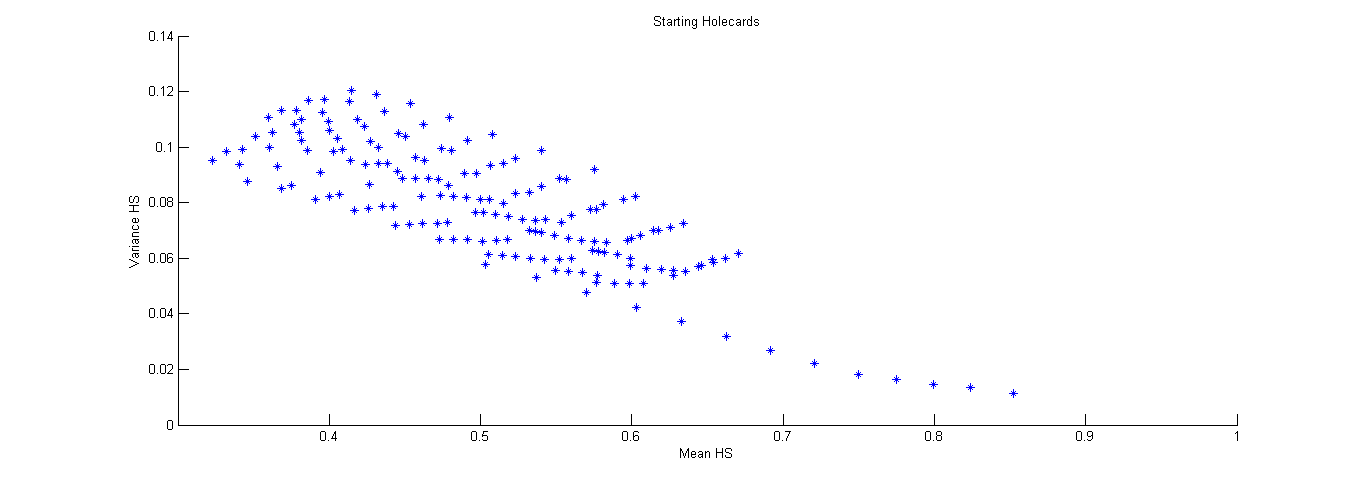
I've calculated handstrength mean and variance for every starting hand, the graphic of the results are shown below. I should strategically divide these hands into buckets. I've been thinking about using a clustering algorithm, but maybe it's better to use 'expert knowledge'. What do you think? I understand the paper (it wasn't easy I'm coding in JAVA, I'm gonna try to make the indexing myself, cause it's a variant where I'm only indexing the board cards (XXX | X | X). Thanks for all help!
|
|||
| Author: | spears [ Fri May 16, 2014 12:24 pm ] |
| Post subject: | Re: Adaptive Opponent Modeling |
If you use a clustering algorithm you need to ensure that it gives the type of clustering you want. You need to choose bins that make a good distinction between different strengths. Equal frequency binning is exactly the wrong solution because it doesn't distinguish between strengths well. There is no expert knowledge to process hands postflop so you can't use that. I think some ad hoc approach that is a 2 dimensional equivalent of equal width binning would probably work quite well. Divide the space into equal size rectangles in such a way that the number of rectangles with any content is the number of bins. I don't understand the graph though. AA has a strength of 85.2% (against a uniform hand). Where is that on your graph? |
|
| Author: | Sacré d'Jeu [ Fri May 16, 2014 1:22 pm ] |
| Post subject: | Re: Adaptive Opponent Modeling |
spears wrote: If you use a clustering algorithm you need to ensure that it gives the type of clustering you want. You need to choose bins that make a good distinction between different strengths. Equal frequency binning is exactly the wrong solution because it doesn't distinguish between strengths well. There is no expert knowledge to process hands postflop so you can't use that. I think some ad hoc approach that is a 2 dimensional equivalent of equal width binning would probably work quite well. Divide the space into equal size rectangles in such a way that the number of rectangles with any content is the number of bins. I don't understand the graph though. AA has a strength of 85.2% (against a uniform hand). Where is that on your graph? Oh, crap. I've calculated the numbers on the rank (using your 7-hand evaluator spears2p2). I'll be back. (Thanks for the reaction about bucketing, I'll look what the actual graphic looks like, and then see how I'll do the division.) |
|
| Author: | spears [ Sat May 17, 2014 6:47 am ] |
| Post subject: | Re: Adaptive Opponent Modeling |
Having thought about this maybe k-means clustering will work ok. You might have to stretch one axis or other to get the right division between strength and variance. Post your data and I'll do some experiments |
|
| Author: | Sacré d'Jeu [ Mon May 19, 2014 10:11 am ] |
| Post subject: | Re: Adaptive Opponent Modeling |
I've struggled more with the indexing algorithm than expected, but it's working now. Eventually, I've basically translated the C-code into Java. I'll upload the code somewhere when this project is over. So now I'm doing this: - I iterate over every possible 5-card board (= 2598960 times).
I'm doing the first iteration now. At the current speed, it will take around a day to complete. The second iteration shouldn't take that long. I'll post the results when I have them. |
|
| Author: | Sacré d'Jeu [ Tue May 20, 2014 12:52 pm ] | ||
| Post subject: | Re: Adaptive Opponent Modeling | ||
The algorithm is finished: Mean HS (in %) A K Q J T 9 8 7 6 5 4 3 2 A 85,20 67,04 66,21 65,39 64,60 62,78 61,94 60,98 59,91 59,92 59,03 58,22 57,38 K 65,32 82,40 63,40 62,57 61,79 59,99 58,31 57,54 56,64 55,79 54,88 54,05 53,21 Q 64,43 61,46 79,93 60,26 59,47 57,66 56,02 54,30 53,61 52,77 51,86 51,02 50,17 J 63,56 60,57 58,13 77,47 57,53 55,66 54,02 52,32 50,61 49,99 49,07 48,23 47,38 T 62,72 59,74 57,29 55,25 75,01 54,03 52,33 50,64 48,94 47,22 46,53 45,69 44,84 9 60,77 57,81 55,36 53,25 51,53 72,06 50,80 49,12 47,43 45,72 43,86 43,26 42,42 8 59,87 56,02 53,60 51,49 49,72 48,10 69,16 47,94 46,24 44,54 42,70 40,87 40,27 7 58,84 55,19 51,77 49,68 47,91 46,30 45,05 66,24 45,37 43,68 41,85 40,04 38,16 6 57,68 54,22 51,02 47,84 46,09 44,49 43,24 42,32 63,28 43,13 41,33 39,53 37,67 5 57,70 53,31 50,12 47,18 44,25 42,67 41,43 40,51 39,94 60,32 41,45 39,69 37,85 4 56,73 52,33 49,13 46,19 43,50 40,67 39,45 38,55 38,01 38,16 57,02 38,64 36,83 3 55,84 51,43 48,22 45,28 42,59 40,02 37,48 36,60 36,08 36,26 35,15 53,69 35,98 2 54,93 50,51 47,30 44,35 41,67 39,10 36,83 34,58 34,08 34,28 33,20 32,30 50,33 Variance HS (*10^(-2)) A K Q J T 9 8 7 6 5 4 3 2 A 1,12 6,16 5,98 5,84 5,75 5,57 5,59 5,65 5,73 5,98 6,12 6,22 6,29 K 5,95 1,33 7,27 7,11 7,00 6,72 6,57 6,59 6,63 6,70 6,82 6,91 7,00 Q 5,72 7,02 1,46 8,23 8,11 7,77 7,54 7,38 7,38 7,41 7,52 7,58 7,64 J 5,53 6,81 7,93 1,62 9,19 8,83 8,57 8,33 8,13 8,12 8,20 8,23 8,26 T 5,39 6,64 7,76 8,86 1,81 9,87 9,61 9,34 9,06 8,82 8,87 8,87 8,87 9 5,11 6,25 7,30 8,37 9,42 2,22 10,46 10,24 9,95 9,63 9,42 9,40 9,37 8 5,08 6,00 6,96 7,99 9,03 9,88 2,68 11,08 10,83 10,50 10,22 9,90 9,86 7 5,09 5,97 6,68 7,63 8,64 9,54 10,38 3,17 11,57 11,28 10,98 10,61 10,24 6 5,12 5,96 6,63 7,30 8,23 9,11 10,00 10,75 3,71 11,88 11,63 11,25 10,83 5 5,38 5,98 6,61 7,24 7,85 8,65 9,52 10,32 10,94 4,23 12,04 11,72 11,31 4 5,49 6,06 6,66 7,26 7,85 8,29 9,09 9,86 10,53 10,99 4,78 11,69 11,31 3 5,54 6,09 6,67 7,23 7,79 8,21 8,61 9,32 9,98 10,51 10,40 5,29 11,07 2 5,56 6,13 6,67 7,20 7,71 8,10 8,50 8,77 9,38 9,92 9,83 9,52 5,78 A graph is shown below. So what do you think? How can I share the raw data with you?
|
|||
| Author: | spears [ Tue May 20, 2014 4:41 pm ] | ||
| Post subject: | Re: Adaptive Opponent Modeling | ||
I've transformed your data so it will go into weka as a csv Code: AAo, 0.852000, 0.011200 AKo, 0.670400, 0.061600 AQo, 0.662100, 0.059800 AJo, 0.653900, 0.058400 ATo, 0.646000, 0.057500 A9o, 0.627800, 0.055700 A8o, 0.619400, 0.055900 A7o, 0.609800, 0.056500 A6o, 0.599100, 0.057300 A5o, 0.599200, 0.059800 A4o, 0.590300, 0.061200 A3o, 0.582200, 0.062200 A2o, 0.573800, 0.062900 KAs, 0.653200, 0.059500 KKo, 0.824000, 0.013300 KQo, 0.634000, 0.072700 KJo, 0.625700, 0.071100 KTo, 0.617900, 0.070000 K9o, 0.599900, 0.067200 K8o, 0.583100, 0.065700 K7o, 0.575400, 0.065900 K6o, 0.566400, 0.066300 K5o, 0.557900, 0.067000 K4o, 0.548800, 0.068200 K3o, 0.540500, 0.069100 K2o, 0.532100, 0.070000 QAs, 0.644300, 0.057200 QKs, 0.614600, 0.070200 QQo, 0.799300, 0.014600 QJo, 0.602600, 0.082300 QTo, 0.594700, 0.081100 Q9o, 0.576600, 0.077700 Q8o, 0.560200, 0.075400 Q7o, 0.543000, 0.073800 Q6o, 0.536100, 0.073800 Q5o, 0.527700, 0.074100 Q4o, 0.518600, 0.075200 Q3o, 0.510200, 0.075800 Q2o, 0.501700, 0.076400 JAs, 0.635600, 0.055300 JKs, 0.605700, 0.068100 JQs, 0.581300, 0.079300 JJo, 0.774700, 0.016200 JTo, 0.575300, 0.091900 J9o, 0.556600, 0.088300 J8o, 0.540200, 0.085700 J7o, 0.523200, 0.083300 J6o, 0.506100, 0.081300 J5o, 0.499900, 0.081200 J4o, 0.490700, 0.082000 J3o, 0.482300, 0.082300 J2o, 0.473800, 0.082600 TAs, 0.627200, 0.053900 TKs, 0.597400, 0.066400 TQs, 0.572900, 0.077600 TJs, 0.552500, 0.088600 TTo, 0.750100, 0.018100 T9o, 0.540300, 0.098700 T8o, 0.523300, 0.096100 T7o, 0.506400, 0.093400 T6o, 0.489400, 0.090600 T5o, 0.472200, 0.088200 T4o, 0.465300, 0.088700 T3o, 0.456900, 0.088700 T2o, 0.448400, 0.088700 9As, 0.607700, 0.051100 9Ks, 0.578100, 0.062500 9Qs, 0.553600, 0.073000 9Js, 0.532500, 0.083700 9Ts, 0.515300, 0.094200 99o, 0.720600, 0.022200 98o, 0.508000, 0.104600 97o, 0.491200, 0.102400 96o, 0.474300, 0.099500 95o, 0.457200, 0.096300 94o, 0.438600, 0.094200 93o, 0.432600, 0.094000 92o, 0.424200, 0.093700 8As, 0.598700, 0.050800 8Ks, 0.560200, 0.060000 8Qs, 0.536000, 0.069600 8Js, 0.514900, 0.079900 8Ts, 0.497200, 0.090300 89s, 0.481000, 0.098800 88o, 0.691600, 0.026800 87o, 0.479400, 0.110800 86o, 0.462400, 0.108300 85o, 0.445400, 0.105000 84o, 0.427000, 0.102200 83o, 0.408700, 0.099000 82o, 0.402700, 0.098600 7As, 0.588400, 0.050900 7Ks, 0.551900, 0.059700 7Qs, 0.517700, 0.066800 7Js, 0.496800, 0.076300 7Ts, 0.479100, 0.086400 79s, 0.463000, 0.095400 78s, 0.450500, 0.103800 77o, 0.662400, 0.031700 76o, 0.453700, 0.115700 75o, 0.436800, 0.112800 74o, 0.418500, 0.109800 73o, 0.400400, 0.106100 72o, 0.381600, 0.102400 6As, 0.576800, 0.051200 6Ks, 0.542200, 0.059600 6Qs, 0.510200, 0.066300 6Js, 0.478400, 0.073000 6Ts, 0.460900, 0.082300 69s, 0.444900, 0.091100 68s, 0.432400, 0.100000 67s, 0.423200, 0.107500 66o, 0.632800, 0.037100 65o, 0.431300, 0.118800 64o, 0.413300, 0.116300 63o, 0.395300, 0.112500 62o, 0.376700, 0.108300 5As, 0.577000, 0.053800 5Ks, 0.533100, 0.059800 5Qs, 0.501200, 0.066100 5Js, 0.471800, 0.072400 5Ts, 0.442500, 0.078500 59s, 0.426700, 0.086500 58s, 0.414300, 0.095200 57s, 0.405100, 0.103200 56s, 0.399400, 0.109400 55o, 0.603200, 0.042300 54o, 0.414500, 0.120400 53o, 0.396900, 0.117200 52o, 0.378500, 0.113100 4As, 0.567300, 0.054900 4Ks, 0.523300, 0.060600 4Qs, 0.491300, 0.066600 4Js, 0.461900, 0.072600 4Ts, 0.435000, 0.078500 49s, 0.406700, 0.082900 48s, 0.394500, 0.090900 47s, 0.385500, 0.098600 46s, 0.380100, 0.105300 45s, 0.381600, 0.109900 44o, 0.570200, 0.047800 43o, 0.386400, 0.116900 42o, 0.368300, 0.113100 3As, 0.558400, 0.055400 3Ks, 0.514300, 0.060900 3Qs, 0.482200, 0.066700 3Js, 0.452800, 0.072300 3Ts, 0.425900, 0.077900 39s, 0.400200, 0.082100 38s, 0.374800, 0.086100 37s, 0.366000, 0.093200 36s, 0.360800, 0.099800 35s, 0.362600, 0.105100 34s, 0.351500, 0.104000 33o, 0.536900, 0.052900 32o, 0.359800, 0.110700 2As, 0.549300, 0.055600 2Ks, 0.505100, 0.061300 2Qs, 0.473000, 0.066700 2Js, 0.443500, 0.072000 2Ts, 0.416700, 0.077100 29s, 0.391000, 0.081000 28s, 0.368300, 0.085000 27s, 0.345800, 0.087700 26s, 0.340800, 0.093800 25s, 0.342800, 0.099200 24s, 0.332000, 0.098300 23s, 0.323000, 0.095200 22o, 0.503300, 0.057800 I've tried clustering in weka. Example attached. I've messed about with stretching and compressing the strength axis but hasn't been very successful. Need to think about this some more. Also wondering if points should be weighted by the number of instances. Will return to this tonight/tomorrow.
|
|||
| Author: | spears [ Tue May 20, 2014 5:38 pm ] | ||
| Post subject: | Re: Adaptive Opponent Modeling | ||
I've added in a dummy point at strength = 0.3, variance = 0.5. Then raised the strength to power of 4 and used weka k means to get this: The dummy point gets a cluster of its own, and there are four points in the strongest cluster.
|
|||
| Author: | Sacré d'Jeu [ Tue May 20, 2014 7:41 pm ] |
| Post subject: | Re: Adaptive Opponent Modeling |
Yeah, I've been doing somewhat the same. (didn't want to post the raw data like you, thought it took to much space :p) The number of clusters could also be altered (keeping in mind the trade-off between simplicity and accuracy). The goal should be to cluster the starting hands that ask for the same strategy, right? So do we have an idea how a good clustering should look like? I'm guessing big buckets for bad holes, and smaller buckets for strong hands? Raising the handstrength to a power is a way to cluster the low starting hands more together while using a less denser clustering for strong hands, right? And what's the reasoning behind the dummy point? Tomorrow, I'm speaking with my supervisor, who has more experience with clustering. I'll come back to here then. THANKS!!!! |
|
| Page 2 of 3 | All times are UTC |
| Powered by phpBB® Forum Software © phpBB Group http://www.phpbb.com/ |
|